Each summer in Czechia, café waiters put out large bowls of water so that dogs taken for a walk under the scorching sun can cool off. Dog owners in Russia, however, have to make sure that their dogs don’t try to eat anything during their walks—as it is not rare to come across poisoned meat set out as baits by dog hunters.
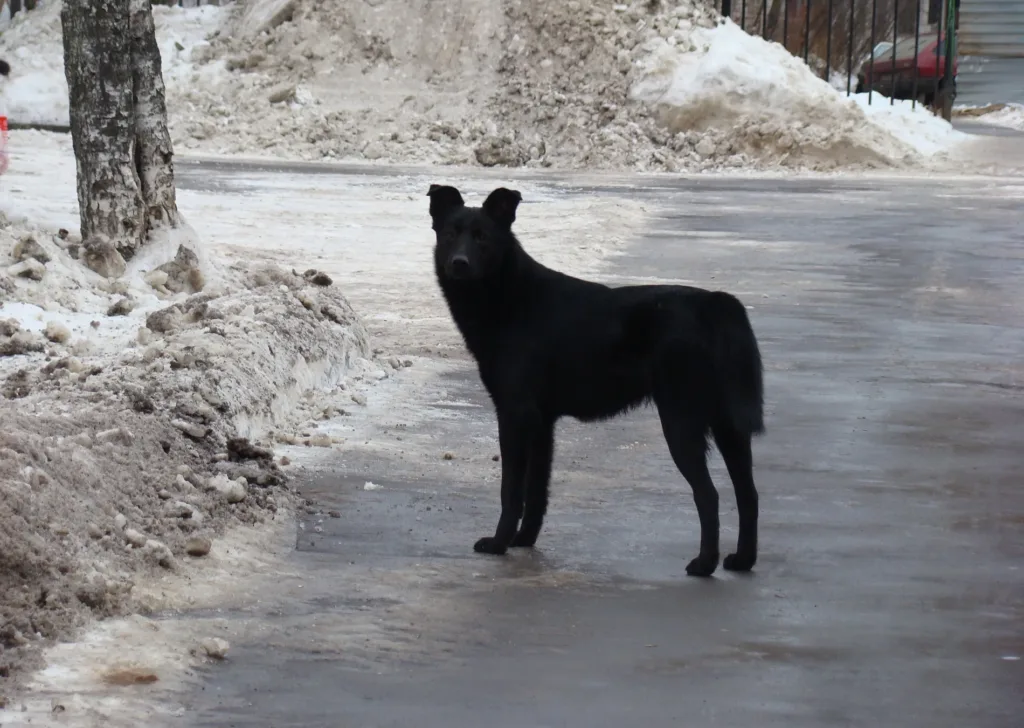
Russians’ relationship to man’s best friend is quite different from that in the West, where stray dogs are relatively rare, and even adopting a rescue dog from a shelter takes a considerable amount of effort. In Russia, it is easy to become a dog owner, and just as easy to abandon it.
Nonetheless, in May 2021, Russian President Vladimir Putin signed a list of instructions aimed at promoting the “a society with a responsible relationship toward animals”. Notably, he ordered records of pets and monitoring stray animals, as well as “encouraging voluntary sterilization, vaccination, and tagging of domestic pets.” The list of measures is published on the Kremlin website.
But there’s a catch—three years ago, Russia had already adopted the Federal Law “On the Responsible Treatment of Animals” (which also includes a proclamation on the “principle of humanity”). That law has not been effective.
According to official data, there are over 650,000 homeless cats and dogs in Russia. Volunteers diligently pick them up off the streets, but there are many more still looking for a home. The underlying problem seems to be lack of responsibility. Owning a pet is not just for fun and taking care of a pet means taking care of its needs, too (walks, food, the vet).
A Crime Unpunished
London resident Tanya G. recently bought a puppy for 800 British pounds, and has already received complaints from her neighbors, who did not appreciate the dog’s whining. “If we mistreat him, the neighbors might call the police. First, regular police might deal with the case, but then they would transfer it to specialized unit,” she says.
A review of laws in the United States, New Zealand, Great Britain, Czechia, and Italy all show that the states are serious about ensuring animal rights.
In Germany, those who abuse animals are subject to up to three years in prison or a fine of up to 25,000 euros, notes Takie Dela.
According to German police data, about 6,000 animal abuse crimes are committed each year.
For comparison, in 2019, Russia registered just 490 violations of laws on animal cruelty.
This is not a matter of Russians simply being much kinder to animals, but is the result of the state turning a blind eye to this type of crime.
The law “On the Responsible Treatment of Animals,” which declares that animals are “capable of experiencing emotions and physical suffering” is ineffective. Those caught violating the law are let off with a simple slap on the wrist.
Volunteer Ksenia Vasilchenko works to find homes for dogs, including abroad. She says that many dogs are sent to Finland and Germany, and before the pandemic, they were also sent to the United States, Czechia, the Netherlands, and Belgium.
In June, a dog named Snowball emigrated to Germany. He had been living in an industrial area of Russia, where some “nice guys” shot him for fun with a pellet gun. One of the pellets hit his spine, causing serious damage. His surgery and recovery cost about RUB 100,000 (~ USD 1.350).
Vasilchenko feels that the Russian law is ineffective, because it is impossible to prove the crime took place, because dogs are seen as things, and because there are no animal control officers in Russia.
Lidia Kondrashova, a communications expert for the RAI charity fund which helps stray animals, agrees. “Unfortunately,” she says, “Law 438 (On the Responsible Treatment of Animals) and Article 245 in the Criminal Code (Animal Cruelty) exist on paper, but in practice, no one is ever punished for these crimes.”
“First of all, we need to ensure that the laws are enforced, and create agencies where anyone can go and report animal cruelty,” she states.
As far as the infamous dog hunters, who leave poison on city streets, Kondrashova believes they should be criminally prosecuted.
“Today, animal cruelty is punishable with a fine of about RUB 80,000 (~ USD 1.100), corrective work, or imprisonment for up to three years,” she says. “But in practice, these sentences are very rarely handed down, and law enforcement agencies are extremely reluctant to take on animal cruelty cases, or even talk about it”.
Programs for catching, sterilizing, and vaccinating animals before releasing them back into their original environment have not been a success either (despite being mandated by the Law on Responsible Treatment of Animals).
“In practice, what we see is the dogs are caught, the government spends some money on them, and then the budget runs out, so they are just taken to the neighboring region and released into the forest, where they die of hunger, parasites, or get hit by cars,” Kondrashova explains.
Everything Is God’s Will
Kondrashova notes that the law also includes a provision for education, to teach people to have a humane relationship with animals, but, “as far as we can see, that change is not taking place”.
“We need to focus on educating people, and right now only some animal welfare organizations are doing that, but they don’t have a lot of resources. We need to give people at least some key information: explain why they can’t let their pets run around outside, why they need to sterilize them, take them to the vet, etc.”
“Today”, she continues, “pet owners have a lot of archaic ideas about what it means to keep a pet, which has a negative impact on animals’ quality of life and can often pose a serious danger.”
“The law on responsible treatment of animals includes provisions that pet owners must spay/neuter their pets, care for them properly, and take them to the vet when they need it,” she says.
Vasilchenko echoes that sentiment, noting that “in our country, there is no information about sterilizing pets—in Europe, you will not see any dogs that have not been neutered, unless you are at a kennel. Here, people project their own reproductive aspirations onto their dogs. “Let my dog be a mom!” they say. There is also a religious element. There was a cat running around with kittens outside of my apartment, and when I said she needed to be spayed, the old women there said, “Aren’t you Orthodox? That is a sin! Everything is God’s will!”
In Russia, there are no free sterilization programs—you can’t simply take your cat to get spayed, she laments.
Despite the fact that in large cities, dogs are tagged at state budget expense, there is no consequence for not tagging one’s dog. “There is not a single tagging database in the entire country,” Vasilchenko adds.
The Role of Money
Vasilchenko states that the Russian Kynological Federation (RFK) does not monitor dog breeding, and there are no breeding quotas.
“Half the kennels are torture chambers! They restrain dogs to forcefully breed (and they do it without stopping), and then they kill them,” she describes. “When you buy a purebred puppy on Avito for RUB 15,000 (~ USD 200) , you need to understand the true costs, and why the price is what it is. Mixed-breed dogs are simply thrown away—no one wants them.”
“This is about money, too: breeders sell puppies without verifying what kind of conditions they are going to live in, who the owners are,” says Vasilchenko. “Take huskies. This is a beautiful breed, but you need to know that they are really difficult to train and take care of. They require a lot of attention, patience, and an active lifestyle. Once the puppy has torn apart the entire apartment, people throw them out of the house, and that is very common.”
Vasilchenko describes how people constantly call the shelter, hoping to get rid of their pets. “A girl will call and say, ‘I want to get rid of my 8-year-old Spitz. I got him when he was still a puppy, and I don’t want him anymore. His eye has started to run,’ they see them like things.”
Far Too Easy
Vasilchenko believes that dogs suffer because in Russia it is too easy to get a pet.
“If you sign an official contract, put down your passport information and recognize that this is a responsibility, things would be different. But instead, people take home Fido, feed him bones, and when he dies, they go get another dog. It is far too easy to abandon a dog,” she says.
In Europe, in order to take a non-purebred dog home from the shelter, one needs to take part in an interview and pay EUR 400-450.
“Signing a contract with the shelter, which only approves you after they have seen your lease (if people rent, they need to show they have the landlord’s permission) and proof of employment. If you are not capable of paying EUR 400-450, how are you going to take the dog to the vet in Germany or Finland?”
European dog owners also have to pay for obedience training, sterilization, required insurance, and pet taxes. If a resident of Germany, for example, wants to stop paying taxes on his or her dog, they will have to explain to the authorities where the dog has gone.
Meanwhile, Russians do not want to spend money on their pets, even when it comes to their health. “Some people want to take a dog home, and when we ask what happened to the last one, they say, ‘She died. She didn’t eat for three days, then she had some swelling, and died.’ And they didn’t even think to take the dog to the vet!” says Vasilchenko, indignant.
A Glimmer of Hope in the City
Despite all of this, Vasilchenko believes that awareness is growing. “In large cities, it’s become fashionable to adopt a rescue dog from the shelter”
“But people still love status symbols: when we put up photos of purebred dogs, the phone will ring off the hook. But mutts are unique, they don’t look like any other dog. If I have five purebreds in front of me, I can’t tell the difference between them, but I know who the mutts are right away,” she says.
Lidia Kondrashova agrees, noting that in large cities, such as Moscow and St. Petersburg, attitudes toward pet ownership are changing, and “more and more people are treating their pets like companion animals.”
“This is facilitated by infrastructure development—there are more parks for walking, public places where you can take your pets, more vet clinics, etc. It is easier and more convenient to take care of your pets and make sure they are comfortable,” she says. “However,” she continues, “things are not quite so rosy in the regions, where the quality of life is rather low, and people are just not very concerned with animal welfare.”
What Can We Do?
Vasilchenko urges limits on dog breeding and registration requirements for pets—starting with dogs—complete with passports, vaccination cards, and (preferably) free sterilization.
“We shouldn’t forget about the carrot and stick approach: if you offer free sterilization, you also need to introduce fines for neglecting dogs. If someone finds your dog abandoned, wandering around the street, you pay a RUB 20,000 (~ USD 270) fine,” she suggests.
Vasilchenko believes that better enforcement of laws on “animal cruelty, neglect, and any violence toward animals.”
“We need social education, we have to explain to people that dogs whose owners provide good care, will not attack people,” she says. “Remember, that cruelty comes from home—why is it that the weakest one in school is always bullied?”
Gradually, though, Vasilchenko believes that appropriate measures will spread to the regions, which always lag behind central cities.
For Lidia Kondrashova, the highest priority is spaying/neutering, vaccination, tagging, stray animals; as well as introduction of strict monitoring of breeding conditions, with punishments for those that violate laws and regulations.
“That would prevent uncontrolled breeding and stray animals,” she suggests.
“All of the tamed animals (generally dogs and cats that used to be someone’s pet and cannot survive on the streets) or those who are capable of being socialized need to be taken off the streets and to shelters so that they can be around people and find new owners,” says Kondrashova. “But here, there is one major caveat—the shelters we have, as they are today, are not able to provide the animals with quality care, and finding new owners becomes the full responsibility of volunteers, who are catastrophically few in numbers. This is why one of the biggest issues the government needs to resolve is a complete overhaul of the shelter system.”
With regard to dog obedience training, similar to what is available in Europe, for Kondrashova, “in the context of such deplorable conditions for stray animals in our country, obedience classes seem to be unattainable.”
“Responsible pet owners will talk to dog trainers and animal psychologists, they read books and watch videos about how they can better understand their pet. Unfortunately, there are still very few people like that in Russia,” she says. “Organizing responsible pet ownership classes would be a logical step for the government’s efforts at solving this dangerous problem.”
Kondrashova notes that the government has already discussed the possibility of introducing a pet tax, which already exists in the West, but “as things stand today, that would probably result in a huge number of pets being abandoned by owners who do not want to incur any additional costs.”
“We get a lot of emails telling us ‘why don’t you take care of people first, and then worry about dogs?’ Of course, the people who write such messages are not helping anyone at all,” says Vasilchenko.
In a country where some people still live in barracks, it will probably be some time before the general public adopts a humane attitude toward man’s best friend.