
In the light of Putin’s brutal aggression against Ukraine, media reports about significant public support for his war among Russians as well as the lack of mass protests in Russia against the war, many Western observers concluded that a democratic change is not to be expected in the country, that Russians are an imperialistic and undemocratic people by default, and this would never change. For many, the most reasonable strategy seems to be isolating Russia or even achieving its fragmentation as a state, rather than making “unrealistic”—as the proponents of such views say—efforts to facilitate Russia’s democratization. Attempt to restore democracy in Russia, some argue, may even propel to power more dangerous, ultra-nationalistic forces, which would pose a greater danger to the world.
This paper briefly explains why such views are erroneous, as they ignore or dismiss facts on the ground and are counterproductive in the long term, because isolating the country will only incentivize imperialists, nationalists, and other extremists to hold ground. The paper also argues that Russia’s democratization is based on genuine bottom-up public demand for democracy and, therefore, democratization is the only way to pacify Russia in the long run.
Why Aren’t Russians Protesting the War?
First of all, they are. According to the OVD-Info, an independent NGO that monitors political persecutions, the number of Russians detained at anti-war protests since the beginning of the war in Ukraine on February 24, 2022, exceeds 16,000. It should be noted that OVD-Info numbers are usually significantly underreported (these are only people who contacted the organization or other NGOs to report their detention); plus, only a fraction of protesters—usually no more than 10-15%—are detained at such rallies. In other words, it would be possible to assume that the number of Russians who were protesting the war was in the six-digit range—a significant number. Given that, the claim that Russians “are not protesting” is quite unfair.
Second, these protests look even more courageous given the unprecedented repressions unraveling in Russia today. The Russian legislative and law enforcement practices targeting political opposition and protest activity were already extremely harsh even before the war. In 2021, a criminal case was launched against Alexei Navalny’s network for “creating an extremist organization,” which is punishable by up to 15 years in prison. Whereas before this case, wide anti-Putin demonstrations would be regularly held across Russia, after it, the fear of lengthy prison terms curbed the protest activity.
Following Putin’s assault on Ukraine on February 24, a newly adopted article 207.3 of the Russian Criminal Code (“public dissemination of deliberately false information about the use of the Armed Forces of the Russian Federation, the exercise by state bodies of the Russian Federation of their powers”) established criminal responsibility with up to 15 years in prison for speaking the truth about Russia’s unprovoked war against Ukraine and atrocities committed by the Russian military in Ukraine. At least dozens of prominent opposition politicians, including Ilya Yashin and Vladimir Kara-Murza, are now in prison facing charges under that article.
These high-profile cases, the record-high number of political prisoners (over 400, according to the Memorial human rights center, which is about twice the number seen in the late Soviet era), as well as intimidation tactics by the authorities (also reaching record numbers), scare many people.
Police and security services, reportedly, visited tens of thousands of homes “warning” people against participation in opposition activity, threatening them with imprisonment. The Russian government has been creating databases of potentially “disloyal” citizens, collecting face recognition information from CCTV cameras at protest rallies, from social media activity that features opposition-related content, and other sources. People are known to have been questioned by police, sometimes approached in public transport because face recognition systems identified them as “extremists.” Russia hasn’t seen this level of crackdown and intimidation since early 1950s.
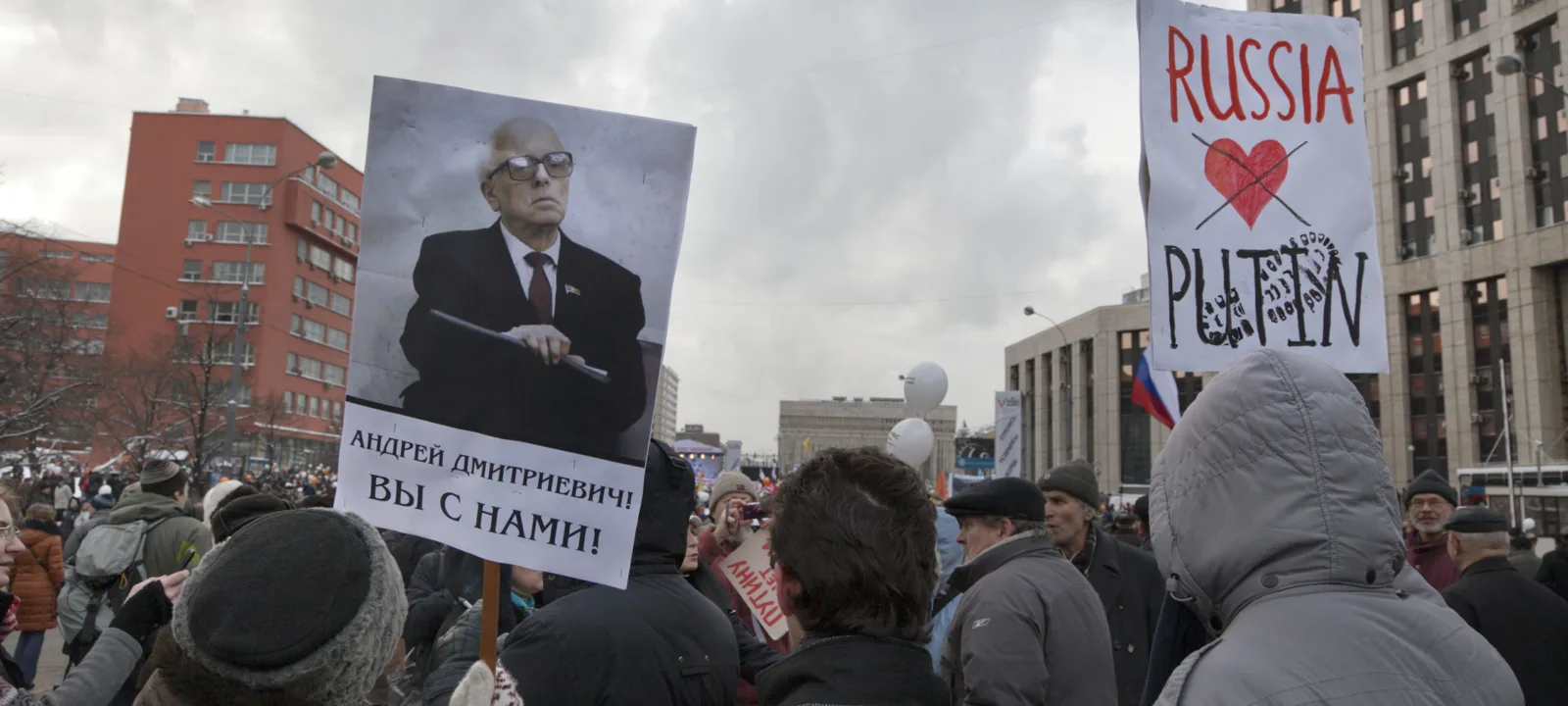
And yet, despite all this, Russians protest in large numbers. The problem is that these protests are less visible to the public, because they are mostly spontaneous and unorganized—a direct result of the regime’s destruction of any organized political opposition, notably, imprisonment of Alexei Navalny and some of his associates and dismantling of his network. We know now that the crackdown on the opposition in Russia in 2021 was likely a preparatory stage for the war with Ukraine aimed at ensuring that no anti-war protests could be organized in the country, as it had happened in 2014-2015.
Those anti-war protests were indeed impressive; they utterly undermine the narrative that “all Russians are imperialists.” Back then, thousands of Russians attended the so-called “peace marches” against the war in Ukraine, bringing Ukrainian flags in support of the neighboring country. Many Ukrainian media outlets, even the official Euromaidan Twitter account, reported on these marches, praising Russians for solidarity.
Organizers of the anti-war protests paid a high price for their courage: some were imprisoned, attacked, or killed, others fled the country. In February 2015, a leader of the Russian opposition and a critic of the war in Ukraine, Boris Nemtsov, was assassinated in the center of Moscow. In 2020, another opposition leader and organizer of anti-war protests, Alexei Navalny was poisoned with military-grade nerve agent by the Russian special services, but he survived.
He was later imprisoned, nonetheless. Russian prisons are known for extremely harsh conditions. Many imprisoned political activists suffered severe damage to their physical and mental health and psychology. In some extreme cases (e.g. Sergei Mokhnatkin), activists are known to have died from torture. Despite these risks, many brave Russians are still protesting the Ukraine war, but their efforts are dispersed and go underreported in the West.
Destruction of the organized opposition is thus the key answer to the question of why Russians are not protesting “visibly enough.” Many Russians admit privately that are willing to protest but see no point doing it alone or in a small group—as opposed to a large crowd—and facing a near-certain risk of a long-term imprisonment with no guaranteed political results. The remaining opposition forces are working on developing methods for staging a nationwide anti-war protest, but it is not easy under the current political conditions. Still, more protests will take place going forward.
Analysis of the 2014-2021 protest activity in Russia allows us to draw several conclusions.
- Russian democratic opposition is by far the largest political force in terms of street mobilization potential. No other political force compares to it in terms of ability to organize large numbers of people who are freely exercising their political rights and civic duties—unlike pro-Putin’s rallies where participants are coerced by administrative force.
- The democratic opposition’s capacities look even more impressive against the backdrop of relentless repressions and intimidation.
- The 2014-2021 pro-democracy protests were marked by affection and support for Russia’s neighboring countries—Ukraine, Georgia, Belarus; there is ample footage of people bringing flags of these countries and banners with supportive slogans. Friendly feelings were clearly shared by most, if not all, protesters. There were no imperialist slogans—on the contrary, many of them were anti-imperialistic, anti-war, pro-EU, and pro-NATO.
Thus, the fact that the most potent political force in Russia in terms of protest-organizing capabilities has shown zero imperialistic sentiment and, instead, great empathy and support for their neighbors facing Putin’s aggression, disproves the narrative that Russians are predominantly imperialists.
Are Russians Really Imperialists?
There is no evidence to support such a claim. Two arguments are often used to back it up. One refers to some opinion polls that allegedly show that the majority of Russians supports imperialist policies (but certain details in these polls actually suggest otherwise). The second is based on the erroneous opinion—debunked above—that there are no large-scale anti-war protests (a highly controversial claim). Below are some arguments against the narrative that Russians are an imperialist nation.
First, the polls that often cited in the West regarding Russians’ attitudes towards Putin’s war against Ukraine are often misinterpreted. For instance, when about 80% of the respondents who say that they support Putin’s “special military operation” (in the wording of the polls), they cite defensive, not aggressive, motives to justify their position.
And they support these actions only against two things: “genocide of Russian-speaking peoples in Donbas” (unfortunately, Russian propaganda has been very effective in spreading this false narrative) and “deployment of the NATO troops and missiles in Ukraine aiming at Russia” (another false propaganda narrative). Only about 20% (or no more than 10-15% of the total population) say that they want Russia to conquer Ukraine, annex its territory, and destroy it as a nation. In other words, Russians were convinced by propaganda that their country was under attack.
Expect for a thin minority, they don’t want to conquer anyone. Accounting for these nuances, we can conclude that most Russians have been convinced by propaganda that their country was under attack. This is not a portrait of an “aggressive imperialist nation.” And all this information can be found in the same polls that are used to justify the false narrative that all Russians are imperialists.
Second, there is very little awareness among the Russian people about what is going on in Ukraine. Many pay little attention to these developments because they believe this is only a limited “special operation in Donbas” to “protect the Russian-speaking people of Donbas”—to use the language of the Russian state media. Over the past years, Russians got used to the fact that there is a “limited military operation” always going on somewhere—Donbas, Syria, Libya.
One of the recent polls conducted by the independent Levada Center at the request of economist Sergei Alexashenko suggests that only 10% (!) of Russians were aware that was active combat going on in the Kyiv region and that the city of Kyiv was assaulted. Most respondents—over 50%—mention only Donetsk and Luhansk as the regions where they supposed military action was taking place, which is, in the view of many, hardly different from what had been going on in these territories since 2014.
Many Western commentators are thus simply unaware about the kind of censorship, propaganda, and disinformation bubble Russians have been living in for the past twenty-plus years. As a reminder, the last independent national television channel, NTV, was taken over by the Kremlin in April 2001. It would be an interesting experiment: to place a staunch Western supporter of liberal and democratic values in a closed room for 20 years with only one television channel showing only Putin’s propaganda and see what he or she say about values and democracy at the end.
There is ample evidence to support this metaphor. Twenty years ago, Russians’ views were drastically different. For instance, over 70% of Russians had positive views of the United States and considered it a friend and an ally. Russian TV networks extensively covered the meetings of presidents Putin and George W. Bush, praising bilateral cooperation. They also broadcasted Putin’s attendance of the May 28, 2002, NATO summit in Rome where the Russian president publicly spoke about the need to “create a joint security space from Vancouver to Vladivostok, which is a goal supported by the majority of the Russian population” (the latter claim was very true at that time).
To illustrate how much damage the propaganda can do to the Russian people, a graph produced by Radio Liberty would be very useful. It shows Russian public attitudes’ fluctuations over the span of over 20 years in response to the question “Which country do you consider to be an enemy?” It is clear that attitudes fluctuate along with the Kremlin propaganda’s narratives. When Putin feuded with Estonia over the Bronze Soldier statue in 2007, or waged a war against Georgia in 2008, or quarreled with Turkey over a shot-down Russian jet in 2015, the public attitudes would surge against the designated “enemy” to 60-80%. But once the propaganda’s narrative changed, the negative attitudes would drop down to 10-15%. Conclusion: Russians citizens’ aggressive sentiment against other nations is fueled by the propaganda.
Even now—as has been the case in the recent period—most Russians, according to the polls, support reconciliation with the West as opposed to having a protracted standoff. Even brainwashed and deprived of accurate information for years, Russians still understand that there is something wrong with the state propaganda. Since the beginning of the war, the trust for the state media and their viewership plunged to historic lows, while the popularity of social media, like YouTube and Telegram, surged and levelled with the major state TV networks, sometimes even overtaking them.
According to various pollsters, such as Romir, Group M, and Levada Center (these include commercial advertising companies that do not ask sensitive political questions), public trust towards state media decreased to 25-30%, which is about a half of the pre-war level. It is simply not possible that, given such massive collapse of viewership of the state television and an enormous search for alternative sources of information, the majority of Russians still support Putin’s war, as some claim. And this conclusion is based not on some obscure, war-time polls with sensitive loyalty-test questions prompting cautious answers—this is open-source, real and verifiable media consumption data.
Another question to consider is: Do Russians support parties that propel aggressive imperialist views? The answer is no: such parties, e.g. Fatherland or National Liberation Movement, barely register in the poll, trailing below 1% of the potential vote, even though their leaders (Nikolai Starikov and Yevgeny Federov, respectively) get lots of media exposure on national television. Their public gatherings attract only hundreds of people, thousands at best, which is nothing compared to the strong showing at the anti-war, pro-democracy protests. This is a fact.
Russia has a widely promoted imperialist pundit Alexander Dugin, who is known the West as the godfather of the Russian imperialism. He is a frequent guest on the Russian television; Russian bookstores offer plenty of his “trashy” writings to the public. But is he popular? The answer, again, is no. His numerous attempts to run in elections yielded zero results over the years. Various pro-imperialist public gatherings featuring Dugin’s speeches since 2014 usually attract no more than a couple of thousand people (just search “Дугин на митинге” on Youtube).
In the end, there is zero evidence that Russians as a nation are somehow inclined to imperialist thinking. Duped by propaganda, yes. Having deep imperialist beliefs and views, definitely no. Facing these facts, proponents of false narratives about the “deeply embedded Russian imperialism” often turn to the “argument” of last resort: that Alexei Navalny and other Russian opposition politicians hold imperialist views. Let us take a closer look.
Is Navalny an Imperialist?
No. Alexey Navalny has always affirmed full integrity of the borders of the post-Soviet states as they were internationally recognized in 1991—as a general undoubted principle. Hence, he fully recognizes Crimea, Donbas, and other regions occupied by Russia as Ukraine’s sovereign territories. Within the same vein, he considers Abkhazia and South Ossetia as integral parts of Georgia, Transnistria as integral part of Moldova.
Where does the “imperialist” accusation come from? It is usually pushed by illiberal forces in Central and Eastern Europe. This distorted and fabricated narrative is building up on Navalny’s remarks made after the 2014 annexation of Crimea.
At the time, Navalny spoke of the complexity of returning Crimea to Ukraine, given the significant opposition to such a move in Russia. In the reality of post-Crimea consensus, he accurately described the reality: the return of Crimea was fiercely opposed by many Russians (again, because the propaganda convinced many people that joining Russia was the free will of the Crimean residents), which meant that such a move would be politically and practically difficult to implement.
This was what Navalny meant, and this can be easily verified by reading his interviews’ transcripts. Navalny has always condemned the annexation of Crimea and never declared any intention to keep it annexed. Statements suggesting otherwise are lies and fabrications aimed at discrediting Navalny and the Russian opposition.
If one does a thorough analysis of open public statements and positions of various groups within the Russian democratic opposition—instead of taking quotes out of context and grossly misrepresenting them—a convincing picture will emerge. It will become clear that the Russian democratic opposition is overwhelmingly anti-imperialist and respectful of the sovereignty and territorial integrity of their neighbors and other countries. There will be no basis for framing it “as imperialistic as Putin.”
Moreover, Alexei Navalny is a firm advocate of Russia’s decentralization, transfer of powers from the president to the parliament, the regional authorities, local communities, and the civil society organizations. His very work is proof of the falsity of the claim that he “might become just another version of Putin.” In fact, the political system that Navalny proposes as part of his political platform, will be very different from the Putin one, excluding the possibility that an aggressive imperialist policy course will be decided by one ruler or his inner circle. Instead, there will be checks and balances that will prevent the country’s leadership from committing Putin-style aggressive acts.
What Was Wrong with Russia in the 1990s?
Another false narrative about Russia that has been recently put forward as part of the indiscriminate bashing campaign targeting the Russian opposition is that even in the 1990s, under Boris Yeltsin’s era of relative freedom, Russia was still pursuing imperialist policies and agenda. Therefore, it is alleged, the country’s democratization is impossible. This is simply untrue and baseless. While, in the 1990s and early 2000s, Russia was still trying to maintain its “zones of influence” and projecting its post-Soviet (post-imperial) power, the country managed to do plenty of good things, even as it was deemed only “partly free” by Freedom House (it continued to be “partly free” until 2005). This point is often deliberately omitted in the analysis. Here are some examples:
- In 1991, Russia has voluntarily agreed to a peaceful dissolution of the Soviet Union and swiftly recognized the independence of the former Soviet republics (including Ukraine). It voluntarily signed the Belovezha Accords on the dissolution of the USSR in December 1991, which was not followed by any significant protests. Russians as a nation wholly accepted the independence of the former Soviet states. When the Russian pro-democracy protesters have overthrown the Communist coup-d-état in August 1991 in Moscow, Ukrainian flags and pro-Ukrainian independence slogans were easily spotted in the pro-democracy crowds in the Russian capital (plentiful footage of this is available).
- The biggest ever protest rally in Moscow happened in January 1991 in support of Lithuania’s fight for independence following the tragic events in Vilnius in January 1991. About 500,000 protesters came out carrying Lithuanian flags and pro-Lithuania slogans, condemning the Russian military crackdown on Lithuanian freedom fighters.
- In 1996, when the Communist-dominated State Duma adopted a resolution calling for the denunciation of the Belovezha Accords and restoration of the Soviet Union, it did not receive any meaningful support by the Russian public and apparently contributed to the fact that leader of the Communist Party Gennady Zyuganov lost the 1996 presidential election.
- Throughout the 1990s, Russia participated in the international efforts aimed at forcing the former Yugoslav government of Slobodan Milosevic to end the Yugoslav wars and stop the genocide of the non-Serb population of the country. Russia authorized the use of force by NATO in Bosnia (operation “Deliberate Force”) and participated in Dayton Peace Agreement ending the Bosnian war. Even in the Kosovo war, Russia, while blocking the UN Security Council resolution to use the force against Milošević, still voted for other resolutions recognizing the genocide of Kosovars by Serbian military and security forces (e.g. Security Council Resolution 1199 of September 1998).
- While Russia’s role with frozen conflicts in Georgia and Moldova was not always constructive, in the 1990s and early 2000s, it coordinated its actions with the international community and the UN, helped facilitate peace negotiations, and did not move to annex these territories until 2008. In 2004, Russia helped Georgia to restore control over the breakaway region of Adjara, evacuating Adjarian dictator Aslan Abashidze to Moscow (the move that received a public praise of then-leader of Georgia Mikheil Saakashvili). Subsequently, Russia withdrew military bases from Georgia’s Batumi and Akhalkalaki under the agreement with Saakashvili government.
- Until February 2014, Russia has never had a problem with recognizing Ukraine’s full sovereignty. It easily recognized Ukrainian independence in 1991, signed a border demarcation agreement in 2003 (fully recognizing the Ukrainian borders). The Russian public has never demanded any of the Ukrainian territories to be transferred to Russia—not until Putin forced the annexation of Crimea in February 2014, to the surprise of many Russians.
- In 1997 and 2002, respectively, Russia signed the Founding Act and the Rome Declaration with NATO, effectively recognizing the NATO enlargement and striking a constructive tone with the Alliance in terms of working together on global security issues.
While Russia’s policies in 1990s and early 2000s were far from perfect, tendentious selectivity of some of Russia’s controversial actions during this period does not really reflect the fact that it was a much more constructive and less imperialistic player in international relations when it was free and relatively democratic.
Russia’s first war in Chechnya (1994-1995) is also often fiercely criticized, but this war was not supported by the Russian people as shown by numerous protests and public opinion polls. The late Boris Nemtsov, who was governor of the Nizhny Novgorod region in the 1990s, was able to collect one million signatures of his constituents against the war and delivered them to then-President Yeltsin. This is another proof refuting the claims that Russians are “imperialists by default.”
Under Boris Yeltsin, Russia also underwent a significant disarmament, which greatly reduced its ability to project imperial power. This period is often harshly criticized by Putin, who admits that, if not for the disarmament and decrease of the size of the Russian military under Yeltsin, Russia would have had much more military power to achieve its imperialist goals today.
Conclusion: when Russia was at least partly free, it was much better at cooperation, respect for international rules and sovereignty of its neighbors. Yes, there were some hiccups, but post-imperial transformation is never easy, as Britain or France would know, but they shouldn’t be overestimated and be confused with Putin’s present all-out imperialist policies. When Russia was relatively free, it was doing a lot of good things at the international arena, and this should not be forgotten.
Would Russians Support Democracy?
While today, the majority of Russians say they don’t support Western-style democracy as a role model for their country (again, 20 years of propaganda have something to do with this), there is evidence that Russian generally favor a much more democratic governance system that the authoritarian one created by Putin. For example, despite abolishment of direct election of regional leaders, about two thirds of Russians consistently favor restoration of such elections for their governors or city mayors, as well as the removal of administrative barriers.
Whenever regional or local elections deliver a real competition with potentially unpredictable outcome, the voter turnout would surge, which suggests a public demand for competitive politics. In cases of little to no competition, meaning that all the candidates are representatives of the “party of power” or their proxies, the voter turnout is at the lowest, indicating that voters disregard manipulative authoritarian politics.
Most recently, in 2020, thousands of protesters in the Khabarovsk region protested for months over an arrest of their governor, Sergei Furgal, who had won the election against the Kremlin’s candidate. Although, until then, Furgal had not been a hero of his constituency, the people of Khabarovsk welcomed the end of the rule of the pro-Kremlin United Russia party in their region as well as the challenge to Moscow’s ever-tightening control. Moreover, the Khabarovsk protests featured no imperialist and anti-Western slogans—instead, people showed solidarity with pro-democracy protests that had unraveled in Belarus at the time and even brought banners in support of Ukraine. So much for the Russians’ “nationwide imperialism.”
As mentioned above, until the war Russian regions saw numerous protests over environmental issues, showing the ability of local community to self-organize and defend their rights defying pressure from the authorities. Despite brainwashing and repression, Russians haven’t lost their basic democratic instincts. Various polls also show that the majority of Russians are unhappy with the fact that they have no influence on political decisions and that the rule of law in the county was dismantled by the Putin regime. In other words, they want democracy.
As in the case of near-zero support for openly imperialistic parties and groups, there are no political antidemocratic forces in Russia that would enjoy popularity beyond marginal. No wonder the Kremlin works hard on maintaining the legalistic facade of “inclusive democracy” at all levels.
The ruling United Russia party holds unnecessary primaries just to make sure their voters don’t feel like the choice was already made for them. The Communists, who openly sympathize with the totalitarian Soviet system and often carry portraits of Stalin, are among most active campaigners for free and fair elections and against voter fraud. Direct elections of the governors were restored in as the result of the 2011-2012 mass protests and have not been formally canceled yet. The whole Putin’s system doesn’t look like it can dismantle the remains of democratic institutions. Putin knows that people would not welcome it. Russian people want to have their say: they are not “slaves” or “serfs” as some of the hawks in the West would like to portray them.
The key question going forward, then, is: Given another chance, will democracy succeed in Russia? Nothing is guaranteed, and it will be an enormous challenge. But, given the evidence summarized above about Russians’ democratic inclinations and lack of aggression, there is a chance to succeed, especially considering the knowledge that the pro-democracy forces have acquired about the actual work of democratic regimes and experience they have accumulated about the flaws of democratic transformation. In the 1990s, we knew nothing about the difficulties of the democratic transition. Now we are armed with knowledge and experience, much of which came the hard way, with lots of suffering and sacrifice.
Democratic Russia Is the Only Way Forward
While there is legitimate doubt about the chances for success of the next democratic transition in Russia, there is absolutely no alternative. Policies aimed at isolating and stigmatizing Russia and Russians are naïve and short-sighted. For one, complete isolation of Russia over the war in Ukraine, as we have seen in the past years and recent months, has proven an impossible task. Russia has suffered, but it has and will find allies in the non-democractic world. It also has vast resources that would allow it to last for a long time in isolation.
Second, isolation and stigmatization only amplify Russia’s post-Versailles syndrome. One solution would be to offer an alternative to Russians: end the war, withdraw from occupied territories of Ukraine, pay the damages and reparations, and adhere to a global rules-based order. Such scenario will:
1) stimulate pro-democracy Russians to act more actively to achieve change;
2) convince the non-aligned or even pro-Putin Russians that there is a chance to extricate themselves from the trap that the Putin regime dragged the country into.
But if the leaders of the Free World choose a different path—send a message to Russians that their country would remain isolated and “cancelled” no matter what they do—this would be a very dangerous scenario. What will it do to Russians? It will extinguish the last vestiges of hope for those who still aspire for democracy or normalcy, make their fight against Putin pointless, as they would be unwelcome in the Free World regardless. It will convince the non-aligned Russians the West is indeed Russophobic, as Putin claims it is. And it will create a favorable climate for imperialists, nationalists, and extremists of all ilk to run amok with their ideas.
The problem with this scenario is that “isolated and canceled” Russia will most certainly come back and strike again, whereas, Free Russia, given a chance to reintegrate into the Free World, will be incentivized to: 1) fight against Putin now, and 2) adhere to the global rules-based order once the country is readmitted to it.
Which approach is most likely to deliver results? Make sure that Russia will stop behaving aggressively against the world? That is largely a rhetorical question. And remember, the period of relative freedom in the 1990s and early 2000s shows good examples of Russia’s constructive behavior. We need to learn from the mistakes of that period. It offers food for thought as to how to correct these past mistakes and overcome failures.
What Do Pro-Democracy Russians Ask for Today?
All this should not be taken as a lengthy apologetic tirade. There is no denial of Russians’ great responsibility for the war in Ukraine—for years of political apathy and denial, believing outrageous propaganda, hoping naively that annexation of Crimea and lawless behavior might yield tactical dividends. Russians will have to work hard to prove that they are ready to be readmitted into the civilized world and will have pay a full price for reconstruction of Ukraine.
However, if Russians accept their responsibility and will be ready to provide guarantees that they completely renounce imperialism, restore democracy, and adhere to the international democratic rules-based order, they should be offered a chance and a vision of peaceful co-existence of the Free World. Moreover, as said above, it is the only viable way forward. While success is not guaranteed, the attempt is worth it, and all the alternatives are worse.
Isolated and stigmatized, Russia will regroup, come back, and strike again. The narratives claiming that “all Russians are hopeless imperialists” and should not be offered a chance to reunite with the Free World, are wrong. They are extremely counterproductive. No wonder Putin’s propaganda feeds on them. They demoralize the Russians who want to fight against Putin’s regime and his war together with the Free World. They disorient the Russians who are clueless and look for answers. They embolden the imperialist hardliners, for whom such adversary rhetoric is a gift and a justification of their cause.
Pro-democracy Russians need to produce a viable vision of the future democratic and peaceful Russia and develop strategies and implementation plans to bring this vision to reality. But even the idea of a future democratic Russia is necessary. The West should embrace it as the only practical solution to the perpetual Russia problem.