

What does Russia expect Ukrainian children living under Russian occupation to become?
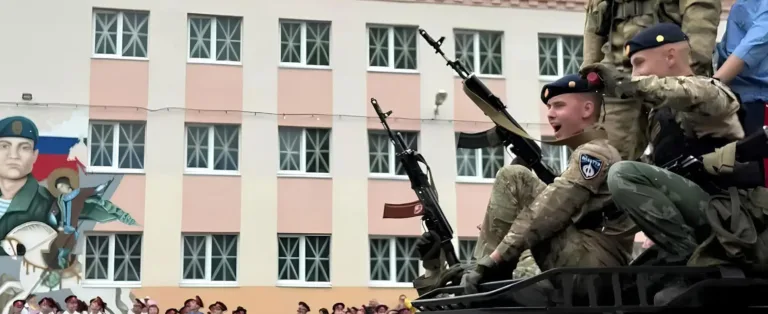
Increasingly, the answer appears brutally simple. Accept the identity the occupying state has prepared for you, and you may eventually wear a Russian military uniform. Resist it, and you may end up wearing a prison uniform instead.
For years, international attention has focused rightly on Russia’s deportation and forcible transfer of Ukrainian children. But removal from their homes is only the beginning of the story. What happens to these children afterward, and to millions of children who remain in Russian-occupied Ukrainian territories, should be equally alarming.
A recent Free Russia Foundation report, “Children as Instruments,” draws on research by the Back to Ukraine initiative, which traced 13 Ukrainian children and young people through open sources and cross-checked their identities against Ukraine’s official Children of War registry. The piece goes far beyond documenting isolated propaganda efforts, as it uncovers an entire infrastructure designed to reshape identity: Russian curricula in schools, military-patriotic organizations, cadet institutions, military camps, and systematic exposure to the Russian armed forces.
The process can begin astonishingly early. At a kindergarten in occupied Henichesk, five- and six-year-olds have been dressed in military uniforms, photographed holding rifles, and taken to a shooting range. At schools in Mariupol, children learn to assemble rifles, occupy combat positions and practice tactical medicine. In Melitopol, representatives of Russian military academies recruit Ukrainian students.
This endpoint is no longer hypothetical.
Oleksandr Mustiatse disappeared from Ukraine’s Kherson region as a child. Years later, OSINT investigators identified him in a Russian military uniform. They subsequently established that he had participated in assaults against Ukrainian positions and had been wounded. His younger brother, Valentyn, meanwhile, was enrolled in Yunarmiya, Russia’s military-patriotic youth organization, and participated in a military exercise as a combat engineer.
The deeper danger lies in what Russia’s system is designed to produce over time: it seeks obedience today, while attempting to manufacture soldiers for tomorrow.
But there is another possible trajectory for a Ukrainian teenager under occupation: refusal.
Consider Viktor Azarovsky from Melitopol.
He was 16 when he was seized in October 2023. According to witness accounts, masked men forced him into a van. Witnesses later reported seeing him near the occupation police building, emaciated and bearing signs of beatings. He was eventually transferred from occupied Melitopol to detention facilities in Mariupol and then to Taganrog in Russia.
Taganrog’s pretrial detention center had by then become notorious in accounts by former Ukrainian detainees and human rights investigators as a place associated with torture and other severe abuse. Viktor was held there in an overcrowded cell with adult men. He turned 18 in detention.
Russian authorities accused him of involvement in a terrorist organization and a series of planned attacks and explosives-related offenses. According to his defense, however, the case files contained no physical evidence establishing the presence of explosives or explosive devices: neither the type nor quantity of explosives was established, and there was no forensic examination confirming their existence.
More importantly, the defense further argues that the conviction ultimately rested on confessions Viktor gave at the beginning of the investigation, without independent evidence corroborating them. A confession from a16-year old in Taganrog, a detention facility repeatedly associated with torture and severe abuse, hardly inspires confidence in the integrity of the case.
Nevertheless, in March 2026, a Russian military court sentenced Viktor to eight and a half years in prison.
Viktor is not an isolated case. Two other teenagers from Melitopol, Oleg Shokola and Denis Vasylik, were detained in connection with the same case. Oleg was 17. In another case, Oleg Huzo was also 17 when Russian forces detained him in the occupied Kherson region in 2022. He was subsequently convicted of espionage and other serious offenses and sentenced to years in a Russian penal colony.
The allegations in these cases differ, and each deserves individual scrutiny. But together with Russia’s militarization policies, they expose a larger reality. Russia is creating an environment in occupied Ukraine in which childhood itself becomes political territory. Across these cases, a broader system has clearly emerged, in which education, militarization, surveillance and punishment are designed to reinforce one another to shape identity, enforce loyalty, and constrain the choices available to Ukrainian children under occupation.
A Ukrainian teenager who accepts the system and is absorbed into it is taught Russian history, incorporated into Russian youth organizations, surrounded by symbols glorifying the invasion, trained to handle weapons, and potentially channeled toward Russian military service. A teenager suspected of actively resisting Russian rule may instead face security services, detention, military courts and years of imprisonment.
These are not two separate stories. They are two sides of the same project by the regime.
One seeks to transform Ukrainian children and their identity until they no longer see themselves as Ukrainian; the other punishes those who refuse that transformation.
This is why securing the return of deported Ukrainian children and protecting those who remain under occupation cannot be treated merely as humanitarian questions to be deferred until after the war. Nor can an international response focused solely on locating and returning deported children address the full scope of the problem: it must also reckon with the systemic transformation of childhood inside the occupied territories themselves and the rehabilitation these inhumane processes will require. Every year matters. A six-year-old placed in a Russian military-patriotic program today will be a teenager before this decade is over. A 16-year-old sentenced today may spend the formative years of his life inside a Russian prison.
For Ukrainian children under Russian control, time is not neutral. The longer occupation persists, the more these policies become embedded in the formative institutions of childhood, and the harder their effects will be to reverse.
With every passing year, Russia is working to narrow the futures available to them toward two stark choices: become part of the machinery of occupation, or be punished for resisting it.