
There was no shortage of bad data for the Russian economy in the recent period. The economy is balancing on the brink of recession (in the first quarter of 2026, GDP officially contracted), budget deficits have broken all records (despite the oil price windfall from the war in the Middle East), and the Central Bank just cannot tame inflation despite a high-interest rate policy nearing its third anniversary. On top of that, Russia has entered a massive investment crisis: fixed investment contracted by 5.3% year-on-year in the fourth quarter of 2025, and by another 14.3% in the first quarter of 2026. In early June, top speakers at the annual St. Petersburg Economic Forum confirmed that some of the worst scenarios for the Russian economy have materialized.
Economic contraction
In the first quarter of 2026, the Russian economy officially contracted, just as we predicted in our previous analysis. Estimates of GDP decline in Q1 2026 vary significantly: from -0.2% by Rosstat to -0.3% by the Ministry of Economy and -0.5% by the Russian Central Bank. Such differences in estimating the dynamics of Russian GDP once again raise questions about the reliability of Russian statistics, but that’s another subject.
In April, though, Russian GDP grew by 1.3%, bringing the annualized GDP growth into positive territory again—according to the Ministry, GDP increased after four months of 2026 by 0.2%. However, this figure should be treated with caution. First, as noted above, Russian statistics are not reliable for the 0.2% figure to be taken at face value. As shown above, differences between various Russian government agencies in estimating first quarter GDP growth reach as much as 0.3% of GDP, so 0.2% growth after 4 months is well within the statistical margin of error.
The Center for Macroeconomic Analysis and Short-Term Forecasting—a leading Russian macroeconomic think tank advising the Government (known under its Russian abbreviation CMAKP, founded by current Russian Defense Minister Andrey Belousov and chaired by his brother Dmitry)—heavily criticizes Rosstat for overestimating the Russian industrial output growth in April, as well as during previous months. In the same report, CMAKP notes that when cleared from military-related output, Russian civilian industries contracted by some 3% in April.
Next, Russian GDP in April was positively impacted by the consequences of the Iran war—as shown below in more detail. But in any case, the “growth” after four months of 2026 is so close to zero, and the official statistics are so publicly disputed, even by government-linked economic analysts, that it’s premature to speak about the Russian economy’s “return to growth”, as some officials claim. Moreover, problems are further exacerbated by the massive investment contraction, which will have obvious negative implications for GDP further on.
Investment collapse
As predicted by many, Russian investment accelerated its contraction against the background of mounting economic difficulties. In the first quarter of 2026, fixed investment contracted by 14.3% year-on-year, much sharper than in the fourth quarter of 2025 (-5.3%). The investment decline continues since the second quarter of 2025, and there are no reasons to think it may revive any time soon.
The main source of financing fixed investment in Russia is corporate profits, which are also sharply contracting due to rising costs and weak demand. (Weak demand has topped the list of problem issues most negatively affecting economic performance in the first quarter of 2026, as per a quarterly review by the Russian Industrialists and Entrepreneurs Union, Russia’s main lobbyist group for large businesses.) In the first quarter of 2026 (latest data available), net corporate profits in Russia contracted by 26.5% as compared to the first quarter of 2025—or by $12 billion, from the total $77 billion in Q1 2025 to $65 billion in Q1 2026. In March, net profit contraction was lower—around 10%, which was clearly impacted by the commodities price windfall related to the Iran war, but, as can be seen, the windfall in and of itself can’t reverse the profit contraction trend.
Much hope was associated with the Central Bank interest-rate cuts and their potential to revive fixed investment. There’s actually very little chance for that. Credit was traditionally only a small share of the sources of financing fixed investment in Russia—standing at no more than 10-15% (with over 60% of fixed investment financed from companies’ own profits). This happens because the Russian banking system lacks long-term assets as a basis for providing long-term credit to the real sector of the economy—whereas the real sector needs long-term money first and foremost.
Previously, the Russian financial system had access to long-term credit through Western financial markets, but that possibility was cut off by Western sanctions. The problem (of a lack of long-term financing) is so severe that it was recently mentioned by Putin as a major impediment to investment processes in Russia—and the Central Bank’s interest rate cuts won’t solve it. As a matter of fact, the average key interest rate was 15.5% in the first four months of 2026, much lower than the average key interest rate in 2025 (19.2%), but it failed to prevent the investment collapse in the first quarter of 2026 mentioned above.
As a matter of fact, past figures of high fixed investment growth in 2022-2024 were also misleading, and did not actually reflect any “investment boom”: much of the money went to replacing Western equipment and intellectual property with Russian or Chinese analogues, or into buildings and structures instead of machinery and equipment. This has been pointed out by the recent analysis done by CMAKP and ICSS (Russian Institute for Complex Strategic Studies). CMAKP points out that, while investments into buildings and intellectual property structures increased to 150-300% in 2024 as compared to the mean level of 2013, investments into machinery and equipment stood below the 2013 level—which indicates that the Russian “investment boom” of 2022-2024 was largely a “paper” phenomenon, not supported by real technological modernization.
Now, even the “paper” fixed investments are collapsing. It is quite hard to imagine economic recovery if the investment trend does not reverse—for which there are no prerequisites. Businesses frequently indicated lately that the Central Bank’s key interest rate will have to drop below 10% to influence a revival of investment activity (which, as noted above, is probably also an optimistic overestimate, since credit money due to its limitations does not serve as a major tool of funding fixed investment). But that prospect is not on the horizon: the Russian Central Bank recently elevated its forecast of average key interest rate for 2026 to 14.0-14.5%.
The budget does not feel the benefits of the oil windfall
There were a lot of hopes that the Russian state budget would have additional capabilities to provide fiscal stimuli to the economy due to windfall revenues from the war in the Middle East, which led to increased global prices for oil, gas, and other basic commodities. But so far, somewhat paradoxically, the Russian federal budget finds itself even in a worse situation than before the Iran war started.
The federal budget deficit after 5 months of 2026 grew to RUR 6.01 trillion (over $83 billion, or 2.6% of GDP—as opposed to just 1.6% envisaged by the adopted budget for 2026. The federal deficit after 5 months is currently higher by 76% than the remaining liquidity funds in the National Wealth Fund (NWF)—where only RUR 3.41 trillion ($48 billion) remains. NWF has lost around RUR 0.8 trillion ($8 billion) since January.
Why can’t the Russian government improve the budget situation despite the commodity price windfall? There are several reasons.
The first reason is that heavy fuel subsidies are paid to oil companies on the background of high oil prices. These subsidies are paid to make sure Russian oil companies don’t increase domestic fuel prices in accordance with the international oil price growth. So, while oil and gas revenues of the federal budget are growing, authorities pay a significant amount of this money back to oil companies to prevent them from hiking up domestic gasoline and diesel prices.
For instance, federal revenues from the main instrument used in oil and gas industry taxation—mineral extraction tax—reached as high as $14 billion in May 2026 (against $5.7 billion in January-February 2026), reflecting the growth of the average Urals oil export price to $95 per barrel in April 2026. On the other hand, much of that amount was neutralized by the payment of fuel price subsidies to oil companies (“fuel damper” and “return excise tax”)—which exceeded $3.5 billion in May alone. There are mounting calls among State Duma members to abolish fuel subsidies and keep the money for the budget—but the main negative consequence of this action would be domestic fuel prices growing sharply in accordance with the international oil price, badly affecting inflation and the Central Bank’s attempts to soften monetary policies.
This leads to the situation when a large part of the oil price windfall is being eaten by the oil industry itself. Russia here is caught in the classic fuel-subsidy trap of the oil-rich countries—when the international oil prices are high, oil-rich governments, which choose to subsidize domestic fuel prices to decouple them from international oil prices, also have to pay heavy subsidies to their own oil sector to avoid domestic fuel price growth. Abolishing the subsidies leads to higher inflation and social discontent—not an easy choice.
The second reason is that the government just can’t contain its spending—and for a reason not due to a simple lack of fiscal discipline. The massive fiscal stimulus of 2022-2024—which was the main source of GDP growth above 4% in 2023-2024, much celebrated by Putin and some Western proponents of the so-called “Russia’s economic resilience”—led to the economy’s overheating and high inflation. After that, the government decided to trim the fiscal stimulus: annual federal expenditure growth was cut from the average 17.9% in 2022-2024 to just 6.8% in 2025, and only a 2.7% federal expenditure growth was envisaged by the currently approved federal budget for 2026. In the words of Finance Minister Anton Siluanov, the “budget stimulus can’t be endless”.
However, such a blunt switch to austerity led to a rapid contraction of GDP and investment—to which the fiscal stimulus was clearly the key driver back in 2022-2024. The government clearly panicked, allowing fiscal expenditures to grow by as much as 17% year-on-year in the first five months of 2026—leaving the plans to trim the expenditure growth to below 3% aside for now.
At the St. Petersburg Economic Forum (SPIEF), taking place on June 3-6, 2026, both Putin and Finance Minister Siluanov admitted that the budget deficit for 2026 is going to be higher than the currently adopted plan. Siluanov also admitted at SPIEF that the government now plans to reach zero “primary structural deficit” (federal budget deficit before debt servicing payments) only by 2029, and only on the condition on “serious work with expenditures” (in other words, bringing expenditures under control, which the government so far failed to achieve). The Central Bank’s Deputy Chairman Alexey Zabotkin immediately shot back, indicating that the higher-than-planned deficit as a key inflationary factor, may reverse earlier plans to cut the key interest rate.
It is highly unlikely that the government will be able to bring federal spending under control and contain the deficit without hurting economic growth—which basically hangs on fiscal stimulus. An attempt to do so in late 2025 quickly contributed to economic contraction.
Another important factor is the impact of tax increases on economic activity. At SPIEF, businesses widely complained that an increased tax burden is one of the major impediments to investment and growth. According to the Russian Ministry of Finance federal budget execution report for January-May, non-oil tax collection after 5 months of 2026 increased by 12.4%—including collection of VAT by 22%—year-on-year, while GDP grew by only 0.2% after 4 months. That means a very severe increase in the effective tax burden on Russian businesses, only further impeding investment. Moreover, the government may face serious further domestic tax under-collection as opposed to initial plans, due to slowdown of economic activity. The negative impact of 2026 tax hikes on small businesses turned out to be so bad that, at SPIEF, even Alexandr Zhukov, First Deputy Chairman of the State Duma—and the key speaker on economic affairs of the ruling “United Russia” party—has called for rollback of decisions made in the fall of 2025 on tax hikes for small entrepreneurs.
On top of that, there’s the deficit of Russia’s regional budgets. In 2025, the total deficit of consolidated regional budgets comprised a record-breaking RUR 1.5 trillion ($18 billion); for 2026, it is projected to be even higher—RUR 1.9 trillion ($25 billion)—probably an early optimistic underestimate. Regions, in the absence of adequate federal financial aid, are forced to massively borrow from banks at high rates, which further increases regional budget expenditures on debt servicing, raising major open concern from the Ministry of Finance.
Inflation and interest rates
According to Central Bank Chairwoman Elvira Nabiullina, “budget expenditures in 2026 considerably exceeded both their seasonal norm and the elevated values of 2025”; “the larger the fiscal stimulus, the lower the growth rate of the second component of money supply should be, i.e. lending. This means that, all else being equal, the key rate should be higher.”
Budget stimulus remains the key driver of growth in the money supply: in May 2026, the M2 money supply has grown by 13.5% year-on-year. Since the end of 2021, the M2 has grown by 2.2 times, or from 46% of GDP to 63% of GDP.
No wonder that, on the background of this, inflation remains high. In early June 2026, annualized inflation accelerated back to 5.5%, well above the Central Bank’s 4% target. So much for the three years of high interest rates. However, Central Bank also reports that the “observed inflation”, according to population surveys currently stands at 15.1%—basically never falling below 14% in the recent period. These two factors—high inflation actually observed by population, and the unique positive gap between double-digit interest rates and inflation reported to be 5-6% for several years—are indications that the actual inflation in Russia remains underreported and is much higher than the official estimates.
Current risk factors—primarily the return to high fiscal stimulus—seriously complicate Central Bank’s efforts to tame inflation through high interest rates, as admitted by Nabiullina (see quote above). It shall be noted that the Russian Central Bank has adopted some strange and controversial approaches. While being tough in its rhetoric and interest rate policies, at the same time it allows such a massive increase of money supply, directly assisting it through providing banks with more and more liquidity through weekly repo auctions. The average weekly amount provided to banks through repo auctions increased from around $10 billion a year ago, to around $25 billion per week at the end of 2025, to around $60 billion per week recently. That has happened against the backdrop of significantly increased budget expenditures in the first five months of 2025, and major commodity exports windfall from the Iran war—do banks really have problems with liquidity?…
However, the Central Bank keeps increasing liquidity injections into the system—allowing banks to buy the Ministry of Finance’s OFZ bonds and cover the budget deficit. The “repo-to-OFZ” scheme is hardly any different from a direct monetary emission, or the Central Bank’s direct credit to the government. It’s very odd to see this happening alongside the Central Bank’s hawkish rhetoric and high interest rates. On the one hand, the Bank of Russia pretends to maintain tight monetary policies, but on the other, keeps printing money.
Considering these developments, it is very hard to imagine Russian inflation being brought under control. The situation is also threatened by nationwide indexation of utility tariffs scheduled for October, after the State Duma elections. As CMAKP center writes in one of its recent reviews:
In principle, stabilizing inflation at around 5% … would be a very favorable development. The problem is that postponing the indexation of administratively regulated utility tariffs from July (when its pro-inflationary effect is offset by the anti-inflationary effect of the seasonal decline in prices of fruit and vegetables) to October creates additional inflationary and macroeconomic risks. This increase is scheduled for a period when seasonal increases in prices for fruit and vegetables and gasoline will create additional pressure on inflation. Furthermore, the fourth quarter, “all other things being equal,” is a period of increased demand for foreign currency from trade (for the purchase of “New Year’s imports”) and the population (outbound tourism during the holidays; transfers to relatives), which creates [ruble] devaluation pressure. All these factors may have a “convergence point”: inflationary expectations (as well as various kinds of “black swans”).
Impact of the Iran war on the Russian economy
As can be seen, the commodity price windfall caused by the Iran war is barely helping Russia solve its economic problems. Extra budget revenue from the windfall is measured in a few billion dollars per month, while the current federal budget deficit alone stands above $80 billion, on top of consolidated regional budgets deficit of at least $25 billion. Extra revenue from higher commodity prices is being offset by sharply increasing spending required to keep the economy at least at zero growth, avoiding recession.
Reviving economic growth—against the background of rapidly declining investment—would require a fiscal stimulus comparable with that of 2022-2024, or in the range of $200-300 billion. Revenue windfall from the Iran war is nowhere near these levels. Certain hopes—or fears—that Putin’s economy may be revived by the windfall caused by the war in the Middle East were premature.
There are, however, certain positive impacts from the Iran war on the Russian GDP dynamics. Some of the commodities saw increased production and exports: LNG, aluminum, grain. That may be seen as an important factor preventing the economy from further contraction in April, and a major factor behind GDP’s return from the red zone in January-February to symbolic statistical growth of 0.2% after four months of 2026. However, these are temporary factors, and, given the major investment collapse described above, one can’t talk about the commodity boom in the aftermath of the Iran war as sufficient to revive the Russian economy.
At the same time, the commodity price windfall is already generating strong negative effects for the Russian economy, primarily in the form of over-strengthening of the ruble, which harms a wide range of exporters across the board. Recently, there have been many public complaints about over-appreciated ruble exchange rate from major players representing Russian big businesses—from military producers (Rostec’s Sergey Chemezov) to oil (Rosneft’s CEO Igor Sechin) and steelmakers (Severstal’s Alexey Mordashov). German Gref, CEO of Sberbank, named an excessively strong ruble among “the Four Horsemen of the Apocalypse” for the Russian economy in his recent remarks at the St. Petersburg Economic Forum (SPIEF) forum (with the other three being expensive credit, increasing taxes, and high administrative barriers).
Impact of Ukrainian drone strikes
Massive Ukrainian drone strikes on Russian territory and infrastructure are having vast military, psychological, and some economic impact on Russia. However, there have been many misinterpretations about it being arguably a major factor creating economic difficulties for Russia. It should be said that the macro-level economic impact of these strikes, so far, has been quite limited—rather it is the cumulative effect of Western sanctions that counts.
For instance, Ukraine has been heavily targeting Russian seaborne oil export terminals in Primorsk, Ust-Luga, and Novorossiysk in the past few months—but, as Bloomberg reported in early June, Russian seaborne crude exports hit record high recently despite that; Russia was forced to cut some oil production in the range of 5% on an annual basis as a result of limitations on exports and refining capacity, but that was overwhelmingly offset by increased revenues due to higher prices.
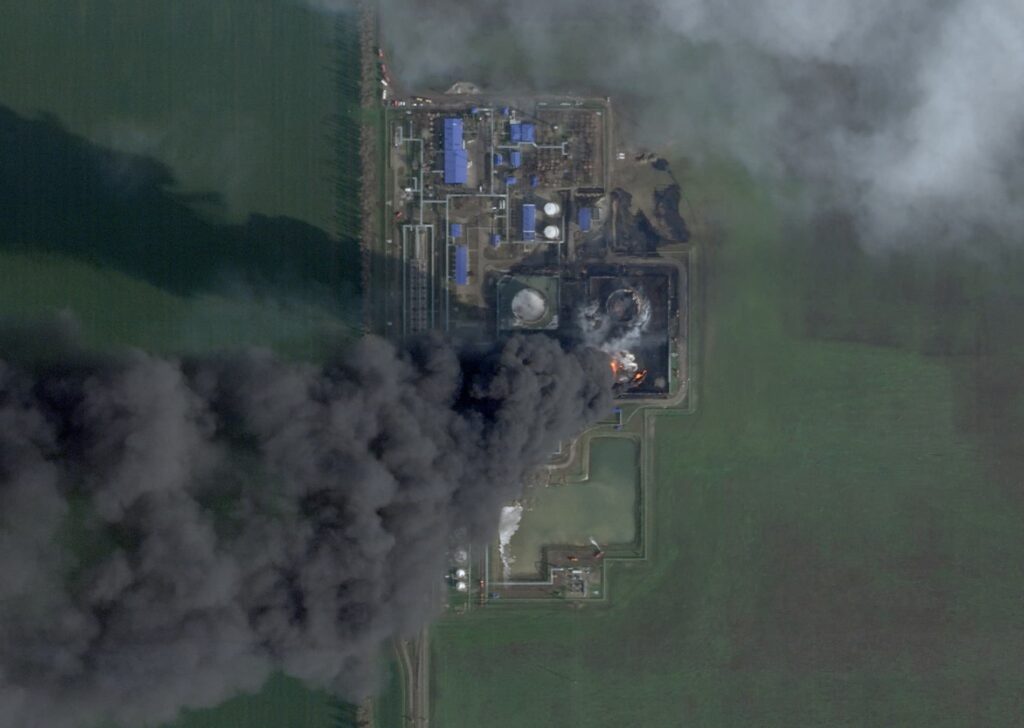
Around a 10% contraction in oil refining in Russia has been reported for April due to Ukrainian strikes. However, it seems to be mostly contraction of output of diesel and heavy fuel oil for exports—after which Russia resorted to simply exporting more crude instead, as shown above, without notable loss in revenue.
Ukrainian drone strikes create some pressure on the Russian domestic gasoline and diesel market, which have led to fuel prices growing faster than inflation. That is a problem for the Central Bank’s policies of taming inflation—gasoline and diesel price growth is a major inflationary risk. However, to speak about widespread fuel shortages in Russia would be a significant overestimation.
This is not to downplay the effects of Ukrainian drone strikes—which are cheap and offer major cost advantages. Costs for Russian businesses are mounting to such an extent that businesses are requesting amendments to the Taxation Code exempting expenditures on repairing the damage from drone strikes from taxation, and the government reportedly agreed to allow businesses to install their own air defense systems, which will also be quite costly.
However, macroeconomic effects of Ukrainian drone strikes—including strikes against Russian oil infrastructure—have been limited so far, and it is a misrepresentation by some media and analysts that these strikes may have an effect comparable, or even exceeding that, of the Western sanctions.
Impact of Western sanctions
The cumulative effects of Western sanctions over recent years, in turn, are very significant. They include:
- Lack of Russia’s access to international financial markets and high borrowing costs. Even with low government debt—which Putin and his ministers love to boast about—borrowing is limited and very expensive, which increases budget deficits.
- Recent fixed investment collapse, as described above, is a direct result of lack of access to Western capital markets.
- Business costs have significantly increased due to sanctions, raising inflation and shrinking profits. Inflation causes high interest rates—which increases government expenditure and hampers economic growth—and falling profits diminish the available capital for investment.
- Export revenues are also depressed, because Russian commodity exporters lost access to a premium European market, whereas in Asia and other countries of the Global South they face major discounts and loss of revenue. That situation has somewhat improved lately for Russia as a result of the war in the Middle East, but probably not for long, and its positive effects for Russia do not offset cumulative revenue losses across the years.
- Due to all these factors, Russia’s government finances are under pressure, financial reserves have been depleted and deficits mounting, preventing the Russian government from providing more fiscal stimulus to the ailing economy.
This means that the Western sanctions are having a massive and systemic impact on the Russian economy, which shouldn’t be unnecessarily downplayed. However, there’s always room for increasing pressure on Russia—in this regard, adoption of European Union’s 21st sanctions package is important, and timely implementation of REPowerEU—the EU’s strategy of phasing out Russian oil, gas and nuclear energy imports—is absolutely crucial to further diminishing Russia’s export revenues and profits.
Regarding the recent relaxing of the U.S. sanctions against Russian oil exports in the wake of oil price spikes caused by the Iran war: while any relaxation of Western sanctions is unwelcome and sends the wrong signals to market players still engaged with Russia, these particular sanctions waivers for seaborne Russian crude haven’t caused major relief for Putin, because oil in Russia is largely taxed at wellhead upon immediately being produced, meaning that crude already loaded onto tankers doesn’t generate any additional revenue for the Russian budget. However, the unhindered ability to sell this crude improves oil companies’ cash flow and profits, which is not a positive outcome.
Impact on Russia’s ability to wage war
While Putin and the Russian government continue to prioritize military spending, due to all the financial constraints described above, they have been forced to effectively cap it, and, given the lack of extra financial resources, are now considering a tough choice: continue military spending at the current level while cutting other vital expenditures—further exacerbating the economic contraction. As per recent remarks by Finance Minister Anton Siluanov, the government’s financial reserves are “not endless”, and, in the current situation, “a certain restraint” in spending is required—which means that the government will inevitably have to cut some of the expenditures, and won’t be able to create additional room for increased military spending. In other words, Russia’s resource depletion has reached a certain tipping point.
Conclusions
Key recent trends show that the Russian economy is balancing on the brink of recession—which was so far been narrowly avoided due to commodity windfall from the war in Iran, but still is quite likely, given the major collapse in fixed investment, a major forward indicator of looming economic contraction.
Budget problems are mounting despite the commodity price windfall from the war in the Middle East—largely due to a renewed government spending push. Without major fiscal stimulus, economic contraction will accelerate. However, heavy spending increases budget deficits, which, in turn, are a major inflationary factor pushing up money supply and inflation, hampering the Central Bank’s efforts to lower key interest rates.
This seems to be a deadlocked situation, from which there’s no easy way out. Against this background, sanctions pressure against Russia must be increased.
Free Russia Foundation continues its series of briefs on the real status of the Russian economy beyond the headlines. Previous reports can be found online here.