
The institution of elections in the Russian Federation has been subjected to deliberate and consistent erosion since the early 2000s. However, after the 2020 nationwide vote on approving constitutional amendments and, especially, after the full-scale invasion of Ukraine in 2022, elections finally lost their competitiveness, procedural transparency, possibility of independent oversight—and, in essence, fully lost the meaning attached to this institution in a democratic society. At least at the federal level.
The outcome of the campaign is largely known in advance, the space for permissible political behavior is tightly constrained, and the voting procedure itself is perceived by a significant part of society as a ritual with little real substance. Nevertheless, an electoral campaign in contemporary Russia remains an important source of information about the political processes taking place in the country. The less free the system, the more carefully its indirect signals must be studied.
A Fight Between Bulldogs Under the Carpet
Even in a society with increasing totalitarian tendencies, politics cannot be fully eliminated; only the ways in which it manifests can be changed. In conditions where public manifestations of civic life and competition are almost invisible, political substance does not disappear—it merely changes form. If there is no open democratic process—with parliamentary debate, independent parties, and alternation of power—then there is closed, bureaucratic, elite politics. Moreover, the more strongly public competition is suppressed, the more important the struggle inside the system itself becomes.
For a long time, the Russian authorities tried to present the country as a “post-political” space, where the main questions had already been resolved and society was supposedly consolidated around the state leadership. But the war destroyed this construct. It sharply increased the number of contradictions—economic, social, bureaucratic, ideological, and even generational.
Sanctions and the partial withdrawal from global markets have created long-term pressure on the economy. Even if statistics allow individual indicators of growth to be demonstrated, the structure of that growth is becoming increasingly distorted. Military spending and state procurement stimulate certain sectors while simultaneously draining others. For a fairly narrow group of beneficiaries, including wage workers, this becomes a source of increased income; for the majority, it is a source of instability, losses, and growing dependence on the state.
Within the system, conflicts are intensifying between various bureaucratic and corporate groups, between regions and the federal center, between the security apparatus and civilian administration, and between the “old” elites and those who have “risen” through the war. The almost complete absence of these conflicts being reflected in the public sphere does not reduce their inevitable influence on personnel decisions, resource distribution, and symbolic practices, including electoral campaigns.
Those Returning from War Are Not Especially Welcome
The emergence of a new social group—participants in the war—is becoming an additional irritant for the established system. State propaganda attempts to declare them the “new elite,” while the classical elites are not at all pleased with them. In addition to specific notions of their own merits and deserved privileges, many Russians who have gone through the war of aggression display noticeable dissatisfaction with the country’s political order, corruption, the unfair distribution of benefits, and the attitude of officials. They sincerely believe that they fought for a “different Russia” than the one they see behind the lines. The Kremlin understands the potential danger of this environment and is trying to integrate it into the system. Hence the instruction to promote war participants into bodies of power, including the State Duma, whose elections are scheduled for September 2026.
This task itself generates new conflicts. The inclusion of war veterans in parliament means a redistribution of influence and symbolic resources, which in the future may become not at all merely symbolic. As a rule, old bureaucratic groups are not interested in the emergence of deputies with their own political capital, social support, and experience of violence. Therefore, the question of exactly how many participants in the war will appear on party lists, which parties’ lists, and in what positions becomes an important indicator of the balance of power inside the regime.
With East German Greetings: Putin Remembers His Youth
Today’s decorative Russian multiparty system was, for a time, relatively successful in masking the degradation of democracy in the country. It was likely inspired by the example of the GDR—East Germany, which remained under communist control until 1990—where four political parties officially existed as part of the National Front and did not claim the leading and guiding role of the SED. This construction allowed the regime to imitate representation of various social groups, distribute elites across institutional niches, and channel limited dissatisfaction.
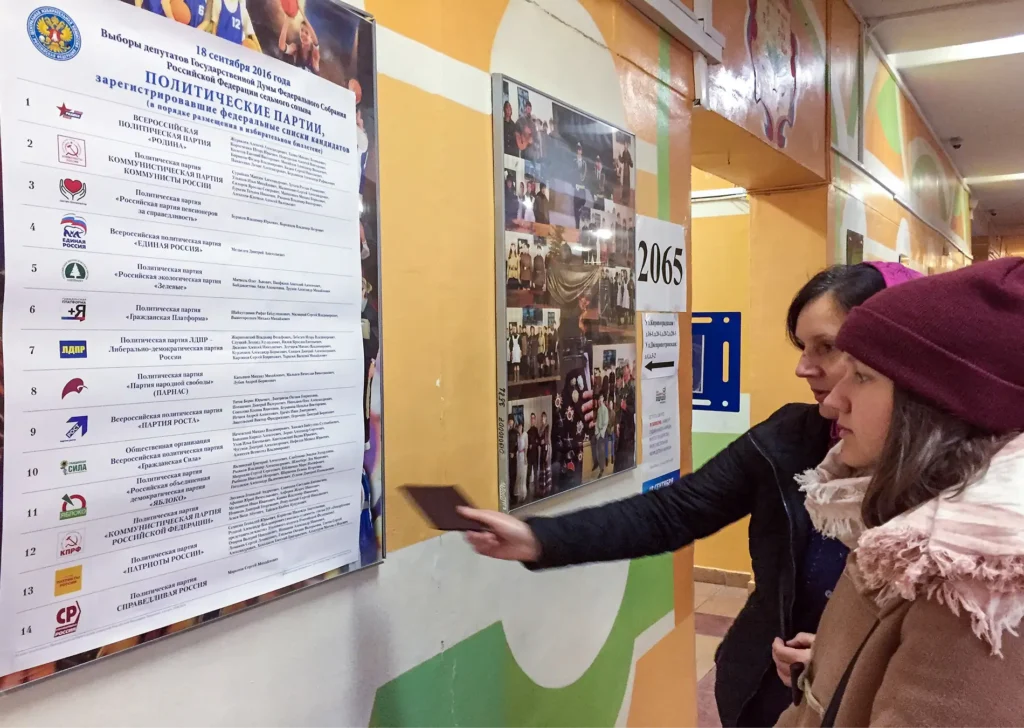
The Russian political system of the era of “mature Putinism” also organically took shape around four parliamentary parties and reproduced itself cycle after cycle. It allowed the authorities to portray political competition without creating any danger to the existing order. Each party had its own niche: the communists—the nostalgic and protest-oriented left-wing electorate; the LDPR—the nationalist, semi-criminal, and ironically protest-oriented electorate; A Just Russia—the moderately socially oriented and loyalist electorate.
Did Someone Order Liberals? A Special Party for Those Who Grew Up Under Putin
The appearance of New People in the State Duma marked the authorities’ need to bring under control the liberal demand emerging among urban audiences, business circles, and young professionals who were not ready to support the radical opposition but also did not feel represented by the traditional systemic parties. The situation of ongoing direct military aggression and harsh suppression of dissent inside the country strengthened this demand: unexpectedly, New People began to crowd out the “eternally second” Communist Party in the struggle for the second place historically held by the communists. Today, the party’s potential electorate is oriented not so much toward ideological liberalism as toward normality, pragmatism, and reducing state aggression in everyday life. A significant part of society is tired of the mobilizational style of existence, the language of war, and constant confrontation. At the same time, the traditional liberal field has been almost entirely destroyed.
The Yabloko party, which declares a consistently anti-war position, has found itself in a political trap. For convinced opponents of the authorities, it is too institutional, although it has not entered parliament for more than two decades, too cautious, and almost indistinguishable in its toothlessness from New People. For the Kremlin, however, it is too uncontrollable and associated with the opposition tradition of the 1990s, with the language and culture of the previous liberal period. A number of Yabloko activists have recently faced severe persecution; it is highly likely that, in one way or another, the party will be barred from participating in the upcoming elections.
Compared with Yavlinsky’s circle, New People offers a depoliticized style: less ideology, more management, services, and individual success. This makes it far more compatible with the current model of fully managed public politics.
It is no accident that the GDR-Putin model of multiparty politics includes only four actors: with a 5 percent electoral threshold, there are simply not enough votes for a fifth. The five-party Duma of the current convocation most likely became a transitional arrangement and will lose one “extra” faction during the elections. The most likely candidate is A Just Russia. It has practically lost both its own ideological identity and its electoral niche. After radicalizing its rhetoric and attempting to compete with nationalists, the party stopped performing its previous function as a left-wing social-democratic force. In theory, administrative resources could be mobilized to get it into parliament. However, that would require diverting forces and resources away from the tasks related to United Russia’s results, which will certainly be assigned to administrations at all levels. Is a party that has clearly outlived its usefulness really so necessary in the Duma? In rigid authoritarian regimes, even controlled institutions eventually undergo a kind of natural selection: if a structure ceases to perform a useful function, it may be marginalized regardless of its previous status.
The “Party of Power” Between the “Towers of the Kremlin”
Overall, party competition is far from the most important storyline of elections in an authoritarian system. Far more interesting is the struggle within power itself. Many independent political scientists and journalists like to discuss the notorious “towers of the Kremlin,” often diverting attention into the realm of semi-fantastical insider accounts. Yet it is precisely an electoral campaign that can provide more reliable material for understanding real processes.
Any candidate list is a recorded balance of interests. Who receives electable positions? Who unexpectedly disappears? Which governors strengthen their positions? Which groups gain representation? In conditions of scarce reliable information, such decisions become valuable empirical material.
The so-called primaries held by United Russia did not become the final point in the formation of the electoral list. The intrigue remains.
If a large number of military personnel, managers of the military-industrial complex, and war-linked administrators end up in electable positions, this will signify the further institutionalization of the “pro-war coalition” inside the regime. If, however, their presence proves limited, it will be possible to assume that the old bureaucracy is still holding its positions and fears too sharp a redistribution of power.
No less important is the question of new faces appearing. Who exactly will become the symbol of the “new elite”? Directors of military factories? Z-bloggers? Regional officials with experience working in occupied territories? Candidates for deputy mandates are likely to become, at the same time, candidates for inclusion on sanctions lists. It cannot be ruled out that this is part of the Russian authorities’ plans: deputies and candidates under sanctions may be viewed as future operators of long-term confrontation with the West. However, if the Kremlin’s plans involve real de-escalation, the system, on the contrary, will try to preserve as technocratic and depoliticized a facade as possible.
Even silence in an authoritarian system is often informative. If the authorities avoid public discussion of the results of intraparty selection, this in itself will become a signal of a high level of conflict in the process. If, on the contrary, new figures begin to be actively promoted, it will mean that the regime is seeking to demonstrate renewal and adaptation to current challenges.
Elections as an X-Ray
Indeed, elections in Russia are not a mechanism for the transfer of power. They should be viewed rather as an instrument for diagnosing the regime. An attentive observer will be able to see which groups are gaining strength and which are losing influence; how the authorities imagine the social coalition of the future and what exactly they fear. In democratic countries, elections show the distribution of public preferences. In authoritarian ones, they show the distribution of fears and expectations inside the system itself.
In an unfree political system, details become especially important. Who received a seat, who lost one, who was allowed into the campaign and who was not, which themes suddenly begin to be discussed in the information space and which disappear. All of this is not noise around a script written in advance, but one of the few ways to understand how the Russian state is actually changing.
If we learn to read the signals correctly, forecasts regarding the development of Russian society and the regime can indeed become more accurate. Because even a controlled political system cannot fully conceal its own contradictions. And nationwide elections are one of a kind of “moments of truth,” when contradictions begin to manifest themselves—even in the course of carefully staged campaigns that were originally intended only to demonstrate stability.