
Introduction
In early 2026, two public interventions by senior Russian state institutions offered an unusually clear view of the place of the Russian Orthodox Church (ROC) in Moscow’s foreign policy. The first concerned Russia’s long-running confrontation with the Ecumenical Patriarchate of Constantinople, Moscow’s principal ecclesiastical rival in the Orthodox world and the Church that granted autocephaly to the Orthodox Church of Ukraine in 2019. Although the dispute is religious and institutional, it also has geopolitical consequences: control over churches, clergy and religious communities abroad can preserve networks of influence in societies where Moscow’s political reach has otherwise diminished.
Against this backdrop, Russia’s Foreign Intelligence Service (SVR) issued two statements targeting Ecumenical Patriarch Bartholomew. On January 12, the agency called him “the Antichrist in a cassock” and “the devil incarnate”, accusing him of acting with the support of British intelligence and interfering in the religious life of Orthodox communities in Lithuania, Latvia, Estonia and Montenegro. On March 31, it added Georgia to the list. The countries singled out were not incidental: each is a setting in which questions of Orthodox jurisdiction intersect with broader contests over Russian influence.
A month later, the other side of this relationship was articulated openly by the Russian Foreign Ministry. At its Easter reception on April 22, 2026, Foreign Minister Sergei Lavrov, speaking in the presence of Patriarch Kirill of Moscow and All Rus’, said:
“Constructive church-diplomatic work is being carried out in many parts of the world. […] We seek to support this work in every possible way. […] We are ready to continue developing our multifaceted cooperation with the Moscow Patriarchate.”
Read together, the SVR’s attacks on Moscow’s ecclesiastical rival and Lavrov’s endorsement of the ROC’s international activity point to the same dynamic: church interests and Russian state interests increasingly overlap abroad.
The Church is consequently more than an ideological partner of the Kremlin. It is involved in politically sensitive operations and struggles for influence in Europe, across the post-Soviet space and on other continents. This takes several forms: the use of church infrastructure in support of diplomacy and intelligence activity; informal personal contacts maintained by representatives of the ROC in different countries; and trust-based networks through which ideological narratives are disseminated.
Since 2022, developments such as sanctions, the reduced scope for official diplomacy, and the contraction of political channels of engagement have made the ROC a more important partner for the Foreign Ministry and the SVR than in previous decades. For the Russian state, the ROC serves as an instrument for preserving influence in Orthodox and post-Soviet societies, circumventing constraints on official diplomacy, engaging with diasporas and elites, and legitimizing foreign-policy positions through moral and religious language. The arrangement also serves the Church’s own interests: it helps preserve jurisdictions and loyal ecclesiastical structures abroad, compete with Constantinople, the Vatican and other religious centers, and secure political protection and material support from the Russian state.
In other words, the relationship is one of mutual reinforcement and support. Alignment between ROC rhetoric and that of different state institutions should be understood not simply as coordinated messaging, but as a reflection of shared political and institutional interests. “Traditional values”, the “Russian World” and the “defense of Orthodoxy” provide the ideological framing for this strategic partnership and its common objectives.
Both sides openly acknowledge the closeness of the relationship. In May 2026, an article published by the Russian International Affairs Council (RIAC)—a think tank established pursuant to a presidential order, with the Russian Foreign Ministry among its co-founders—described the ROC’s role in foreign policy as follows: “Russia’s soft-power strategy gains an additional dimension that goes beyond purely cultural or linguistic influence. […] Under Patriarch Kirill, the Russian Orthodox Church acts not only as a spiritual institution but also as an important foreign-policy actor, sanctifying the state’s geopolitical aspirations as a civilizational mission.”
What Russian sources describe as “soft power” resembles what has been termed “sharp power” in Western scholarship: influence that penetrates a target society’s institutions and information environment rather than primarily seeking to attract or persuade. In the ROC’s case, this operates in part through the political use of religious infrastructure and informal networks whose religious status affords them protections, access and trust not generally available to overt instruments of state influence.
The ROC’s foreign-policy activity can be grouped into four main areas:
• political influence across the post-Soviet space—particularly in countries where ROC institutional structures remain directly or indirectly under Moscow’s control (such as the Baltic states and Moldova);
• inter-Orthodox relations—engagement with Local Orthodox Churches historically within the ROC’s sphere of influence (Serbia, Georgia and Bulgaria), and efforts to challenge the position of churches of the Greek tradition that recognized Ukrainian autocephaly, above all through expansion in Africa, within the canonical territory of the Patriarchate of Alexandria;
• direct diplomatic and intelligence activity through parishes and representative offices;
• ecumenical engagement—relations with the Vatican and participation in international interchurch organizations, above all the World Council of Churches.
Any attempt to describe the ROC’s foreign policy, however, encounters a structural problem: there is no single strategy or doctrine. Some relationships have developed over decades, and in some cases, centuries. At times there is direct coordination with the Foreign Ministry and the SVR, occasionally documented in public. Other decisions are situational, driven by the interests of particular individuals and groups within different institutions. What looks like a system is in fact an accumulation of individual decisions and intersecting strands of activity, rather than the product of a single, centrally coordinated policy.
The Church in the Grey Zone: Why the ROC Is Valuable to the Russian State Abroad
The Russian Orthodox Church, the state and the security and intelligence services have worked together in foreign affairs for decades. To understand their present-day relationship, one must understand their relations reaching back to the Cold War.
The modern Soviet institutional form of the Russian Orthodox Church (Moscow Patriarchate) was reconstituted under Stalin’s orders in 1943. Its new institutional structure brought together three metropolitans of the pre-revolutionary Church, whose institutional structures had been largely destroyed during the first decades of Soviet rule, with People’s Commissar for Foreign Affairs Vyacheslav Molotov and State Security Colonel Georgy Karpov. Karpov became the first chairman of the Council for the Affairs of the Russian Orthodox Church, the state body created to control it. The ROC that emerged was a fundamentally new administrative structure, subordinate to the Soviet government and security services. Two of the three metropolitans who met Stalin—Sergius Stragorodsky and Alexy Simansky—later succeeded one another as patriarch. The third, Nikolai Yarushevich, became head of the Department for External Church Relations (DECR), established in 1946 as the Church’s de facto foreign ministry. Taken together, this institutional design and Molotov’s involvement suggest that foreign policy was one of the principal reasons, or perhaps the principal reason, for creating both the ROC in this form and the state body that controlled it, later incorporated into the Council for Religious Affairs.
From the middle of the Second World War until the collapse of the Soviet Union, the Church operated under the supervision of the Foreign Ministry and KGB in carrying out foreign-policy tasks set by Soviet leadership. These included confronting the Ecumenical Patriarchate, regarded in Moscow as pro-American; building an alternative center of global Orthodoxy by rallying Orthodox countries around Moscow; supporting Soviet policy in Eastern Europe; and confronting the Vatican and seeking to weaken its position. This included both the suppression of Greek Catholicism in Western Ukraine and attempts to sever Catholics in the USSR and Warsaw Pact countries from the Holy See.
Under Khrushchev and Brezhnev, these objectives became less confrontational but did not disappear. Greater emphasis was placed on propaganda: rebutting reports of discrimination against believers and religious persecution in the USSR and cultivating sympathy for socialism and the Soviet system among religious leaders, including in developing countries now commonly described as part of the Global South. Another priority was representation in international ecumenical and inter-church organizations, some of which received Soviet government funding through the ROC. Researchers describe close links between church diplomacy—by the mid-1970s a distinct elite corps within the ROC—and Foreign Ministry infrastructure; church diplomats, for example, used Soviet embassy premises to host receptions. The relatively small body of KGB documents released in the early 1990s provides further evidence of this relationship. The records describe foreign travel by agents drawn from the Soviet episcopate and the tasks assigned to them, including contacts with emigres and efforts to influence the leadership of ecumenical bodies, particularly the World Council of Churches. During the 1970s, church delegations routinely traveled abroad with Foreign Ministry approval and under KGB supervision.
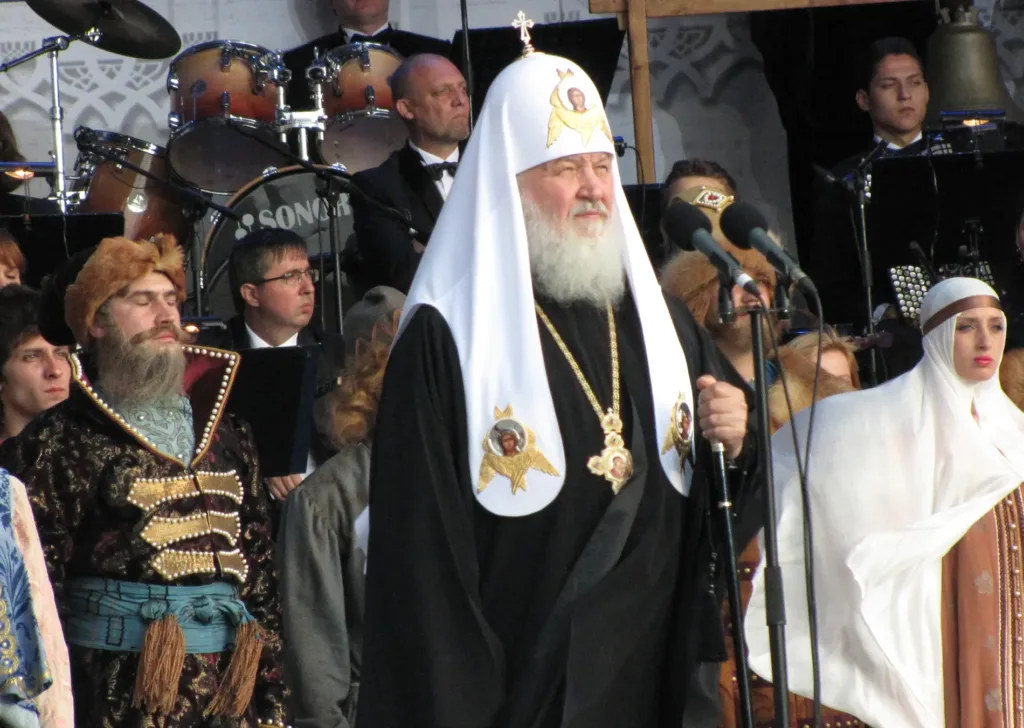
Patriarch Kirill emerged from this milieu of “privileged churchmen”, whose positions allowed them to live abroad or travel internationally while working closely with the KGB. From 1971 to 1974 he represented the ROC at the World Council of Churches in Geneva. Recent investigations by Swiss journalists and French journalists, drawing on Swiss police archives, have revisited this period. Together with KGB archival material copied in the early 1990s by the human-rights activist and priest Gleb Yakunin, these records identify Kirill as a KGB agent operating under the codename “Mikhailov”.
Kirill’s subsequent career also remained closely tied to foreign affairs. He served on the executive committee of the World Council of Churches and as deputy patriarchal exarch in Western Europe. From 1989 until his election as patriarch, Metropolitan Kirill headed the Department for External Church Relations (DECR). Throughout the Soviet period and up to Kirill’s patriarchate, the DECR was one of the ROC’s most powerful centers of influence and the key institution linking the Church to the Soviet and later Russian leadership on international matters. It controlled the Church’s entire foreign-policy operation. Once elected patriarch, Kirill divided a number of the DECR’s functions among smaller departments, reducing its institutional weight and limiting the possibility that it could become an alternative center of power.
The collapse of the Soviet Union shifted the objectives, but not the underlying model of church and state cooperation. Church diplomacy retained a privileged role, as did engagement with international religious organizations, competition with the Ecumenical Patriarchate, activity in the Balkans and the wider Orthodox world, and a complicated relationship with the Vatican. In the late Soviet period, church diplomacy helped project an image of the USSR as a country of “peace” and of “socialism with a human face”. Today, the ROC helps build international conservative alliances organized around “traditional values”, anti-liberalism and the defense of a “normal” or “Christian” world. The universalist communist project has largely given way to the concept of the “Russian World”—less a political ideology in the strict sense, than a civilizational and cultural-religious model of influence, and a new imperial project centered on Moscow.
Following Russia’s launch of its full-scale war against Ukraine in 2022, sanctions, international isolation, and the reduced scope for official diplomacy increased the value of channels that formally sit outside the state while retaining durable structures abroad. The Church, with its overseas dioceses, parishes, metochia (ecclesiastical representative compounds) and representative offices, was particularly well placed to fill that role.
Unlike embassies, consulates and state-run cultural centers, church structures operate in a legal and social space protected by the principles of freedom of conscience and religion. Their religious status can obscure their political role. This does not make them invisible to governments, intelligence services or researchers, but it can make political and legal responses more difficult. Where official Russian institutions face restrictions, church structures can continue to function as religious organizations while also serving as channels of communication, instruments of covert diplomacy, conduits for propaganda and—as Soviet experience and a number of contemporary cases indicate—participants in intelligence activity.
At the same time, the ROC should not be treated as an automatic conduit for Kremlin interests. It has institutional goals of its own, including preserving jurisdictions abroad, expanding into new countries and confronting Constantinople. Three features are particularly important in understanding its foreign-policy behavior: its own institutional agency, its extensive international infrastructure, and its non-state, informal status.
The Role of the ROC in Post-Soviet Territories
After the Soviet Union collapsed, the ROC remained the only transnational institution whose governing center was still in Moscow. For Russian foreign policy, this meant that Moscow retained an institutional presence, and channels of influence, across much of the post-Soviet space through an organization formally outside the state apparatus.
The full-scale invasion of Ukraine put this arrangement under severe strain. Every Moscow Patriarchate structure abroad faced the same dilemma: how to retain its canonical ties to Moscow—in practice, administrative subordination—without losing legitimacy at home.
Moldova
Moldova is among Europe’s more religious countries. Orthodoxy has a prominent place in public life, and trust in the clergy remains among the highest recorded for the country’s institutions. Metropolitan Vladimir (Cantarean), the long-serving primate of the Orthodox Church of Moldova (OCM), is a Russian citizen who has consistently taken pro-Russian political positions. During a sermon in 2016, he praised the pro-Russian presidential candidate Igor Dodon, addressing him as “Mr. President”; priests across the country also held press conferences in Dodon’s support. After Russia launched its full-scale invasion of Ukraine, Bishop Marchel of Bălți and Fălești publicly wore the Ribbon of St George on May 9, 2022, despite a ban on the symbol already being in force. Administrative proceedings were opened against him.
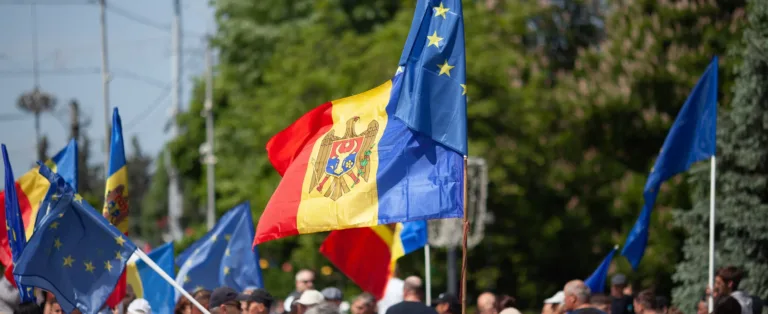
Moldova provides a particularly clear example of how church infrastructure can be deployed for political ends as part of broader hybrid influence efforts. The OCM is formally autonomous but remains part of the Moscow Patriarchate and retains close organizational and symbolic ties with the ROC. Since the start of the war, its parish network has become one of the most durable ways in which Russia retains a presence inside the country, particularly in smaller towns and rural areas where clergy are trusted more than state institutions or the media.
In the run-up to Moldova’s 2024 referendum on EU integration and the presidential election, the authorities repeatedly alleged attempts to use Moscow Patriarchate clergy to campaign against the country’s integration with the EU. Similar accusations were made by the Romanian Orthodox Church. At that stage, however, the public case rested mainly on individual incidents and statements.
A Reuters investigation published shortly before the 2025 parliamentary election was the first to show in detail what this activity looked like in practice. According to Reuters, Russia paid for pilgrimage trips taken by hundreds of Moldovan priests. During the visits, the priests were given bank cards operating on a Russian payment network and encouraged to campaign against EU integration and the governing pro-European Party of Action and Solidarity (PAS). They were advised to create parish Telegram channels, post anti-Western material, circulate messages attacking President Maia Sandu and portray European integration as a threat to “traditional Christian values”. Reuters identified almost 90 such channels posting the same narratives in a coordinated manner. Some priests interviewed for the investigation openly acknowledged receiving money for political activity. Reuters reported payments of up to EUR 1,200 to individual priests, more than twice Moldova’s average monthly salary.
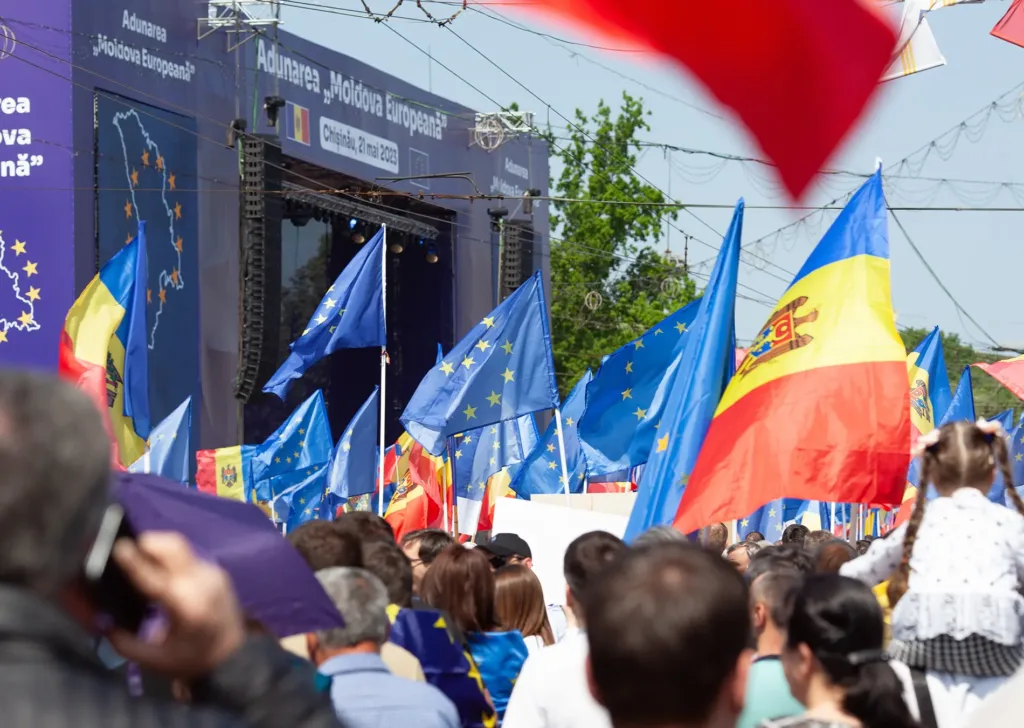
President Maia Sandu publicly described these efforts as part of Russia’s campaign to interfere in Moldovan elections and warned that Moscow was using the Church as a political instrument. In an interview with the Financial Times, she placed the church network alongside bot farms, disinformation and vote-buying schemes. The Moldovan case is therefore revealing for what it shows about the practical value of church infrastructure in political mobilization. Parish networks can be combined with social media, financial channels and informal coordination. The Church contributes more than ideological messaging: it provides an established, trusted organizational network with direct access to local communities.
Yet Moscow did not get the political outcome it wanted. In October 2024, supporters of European integration won the referendum by less than one percentage point. Maia Sandu won the presidential election, and in autumn 2025 the pro-European PAS retained its parliamentary majority.
The Baltic States: Church Affiliation as a National-Security Issue
Since Russia’s full-scale invasion of Ukraine, the Baltic states have been among the first EU countries to treat the institutional dependence of local Orthodox Churches on Moscow as a national-security concern. The underlying question is difficult: can a Church that is registered under domestic law and protected by freedom of religion also serve as a channel of influence for an aggressor state? Lithuania, Latvia and Estonia have all confronted this problem, but they have responded in markedly different ways.
In spring 2022, Metropolitan Innokenty of Lithuania asked the ROC Synod to grant the Lithuanian diocese greater self-government. The Synod established a special commission to consider the request, but four years later, still no decision has been made. The initiative was probably more performative than substantive: it allowed the diocese to signal to the Lithuanian authorities that it was seeking distance from Moscow without actually securing that distance. At the same time, Metropolitan Innokenty dismissed and defrocked five priests who had publicly opposed the war and Moscow.
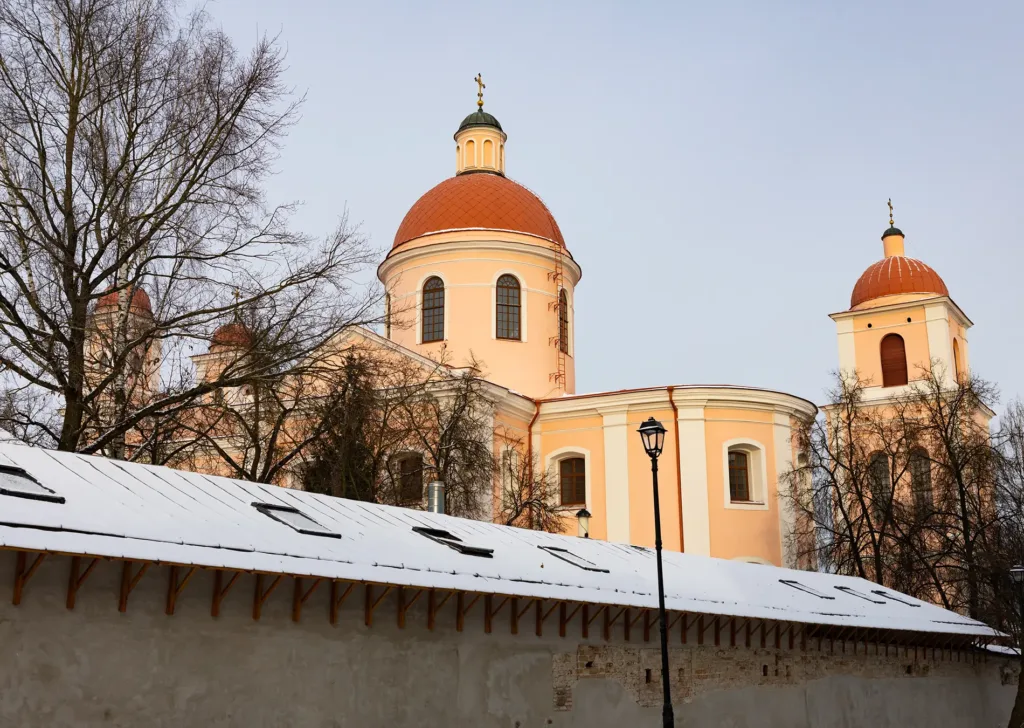
The Lithuanian authorities, meanwhile, wanted an Orthodox structure that would not answer to Moscow and could serve Orthodox Lithuanians, Ukrainian refugees, and Russian and Belarusian political exiles. They opened talks with the Ecumenical Patriarchate. In February 2023, its Synod restored the five expelled priests to the priesthood, and the following month Ecumenical Patriarch Bartholomew visited Vilnius and met Prime Minister Ingrida Šimonytė. Soon afterwards, the Ecumenical Patriarchate established an exarchate in Lithuania, which also received several priests who had fled Belarus. In early 2024, Lithuania’s Ministry of Justice registered the exarchate under Lithuanian law. Lithuania thus came to have two Orthodox jurisdictions, one linked to Moscow and the other to Constantinople. Most Orthodox churches still belong to the ROC diocese, and most Orthodox believers remain parishioners of the Moscow Patriarchate, leaving Moscow with a substantial audience potentially exposed to its ideological messaging.
In March 2026, Lithuania’s State Security Department published its national threat assessment and identified the Diocese of Vilnius and Lithuania of the Russian Orthodox Church as one of the channels of Russian influence in the country. The report stated that “Russia uses the Orthodox Church to spread the idea of the ‘Russian World’ and strengthen its influence in foreign countries, particularly where there are large Orthodox and Russian-speaking communities”. A few days later, Foreign Minister Kęstutis Budrys said that the activities of Russian intelligence services operating through structures of the Moscow Patriarchate’s Diocese of Vilnius and Lithuania had to be curtailed.Yet these pressures have not prevented the diocese from operating openly. In April 2026, it organized an international conference in Vilnius entitled “680 Years of the Cathedral of the Theotokos: Orthodoxy in Lithuania and the Continuity of Canonical Order”, which brought together pro-Russian participants from several countries.
Latvia chose a fundamentally different route. In 2022, President Egils Levits introduced legislation establishing in Latvian law that the Latvian Orthodox Church was fully independent of any ecclesiastical authority outside Latvia; in other words, autocephalous. The Saeima passed the law. This amounted in domestic law to a declaration of independence from the Moscow Patriarchate, although under Orthodox canon law a secular authority cannot itself grant autocephaly. The measure therefore created an evident tension with freedom-of-religion principles because the state was intervening in the internal affairs of a religious denomination. What the legislation could do, was regulate governance. It established procedures for approving and removing the metropolitan, archbishops and bishops, excluding Moscow or any other external body from appointments and administrative decisions. In the explanatory note, Levits wrote: “The renunciation of any ties with the Moscow Patriarch is an essential issue for our Orthodox believers, for Latvian society as a whole and for national security.”
The Latvian Orthodox Church did not fight the measure. Despite Moscow’s anger, it convened a council at which an overwhelming majority voted to ask Patriarch Kirill for canonical autocephaly, thereby bringing the Church’s canonical status into line with the new law. Moscow has left the request unresolved and continues to regard the Latvian Church as part of the ROC. Metropolitan Alexander (Kudryashov), the head of the Latvian Church, nevertheless has good relations with the Latvian state and has complied with the new arrangements, despite his past as a KGB agent. This is notable because Latvia has otherwise pursued a hard line on the Russian language, Russian-language media, and Russian cultural presence. The Church has retained its Russian-speaking character, conservative identity, and historical connection with the Moscow Patriarchate without becoming a comparable target of state pressure.
Notably, that does not rule out the use of Latvian Orthodox parishes to spread Russian ideological narratives, particularly among Russian-speaking communities. To date, however, there has been no investigation that documents such activity with the same specificity as the evidence available for Moldova or Lithuania.
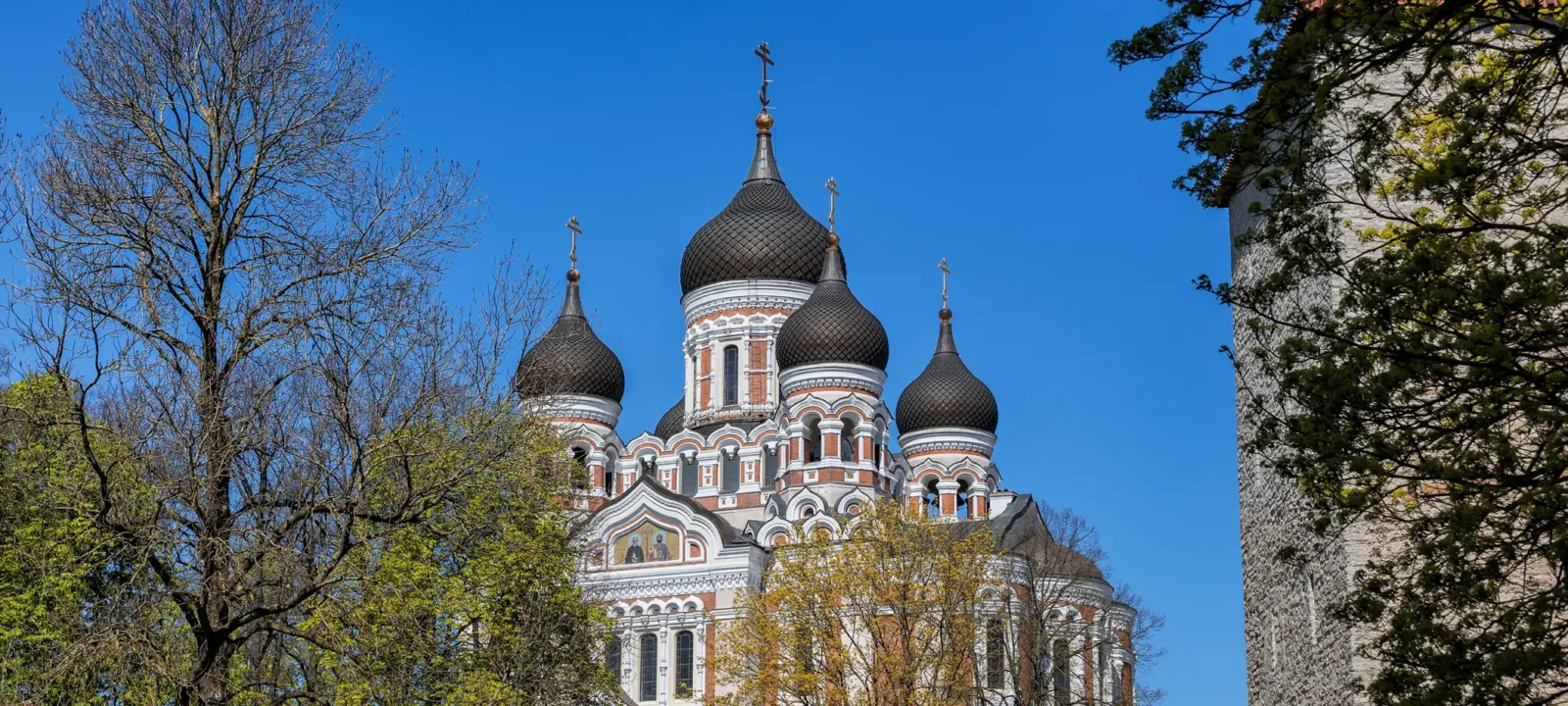
Estonia is the most complex of the three cases. Since 1996, the country has had two Orthodox jurisdictions: the Estonian Orthodox Church within the Moscow Patriarchate and the Estonian Apostolic Orthodox Church under Constantinople. The latter emerged from a bitter dispute between Moscow and Constantinople and claims continuity with the Orthodox Church of independent Estonia in the interwar period. The post-Soviet division of the ROC’s Tallinn diocese therefore also became a question of identity: whether Orthodoxy in Estonia should be represented by an Estonian national Church or primarily by a Church serving the Russian-speaking population. At the start of the war, the Moscow-affiliated jurisdiction nevertheless had seven times as many parishioners.
The Moscow-affiliated Church was led by Metropolitan Eugene (Reshetnikov), a Russian citizen appointed from Moscow who did not speak Estonian and had no biographical connection with the country. At the start of the war, he tried to navigate between the Estonian authorities and Patriarch Kirill, avoiding an explicit condemnation of Russia’s aggression while also trying not to provoke Tallinn. Estonia’s Ministry of Interior eventually concluded that his public statements posed a national-security threat. On January 18, 2024, the Ministry refused to renew his residence permit, and on February 6, Reshetnikov left Estonia. He continued to formally lead the Church from abroad, underscoring the extent to which its governance remained tied to Russia while it was waging war against Ukraine. Legal disputes between the Church and the Estonian state continued. Bishops and priests maintained that their connection to the Moscow Patriarchate was purely spiritual, while the institutional arrangements suggested otherwise. In April 2024, shortly after the World Russian People’s Council described the war as “holy”, Interior Minister Lauri Läänemets said he would ask parliament to designate the ROC a terrorist organization as a means of severing the Estonian Church’s ties with Moscow; the proposal did not proceed. In 2025, the Church won a court case allowing it to change its name to the Estonian Christian Orthodox Church (ECOC), but the underlying ambiguity of its position remained.
An investigation by Põhjarannik, part of the Estonian Postimees media group, exposed one way in which church structures could intersect with cross-border political activity. Nuns who in practice lived in Moscow had been formally employed at Narva Cathedral under fictitious contracts. They publicly supported the war in Ukraine and traveled to the front with humanitarian aid; their nominal employment in Narva enabled them to renew Estonian work residence permits. After the investigation was published, the permits were revoked and the nuns were barred from entering the Schengen area.
The Pühtitsa Convent presents a separate problem. It is a large monastery of considerable importance to the ROC and, as a stavropegial institution (a monastery directly subordinate to the patriarch), reports directly to Patriarch Kirill rather than through the Estonian Church. In 2024, Interior Minister Läänemets personally visited the convent and tried to persuade it to leave the jurisdiction of the Moscow Patriarchate. Abbess Filareta refused, with the nuns appealing to the Estonian Council of Churches and arguing that the monastery was “outside politics” and had no intention of severing its “canonical ties with the Mother Church”—meaning the Moscow Patriarchate.
On 27 June 2026, amendments to Estonia’s Churches and Congregations Act entered into force, stipulating that religious associations operating in Estonia may no longer be subordinate to a cleric based in a foreign state who poses a threat to Estonia’s security. Tarmo Miilits, Secretary General of the Ministry of the Interior, informed religious associations that they had six months, until 28 December, to comply. For the Estonian Christian Orthodox Church, the new requirements mean electing a metropolitan from among bishops resident in Estonia and ending the practice, required by its statutes, of sending budgets and reports to Moscow for approval. Ilmo Au, an adviser to the Ministry of the Interior, put the issue starkly: “The local clergy of the Orthodox Church need to do serious internal work and clearly decide whom they serve: the Holy Trinity or the Kremlin and the Moscow Patriarch.”
Inter-Orthodox Relations
Moscow has worked actively to keep the Orthodox Churches of the former socialist states within its sphere of influence, and with considerable success. Historical ties are only part of the explanation. These Churches also share a broadly conservative agenda and occupy a similar place in their respective societies: large majorities identify as Orthodox, while for many believers that affiliation is primarily cultural and national rather than a matter of regular religious practice. The Serbian, Bulgarian and Georgian Churches have not condemned Russia’s invasion of Ukraine and continue to serve as conduits for elements of Russian soft power in their respective countries. Their alignment with Moscow, however, lasts only as long as it serves their own political and institutional interests. They are better understood as partners of convenience than as allies.
It is tempting to divide the Orthodox world into two spheres of influence: a Slavic, broadly post-socialist one centered on Moscow, and a Greek one centered on Constantinople. The long and increasingly bitter conflict between the two patriarchates encourages such a reading. In practice, however, the space between these poles is far less orderly. Alliances can be durable or temporary, and their composition changes from one issue to another.
The dispute over Ukrainian autocephaly brought these tensions into the open. In October 2018, the Synod of the Ecumenical Patriarchate announced that it would grant autocephaly to Ukrainian Orthodoxy. Moscow responded by unilaterally breaking Eucharistic communion with Constantinople. In January 2019, the newly established Orthodox Church of Ukraine (OCU) received its tomos of autocephaly. The ROC regarded the move as an encroachment on its canonical territory. Moscow later invoked the defense of the ROC’s interests and of ‘canonical Orthodoxy’ in Ukraine among the arguments it used to justify the invasion.
The rupture forced every Local Orthodox Church to take a position. Those that declined to recognize the OCU were, at least on this issue, aligned with Moscow. Formally, only four of the fifteen Local Orthodox Churches recognized the OCU: Constantinople, the Church of Greece, the Church of Cyprus and the Patriarchate of Alexandria—all part of the Greek and, in broad terms, more Western-oriented tradition. But non-recognition does not in itself amount to support for Moscow. Every episcopate contains competing views. In Cyprus, for example, many bishops opposed recognition but did not command a majority; in Bulgaria, Romania, Serbia and Georgia, influential minorities have supported the OCU. Caution over a new autocephaly also reflects concerns closer to home: if Constantinople intervened in Ukraine, might it do the same in another Church’s internal dispute? The theological and cultural divide matters as well. Most Orthodox Churches are more conservative than the Ecumenical Patriarchate and often regard its relative liberalism as excessively Western.
The same forces that draw these Churches towards Moscow also place limits on Russian influence. Each national Church sees itself as a custodian of its people, statehood and national identity. In domestic politics, they tend to gravitate towards the most conservative and increasingly authoritarian forces, usually right-wing populists or governing parties. This makes them receptive to Moscow’s support—probably including financial support in some cases—and to much of its ideological repertoire: anti-liberalism, ‘traditional values’ and hostility towards the West. It also encourages distance from Constantinople. But there is a clear boundary. When the ‘Russian World’ conflicts with a Church’s own national project, national interests prevail. Churches that helped sustain national identity under imperial rule have little difficulty recognizing the costs of political or ecclesiastical domination by another power.
Balkan States
Serbia and Montenegro
The Serbian Orthodox Church is Moscow’s most important partner in the Orthodox world outside the post-Soviet space. Since Russia’s full-scale invasion of Ukraine, Patriarch Porfirije has visited Moscow twice. On April 22, 2025, accompanied by Patriarch Kirill, he met Vladimir Putin and during the same visit described the student protests in Serbia as a “color revolution”.
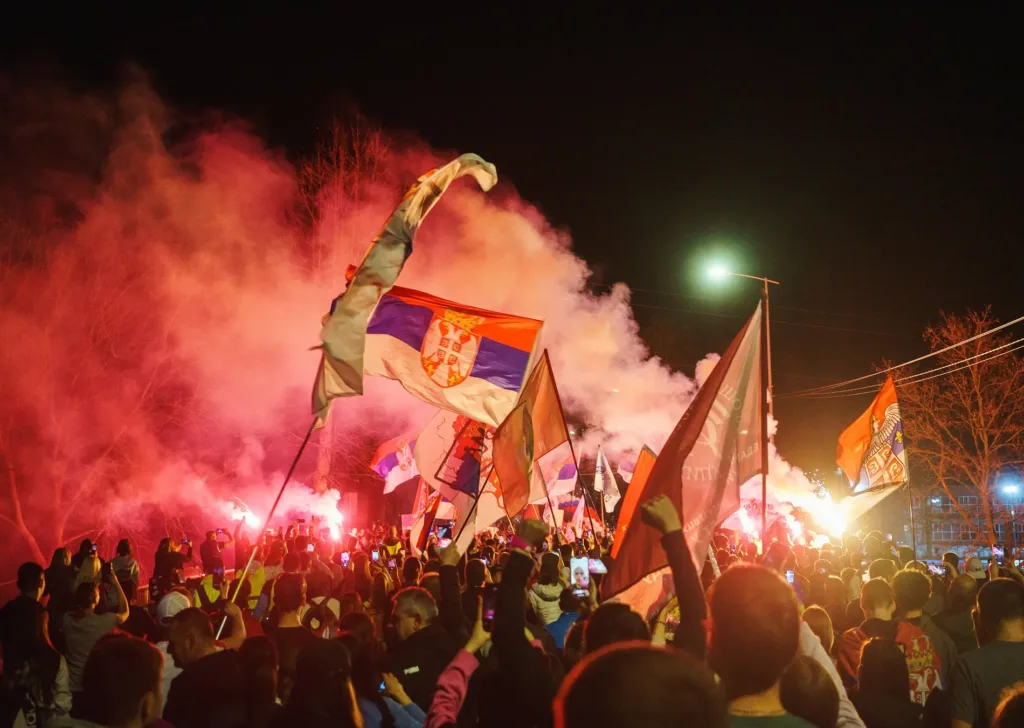
That closeness does not make the Serbian Church subordinate to Moscow. It supports the Russian Orthodox Church in its dispute with Constantinople and has not recognized Ukrainian autocephaly, but it acts above all according to its own political and ecclesiastical interests: defending Serbian positions in Kosovo, Bosnia and Herzegovina and Montenegro, and in disputes over national identity and ecclesiastical boundaries. So long as Moscow supports it on these issues, their interests coincide.
The “Serbian World”, however, is not an extension of the “Russian World”. It is a structurally similar but independent national project. On June 8, 2024, Belgrade hosted the first All-Serbian Assembly under the slogan “One People—One Assembly”, convened by Serbian President Aleksandar Vučić and Republika Srpska President Milorad Dodik. The declaration adopted at the gathering affirmed the Serbs as a single people, while Patriarch Porfirije’s presence gave the project ecclesiastical legitimacy. In this model, the Serbian Church serves as an institution of national cohesion, linking Serbs across state borders and sustaining the idea of a shared cultural and political space.
For Moscow, this is a congenial arrangement. The Serbian national project uses language close to that of the “Russian World”: a nation extending beyond state borders, the Church as guardian of identity, resistance to the West and the defense of tradition. Russian diplomacy has also aligned itself closely with this project: Dodik brought a letter of support from Foreign Minister Sergei Lavrov to the All-Serbian Assembly. But similarity does not mean subordination. Serbia has no interest in becoming Moscow’s vassal, just as Tito’s Yugoslavia, although socialist, did not become a vassal of Stalin’s Soviet Union. Russia matters instead as a source of support and as a symbolic center of anti-Western Orthodox politics.
Montenegro presents a different configuration. It has been an independent state for two decades and is a member of NATO, yet most Orthodox believers belong to the Metropolitanate of Montenegro and the Littoral, part of the Serbian Orthodox Church. Religious affiliation therefore repeatedly overlaps with disputes over identity, statehood and foreign-policy orientation. Serbian and pro-Russian actors often use similar language, portraying Serbs and Montenegrins as one people and invoking church affiliation to challenge a distinct Montenegrin identity.
This was most visible during the 2019-2020 protests against the Law on Freedom of Religion. The law threatened the Metropolitanate’s property interests; Church-led mobilization coincided with parliamentary elections and was one factor in the country’s first change of government in thirty years. Montenegro therefore offers an example of a NATO state in which a legitimate Church institution tied to the Serbian Orthodox Church can mobilize mass support, affect the political balance and speak in a register that overlaps with Moscow’s anti-Western and anti-liberal rhetoric.
European leaders have also recognized the political importance of religion in the region. Following the Western Balkans-EU summit held in Tivat in early June 2026, French President Emmanuel Macron traveled to Cetinje Monastery, where he was received by Metropolitan Joanikije of Montenegro. The visit reflected a practical concern: substantial progress towards EU membership would be harder if it encountered Church opposition, making respectful engagement with the Church politically important.
Bulgaria
Bulgaria offers an example of a more restrained form of alignment with the ROC within the European political system. It is an EU and NATO member with an independent autocephalous Church, where Orthodoxy remains an important marker of national identity, historical memory and cultural belonging, even though levels of everyday religious observance are relatively low. In this respect, Bulgaria is closer to Russia and, to some extent, Serbia than to Romania or Moldova, where the Church is more deeply embedded in public and political life. The political role of the Bulgarian Orthodox Church is not constant: it depends on the government of the day, the broader social context and the extent to which Orthodox rhetoric is politically salient at a given moment.
On June 18, 2026, ahead of a meeting of the European Council, Bulgarian Prime Minister Rumen Radev, the country’s former president who had taken office as head of government in May 2026, said on the sidelines of an EU Council meeting that Sofia would demand that Patriarch Kirill be removed from the forthcoming 21st package of sanctions: “I am not interested in Patriarch Kirill as such. I am interested in the Russian Orthodox Church, because the Russian Orthodox Church contributed to our liberation from five hundred years of Ottoman slavery. I am interested in Russian society as a whole, in which this Church exists and which, like ours, is Eastern Orthodox. We are one family.” Until then, Viktor Orbán had blocked Kirill’s inclusion on EU sanctions lists for several years; after the political situation in Budapest changed, Sofia emerged as the opponent of sanctions.
Several days later, Radev met Patriarch Daniil and members of the Holy Synod of the Bulgarian Orthodox Church. The discussion covered cooperation between Church and state, the introduction of Orthodox religious education into school curricula and engagement with Bulgarian communities abroad. Radev said that the Bulgarian state and the Bulgarian Orthodox Church shared a “common mission,” while the patriarch presented him with an icon of Christ the Saviour. The language of an Orthodox “family” thus carried over into domestic politics, as Church and state publicly articulated a shared agenda.
This episode grew out of a conflict dating back to the recognition of Ukrainian autocephaly and intensified after the start of the full-scale war. By then, hierarchs seeking greater distance from Moscow had become more visible within the Bulgarian Church: several metropolitans openly commemorated the head of the Orthodox Church of Ukraine during services or concelebrated with Ukrainian clergy, prompting Russian conservative church media to interpret these developments as signs of a possible shift by the Bulgarian Orthodox Church toward Constantinople.
After the death of Patriarch Neofit in March 2024, the question of his successor was viewed through the prism of the war in Ukraine and the confrontation between Moscow and Constantinople. Shortly before his death, Neofit had issued a cautious statement referring to the “destructive war against fraternal Ukraine,” which was interpreted in Russia as a condemnation of the war.
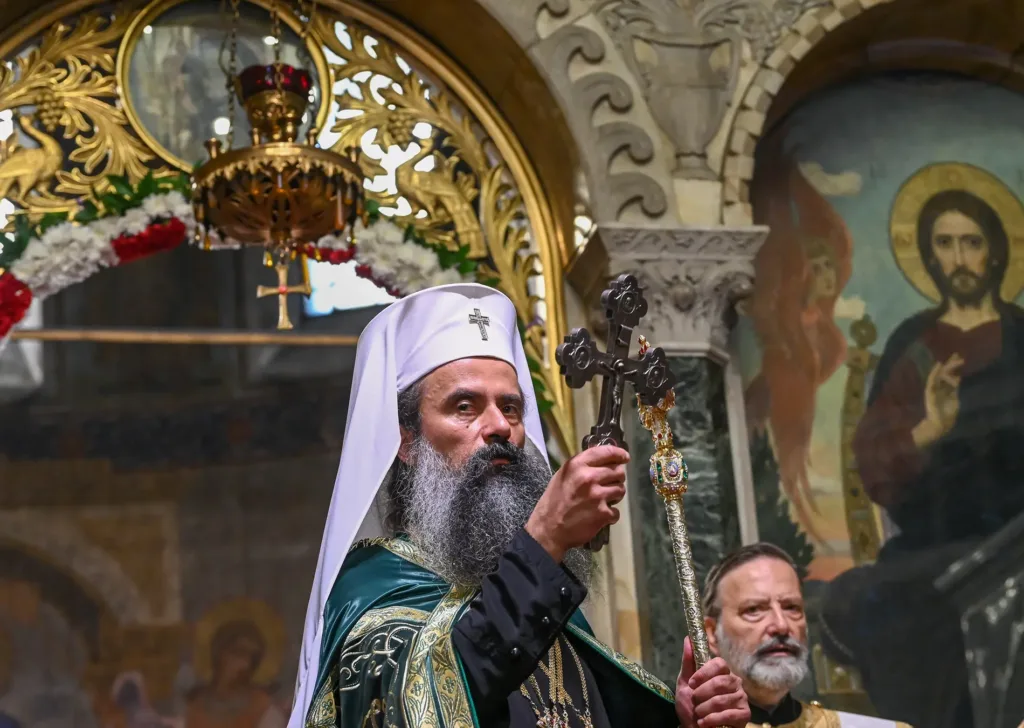
The Bulgarian Orthodox Church does not vest absolute authority in the patriarch and is governed far more collegially than the Russian Church. Although the episcopate and clergy are, on balance, more inclined toward pro-Russian positions, influential dissenting voices remain. Nevertheless, Metropolitan Daniil of Vidin won the patriarchal election. He is a critic of the Ecumenical Patriarchate’s actions, an opponent of Ukrainian autocephaly and a defender of traditional values. For the ROC, this was a favorable outcome: the Bulgarian Church did not recognize the Orthodox Church of Ukraine and did not join the Greek Churches in supporting Constantinople.
By summer 2026, the Bulgarian configuration was therefore as follows: the Bulgarian Orthodox Church was headed by a patriarch close to Moscow’s position in its dispute with Constantinople and the OCU; the head of government was defending Patriarch Kirill against European sanctions using the language of an “Orthodox family”; and the Holy Synod and prime minister were publicly speaking of a “common mission” shared by Church and state. At the same time, the Bulgarian Church retained its own agency and internal diversity. This is precisely what makes the Bulgarian case instructive: a restrained and informal closeness to Moscow, without direct dependence, mass mobilization or departure from the European framework, was nevertheless capable of translating into a concrete political decision within the EU: blocking sanctions against the Moscow patriarch, who supports Russia’s war against Ukraine.
South Caucasus: Georgia
The Georgian Orthodox Church (GOC) occupies an unusually prominent place in the country’s national life. Between 83 and 87 per cent of Georgians identify as Orthodox. When Patriarch Ilia II died on March 17, 2026, hundreds of thousands of people reportedly came to pay their respects during five days of mourning at Tbilisi’s Sameba Cathedral and along the funeral procession to Sioni Cathedral.
The GOC is autocephalous, commands enormous public authority and maintains close ties with the Russian Orthodox Church. Those ties rest on longstanding institutional contacts, the backgrounds of senior clergy, a shared position on Ukrainian autocephaly and a common wariness of Constantinople. Yet it would be misleading to describe the Georgian Church simply as a channel of Russian influence. Georgia has its own history of ecclesiastical independence, including the abolition of its autocephaly by the Russian Empire. That independence is precisely what makes the GOC valuable to Moscow: its silence on the war, refusal to recognize the Orthodox Church of Ukraine (OCU) and caution towards Constantinople carry greater weight when they appear to be the choices of an independent national Church rather than the position of an institution dependent on Moscow.
Ilia II was widely regarded as a “father of the nation”. He had led the Georgian Church since 1977, under Brezhnev, and generations of Georgians grew up with the Church and its patriarch almost inseparable in public life. The post-Soviet relationship between Church and state was largely shaped during his tenure. In 2002, Ilia signed a constitutional agreement with President Eduard Shevardnadze recognizing the Orthodox Church’s special status, guaranteeing its property rights and providing for state funding. Human-rights groups criticized the agreement from the outset for placing other religious communities at a disadvantage.
The GOC is also among the most conservative Churches in the Orthodox world. It withdrew from the World Council of Churches in 1997 and has consistently opposed ecumenism. Yet this anti-ecumenical stance has not kept it outside transnational Christian conservative networks. In 2016, Tbilisi hosted the World Congress of Families, one of the leading organizations promoting the global “traditional values” agenda.
Ilia II’s death in March 2026 was therefore both a symbolic and a political event. In practice, however, much of the Church’s leadership had already passed to Metropolitan Shio (Mujiri), who had served as locum tenens of the patriarchal throne since 2017. A graduate of St Tikhon’s Orthodox University in Moscow, Shio is a prominent figure in Georgia’s ultraconservative religious milieu. In May 2026, the Synod elected him Catholicos-Patriarch as Shio III. There is no public evidence that Moscow interfered in the election, although Shio was widely regarded as the candidate most acceptable to the ROC.
On March 31, 2026, the Russian Foreign Intelligence Service (SVR) issued a statement entitled “Bartholomew Has Forgotten Himself in His Arrogance”. Rather than acknowledge the possibility of Russian interference in the succession, the SVR accused Constantinople of trying to influence the election, claiming that Ecumenical Patriarch Bartholomew sought to “subjugate” the Georgian Church after Ilia II’s death. The statement grouped Georgia with Ukraine, Serbia and the Baltic states. In doing so, the SVR effectively identified the areas in which Moscow has particular church-political interests, while presenting those same areas as targets of outside aggression.
Since 2022, Georgian politics has moved markedly away from the West, with the governing Georgian Dream party driving the shift. This has been reflected in the “foreign agents” law, an anti-LGBT agenda, accusations that protesters are plotting a “color revolution”, and the effective suspension of Georgia’s EU integration process.
The Church has become part of this domestic confrontation. Protests against Georgian Dream have continued since late 2024, and the GOC—both a guardian of national tradition and one of the country’s most powerful conservative institutions—has condemned them. Some individual priests and even bishops, however, have supported the protesters in a personal capacity. The resulting alignment works to Moscow’s advantage without requiring direct instructions from Russia: the government is moving away from the West, the Church broadly shares its conservative agenda, and the new patriarch has ties to Russia.
Yet overt support for Russia remains politically toxic for much of Georgian society. The legacy of the 2008 war, the occupation of Abkhazia and South Ossetia, and mass protests against the government’s anti-Western direction make an openly pro-Russian position extremely difficult to sustain. The Georgian Church’s closeness to Moscow therefore cannot be expressed as openly as it is in Serbia. Instead, it is visible in the Church’s silence on the war, its refusal to recognize the OCU, its guarded approach to Constantinople and its convergence with the government on conservative issues.
Africa
The sharpest break with the inter-Orthodox status quo following Ukrainian autocephaly came in Africa. At the end of 2021, the Moscow Patriarchate established the Patriarchal Exarchate of Africa, creating its own structure on the territory of the Patriarchate of Alexandria, whose jurisdiction has historically encompassed Orthodox communities across Africa. The move followed Alexandria’s recognition of the Orthodox Church of Ukraine (OCU) and was Moscow’s most overt step in its confrontation with the Churches of the Greek tradition: the ROC began accepting clergy and communities into its jurisdiction on the territory of another ancient patriarchate.
The African project also extends a longstanding dispute over who is entitled to operate across national boundaries in the Orthodox world. In contemporary Orthodoxy, Constantinople claims a distinctive transnational role. Following the collapse of the Ottoman Empire and the near disappearance of the Orthodox flock in Turkey itself, the Ecumenical Patriarchate does not function as the national Church of a sovereign state: the Patriarch remains a Turkish citizen, much of the flock and its sources of funding are in the United States and the Greek diaspora, and its dioceses operate around the world. The ROC, by contrast, does not see itself simply as one national Church among the Serbian, Bulgarian or Greek Churches, but as the Church of an empire, and claims a similarly supranational, transnational scope. The difference is that its transnational reach is not autonomous: its expansion is possible only in conjunction with the Russian state—through diplomacy, state corporations, political alliances and state-adjacent networks of influence.
After 2022, this dependence became still more visible. The war, sanctions and Western consolidation around support for Kyiv increased the importance of the Global South to Russian foreign policy, both as an arena for diplomatic contacts and economic projects and as a setting for symbolic confrontation with the West. For the ROC, this shift coincided with ecclesiastical interests of its own: after the rupture over Ukraine and the conflict with Constantinople, it needed a new arena for expansion, while the Russian state gained a religious component to its presence beyond the familiar post-Soviet and European theaters.
In its ecclesiastical justification, Moscow presented the creation of the Exarchate as a response to requests from African priests who did not wish to remain under the Patriarchate of Alexandria after its recognition of the OCU. In the ROC’s account, Alexandria had sided with the “schism”, while the Moscow Patriarchate was restoring to African Orthodox Christians the possibility of belonging to a “canonical” Church. In practice, the claim went further: the ROC asserted a much broader claim to ecclesiastical jurisdiction over Orthodox Christians far beyond Russia, the Russian diaspora and the familiar territory of the “Russian World”.
The most visible public showcase for the African project came at the Russia-Africa summit in St Petersburg in July 2023, where the Church appeared alongside Russian state corporations. Patriarch Kirill addressed African leaders in the language of traditional values, a conservative view of human nature and rejection of an ideology of “permissiveness and overconsumption”. At the ROC stand, visitors were shown plans for a Russian spiritual center in Kampala, the Ugandan capital, comprising a church, bell tower, school, hospital and hotel opposite the presidential palace. On the same day, 27 July 2023, the first head of the Exarchate, Metropolitan Leonid (Gorbachev), who had been suspected of links to Yevgeny Prigozhin and his structures, signed a tripartite agreement with Maria Lvova-Belova—Russia’s presidential commissioner for children’s rights, who is subject to an International Criminal Court arrest warrant over the deportation of Ukrainian children—and the “A Country for Children” foundation. The agreement covered humanitarian projects based at Exarchate parishes in Kenya and the Democratic Republic of Congo: a poultry house for 500 chickens, an agricultural farm and a medical laboratory. The projects were genuinely small and local. According to the foundation itself, leasing and cultivating 20 hectares of land in Congo cost about 2 million rubles. Since then, however, these initiatives have largely disappeared from public view: there have been no convincing reports on their subsequent fate, or on construction of the spiritual center in Kampala.
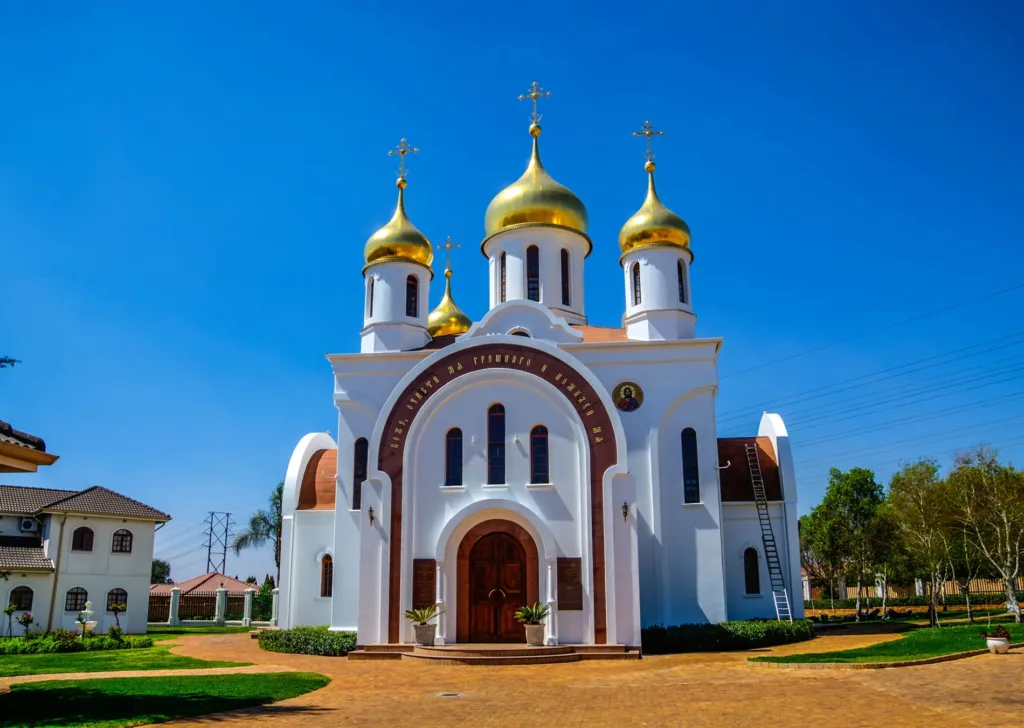
The countries in which the Moscow Patriarchate has established a foothold fall into three broad groups. The first comprises states where Russian interests are concentrated and where, in some cases, the Wagner Group has also maintained a presence: the Central African Republic, Uganda—which has been described as a “spiritual hub of the Russian Orthodox Church in East Africa”—and Mali. The second consists of countries with historically large Russian diasporas, above all South Africa and, for example, Morocco. The third includes countries with substantial Orthodox populations that Moscow hopes to draw away from the Patriarchate of Alexandria, chiefly Kenya and Tanzania.
The ROC’s expansion is closely intertwined with Russian state corporations and major companies, which finance its growth; Russian Railways, Rosatom and Rusal are cited among the principal sponsors. The scale and mechanics of this funding are not documented in open sources, and that opacity is itself part of the same structural protection that makes the channel as a whole difficult to monitor from the outside. To compete with other Churches, the Moscow Patriarchate recruits existing communities and priests into its jurisdiction. African states do not pay clergy salaries, unlike, for example, Greece or Cyprus, while congregations are too poor to support their clergy. The Moscow Patriarchate can therefore offer salaries and finance infrastructure such as churches and schools. It also offers exchanges, education and travel: in November 2022, the first group of students from Kenya, Rwanda and Nigeria arrived at the St Petersburg Theological Academy under a program funded by Rosatom. When parishes transfer to the ROC, signs reading “Russian Orthodoxy” appear on churches that had previously carried names such as “African Orthodox Church in Kenya”. Moscow also prefers to take over existing parishes rather than build new communities from scratch, and this has not always worked to its advantage. Among the first hundred priests to transfer were clergy who had been suspended from ministry or had questionable reputations; some continued to maintain relationships with both jurisdictions—Moscow and Alexandria—exploiting the confusion. In 2022, Kenyan Bishop Neofitos of Nyeri compared these takeovers to Russia’s invasion of Ukraine.
The scale of the Exarchate presents a separate problem. Its multilingual website regularly reports new parishes, baptisms, visits, humanitarian activities and clergy transferring jurisdictions; these claims are then reproduced in outside publications as ready-made statistics. In February 2026, for example, Bloomberg published a map showing around 350 parishes and 270 clergy in 34 countries. The agency had not compiled those figures independently: it took them from the Exarchate’s website and from an article by one of its own employees, Father Georgy Maximov, one of the Exarchate’s principal ideologues. A major Western outlet thus presented the ROC’s own figures as factual, although it is unclear how they were calculated or independently verified. They cannot be meaningfully audited from the information available. It is unclear whether they represent genuine bureaucratic records or a publicity exercise; what counts as a parish; how priests moving between jurisdictions are counted; who is actually serving under the ROC, who has returned to Alexandria, who has been suspended from ministry, and who exists only in the reporting.
In 2026, reports emerged suggesting that the ROC’s African Exarchate may be connected to the recruitment of Kenyans into the Russian armed forces. The pan-African human-rights organization Vocal Africa reported hundreds of Kenyan families whose sons had traveled to Russia through schemes linked to church-adjacent intermediaries. The young men were allegedly promised paid work, had their documents taken on arrival and were then sent to the war. Representatives of the Exarchate in Nairobi deny involvement, saying that the Church sends only seminarians to Russia, while also acknowledging that they warn those traveling about the “risk” of military recruitment once in Russia.
By 2026, the ROC’s expansion in Africa had become an opaque enterprise in which ecclesiastical, state and probably business interests converge. Both Metropolitan Leonid and his successor, Metropolitan Konstantin (Ostrovsky), have been defrocked by the Patriarchate of Alexandria, and the ROC’s African structure has no legitimate status in the wider Orthodox world.
Diplomacy, Intelligence and Informal Networks
Russian presence abroad often follows a three-part pattern: a diplomatic mission; cultural and humanitarian infrastructure, including Rossotrudnichestvo, Russian Houses and affiliated organizations; and an ROC parish or representative office. The first two have formal state status and clearly defined functions. The third is different. A parish is registered under local law, its priest acts as a religious leader, and the community conducts an ordinary religious life centered on worship and the everyday concerns of the diaspora.
Formally, ROC dioceses and parishes are not part of Russia’s diplomatic representation. In practice, however, church infrastructure can provide access to Russian-speaking communities and local elites, sustain loyal diaspora networks, facilitate closed contacts, create a symbolic presence and, in some cases, provide an environment for political influence or operational activity. Such activity is rarely easy for journalists, police or counter-intelligence services to investigate because it is built largely on informal relationships.
On 21 September 2023, Bulgaria expelled the head of the ROC metochion in Sofia, Archimandrite Vassian (Zmeyev), its secretary, Archpriest Evgeny Pavelchuk, a Belarusian citizen, and another employee of the metochion. All three were also banned from entering the country for five years. Prime Minister Nikolai Denkov distanced himself from the decision without disputing it: “The decision was taken on the basis of a classified report. I merely familiarized myself with it and was not directly involved in making it. It is a decision of the State Agency for National Security”. The ROC called the expulsions “unfounded” and shortly afterwards appointed Vassian head of the Russian Ecclesiastical Mission in Jerusalem—effectively a promotion.
A similar case in the Czech Republic unfolded over a longer period and concluded in 2024. Archpriest Nikolai Lishchenyuk, rector of the ROC metochion in Karlovy Vary since 2006 and the Patriarchate’s representative to the Orthodox Church of the Czech Lands and Slovakia, lost his residence permit in August 2023, soon after the Czech government placed Patriarch Kirill on its national sanctions list. He challenged the decision through three levels of the courts and lost at each stage; the Constitutional Court disposed of the final appeal on 12 June 2024, and in August the Interior Ministry formally declared him persona non grata. The Supreme Administrative Court stated the rationale directly: Lishchenyuk’s activities, “with the support of state bodies of the Russian Federation, created a structure of influence whose purpose was to support separatist tendencies in European Union countries”. Foreign Minister Jan Lipavský went further: “I do not consider the Russian Orthodox Church of the Moscow Patriarchate a church, or its representatives, clergy. It is part of the Kremlin’s repressive machinery, which takes part in Russian influence operations”. In both the Bulgarian and Czech cases, activity normally protected by the status of a religious community became the subject of decisions by security and migration authorities.
In spring 2023, the FBI circulated a six-page warning to Orthodox parishes in the United States, not only Russian but also Greek, entitled “Russian Intelligence Services Victimize Russian Orthodox Church and other Eastern Orthodox Churches.”. Andrei Soldatov and Irina Borogan later reported on the case in Foreign Affairs. At its center was Dmitry Petrovsky, an employee of the Moscow Patriarchate’s Department for External Church Relations (DECR). The FBI had files found on his computer containing biographies of prominent American Orthodox priests and their families, and suspected him of working for Russian intelligence under church cover. Among the files was a document drawn up shortly after Kirill became patriarch in 2009: a plan for cooperation between the ROC and the security services that referred, among other things, to “involving clergy in operational activity”.
The significance of the case was therefore not simply the possible intelligence role of one Church employee, but the potential operational use of an existing overseas ecclesiastical network. Moscow Patriarchate priests sent abroad are already embedded in a system of external church relations: they deal with parishes and communities, diplomatic missions, local religious leaders and DECR structures. Such a person can be useful not only as a source of information, but also as an intermediary able to introduce people, open doors and establish channels based on trust.
In June 2023, the Russian Orthodox Church announced that, with its participation, a group of Ukrainian prisoners of war from Transcarpathia had been transferred to Hungary. Eleven servicemen were involved. The transfer was coordinated by Zsolt Semjén, Hungary’s deputy prime minister responsible for church and national affairs, with the Hungarian Maltese Charity Service acting as intermediary; Semjén said that the released men “owed their freedom” to the Russian Orthodox Church. Foreign Minister Péter Szijjártó, by contrast, distanced the government from the operation, saying that official Budapest had not been involved in bringing the prisoners to Hungary.
Kyiv described the episode differently. Ukrainian officials said the transfer had taken place without coordination with the Ukrainian government and that Ukrainian diplomats had not been given proper access to their citizens. The Ukrainian side suspected Russia of using the opaque release of prisoners for a propaganda operation involving Hungary. Five of the eleven later returned to Ukraine; the others left for EU countries.
The church channel thus allowed Russia and Hungary to conduct a sensitive operation involving Ukrainian prisoners of war without involving Kyiv and outside the normal state-to-state exchange procedure. By its own account, the ROC acted as an intermediary through which a contentious issue could be moved beyond formal diplomacy. The mechanics of the transfer and the arrangements behind it remain unknown. The later handling of Metropolitan Hilarion (Alfeyev), who had represented the ROC in Hungary, also illustrates how informal Church personnel decisions can obscure reputational problems. At the end of 2024, after allegations of harassment by a former cell attendant, the Synod moved him from Budapest to become rector of the metochion in Karlovy Vary—the same church from which Nikolai Lishchenyuk had been expelled a year earlier. On 24 May 2026, Czech police found cocaine in Hilarion’s car; he was released without charge, and on 3 June Patriarch Kirill reassigned him to the Argentine and South American Diocese, to serve parishes near the borders with Paraguay and Argentina.
Several unusual episodes in Scandinavia have likewise raised suspicions of Russian intelligence involvement. In 2017, the authorities in the Swedish city of Västerås granted a local Orthodox community permission to build a church despite objections from SÄPO, the Swedish Security Service, which had raised security concerns. The site is only around 300 meters from Stockholm Västerås Airport at Hässlö, which served as a Swedish Air Force base until 1983 and, after Sweden joined NATO in 2024, became a strategic hub regularly used for Alliance exercises. Permission was also granted for a 22-meter spire despite local zoning rules limiting structures near the airfield to ten meters. Construction, costing more than SEK 35 million, was financed by the Foundation for the Support of Christian Culture and Heritage, managed through Rosatom structures; the parish also owned a house at which Russian diplomats were registered.
Metropolitan Anthony (Sevryuk), chairman of the DECR, traveled to the church’s consecration in November 2023. Guests included Belarusian Ambassador to Sweden Dmitry Mironchik, Russian embassy adviser Vladimir Lyapin—later identified by Swedish investigative journalists as a career Russian intelligence officer—and several Cossack leaders (atamans). A photographic report published on the website of the World Russian People’s Council included an image of Anthony presenting the parish rector, Father Pavel Makarenko, with an SVR medal “For Cooperation”. The award order, No. 4023 PN, was signed by SVR Director Sergei Naryshkin on 4 November 2023, the day of the consecration. The DECR’s official account of the visit made no mention of an SVR medal and referred only to Church awards. Vestmanlands Läns Tidning (VLT) was the first outlet to publish the photograph and the award document; subsequent reporting based on its investigation found no evidence that the image had been manipulated. The photograph was later removed from the World Russian People’s Council website but remained available in a web archive. The parish said the images had appeared as the result of a hacking attack, citing a letter from the DECR in support of its claim.
In December 2023, two weeks after the consecration, SÄPO issued a statement saying that Russia was using the Moscow Patriarchate in Sweden “as a platform for intelligence gathering and other activities that threaten national security”. It also referred to contacts between parish representatives and Russian intelligence services and to regular, substantial funding from the Russian state. The Swedish state subsequently ended grants to Moscow Patriarchate communities. In 2025, the Västerås authorities asked the government to consider compulsory purchase of the church site because of the perceived threat to a total-defense facility.
The OSINT agency Molfar has gone further, alleging that the ROC is building churches near strategic facilities across Europe. Its investigation geolocated Russian churches in Bryne, Oslo and Kirkenes in Norway. In Trondheim, a Russian church is roughly one kilometer from the Air Force Academy and less than a kilometer from a submarine bunker; in Finland, a Russian church in Turku was located close to the Coastal Fleet, its base and command at Pansio, as well as the port, city hall and the Russian consulate. The case made by the investigation was not always persuasive, however. Older churches in Vienna, Thessaloniki and Stockholm, built long before the current war and in some cases in the nineteenth century, were also found to be near one or another “strategic facility”. Proximity alone does not establish intent. It is not possible to conclude with confidence that churches built at varying—sometimes considerable—distances from important sites were deliberately positioned for intelligence purposes, particularly when the investigation classifies not only airports and military bases but also, for example, foreign embassies as strategic objects.
The Vatican
After February 2022, the ROC’s Vatican track developed along several lines as the popes’ public position on the war evolved. These included contacts around the Holy See’s humanitarian mission; direct engagement between Russian officials and ROC hierarchs and the Catholic Church; and discussion of the Vatican as a possible venue for negotiations between Russia and Ukraine.
The Holy See followed a familiar diplomatic tradition: keeping channels open to regimes with which it is in deep moral conflict, lowering the ideological temperature, pursuing limited practical results and preserving room for negotiation. During the Cold War, this approach was associated with the Ostpolitik of Paul VI and Cardinal Agostino Casaroli, Vatican secretary of state and the principal architect of the Holy See’s eastern policy. After 2022, the same diplomatic instinct operated in the context of Russia’s war against Ukraine. For Moscow, this meant that the Vatican did not simply align itself with Western governments or speak the language of a military bloc. That did not make it a Russian ally. The Holy See continued to call for an end to the war, progress on humanitarian issues, the return of children and exchanges of prisoners.
Pope Francis adopted an emphatically peace-oriented position, which also made it politically ambiguous. He condemned the war and spoke repeatedly about Ukraine’s suffering, but his criticism of the West, his skepticism towards the logic of military blocs and his calls for negotiations sometimes struck Ukrainian and Western audiences as excessive caution or a reluctance to name the aggressor directly. Even so, his position never fully matched Moscow’s expectations. Francis rejected the Church’s theological justification of the war, while the Vatican increasingly linked the prospect of peace to an end to Russian aggression.
The personal channel between the two Church leaders broke down quickly. Francis and Kirill spoke by video link for forty minutes on 15 March 2022. In a later interview with Corriere della Sera, Francis described the conversation by saying that the patriarch had spent half of it reading from a prepared text setting out the ‘justifications for the war’. He added: ‘The patriarch cannot become Putin’s altar boy‘. The Department for External Church Relations (DECR) responded that the pope had described the conversation incorrectly and expressed regret over his account. The same interview revealed that a second, face-to-face meeting between the pope and patriarch had been planned for Jerusalem on 14 June 2022. It did not take place.
Contacts continued through other channels. In August 2022, Francis met Metropolitan Hilarion (Alfeyev), who had recently been removed as chairman of the DECR and transferred to Budapest. The central figure later became the pope’s special envoy, Cardinal Matteo Zuppi, Archbishop of Bologna and president of the Italian Episcopal Conference. In 2023, Zuppi traveled to Kyiv, Moscow, Washington and Beijing. In Moscow he met Patriarch Kirill, presidential aide Yuri Ushakov and Maria Lvova-Belova. Publicly, the mission was framed above all in humanitarian terms: the return of Ukrainian children taken to Russia, prisoner exchanges and the fate of detained civilians. What was discussed behind closed doors is known only in the broadest terms.
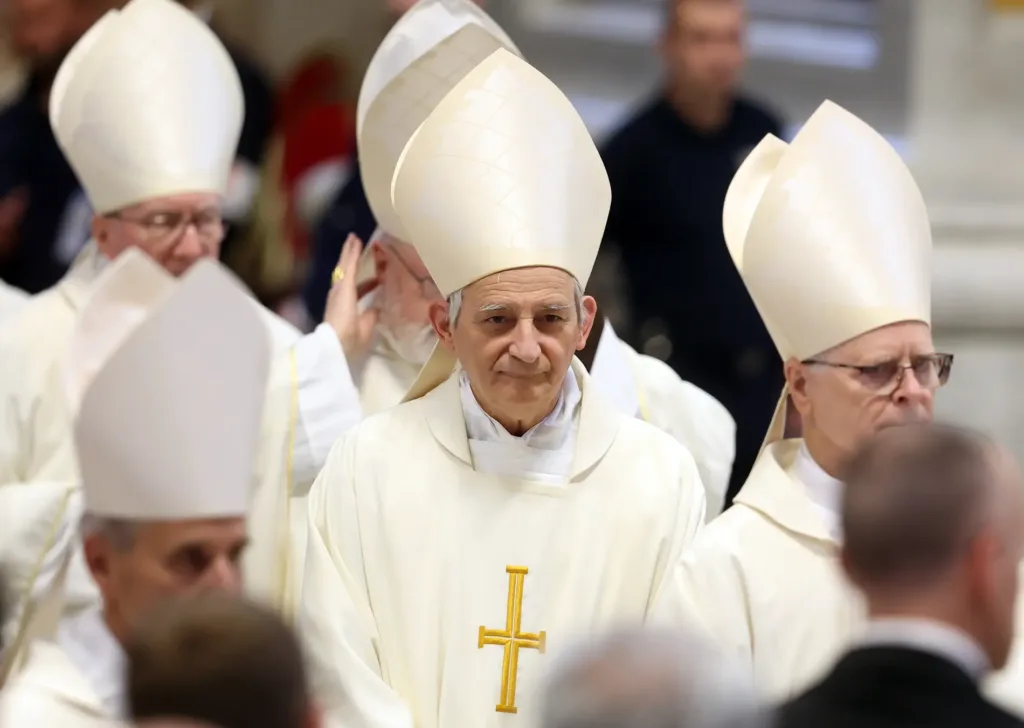
For Moscow, an informal humanitarian channel was more convenient than a formal mechanism. On 19 November 2025, Volodymyr Zelenskyy wrote to Pope Leo XIV asking the Holy See to formalize its role in returning Ukrainian children and civilians held by Russia—in other words, to turn the informal mediation conducted by Cardinal Zuppi under Pope Francis into an established mechanism. Iryna Vereshchuk, deputy head of the Office of the President of Ukraine, told journalists in Rome that as long as Zuppi’s mission remained informal, Russia could use this ‘grey zone’ to avoid responding to Ukrainian lists of civilians. Ukraine wanted the Holy See to become an official intermediary—a ‘platform’ through which Kyiv and Moscow could discuss their return. Formalizing Vatican mediation would have transformed a humanitarian channel into a mechanism capable of creating public obligations for Russia. Moscow did not agree to this.
Moscow also has another source of leverage over the Holy See: the Catholic infrastructure inside Russia itself—four dioceses, along with priests, parishes and communities. It is small, but entirely dependent on Russia’s legal and political environment. The Vatican therefore must keep that vulnerability in mind in every discussion with Moscow: it has people and institutions in Russia that can effectively be held hostage to the relationship, just as it has a much larger flock in Ukraine, including in the occupied territories.
At Francis’s funeral in April 2025, the ROC was represented by DECR chairman Metropolitan Anthony (Sevryuk); Ecumenical Patriarch Bartholomew attended on behalf of Constantinople. In July, Pope Leo XIV received Anthony and an ROC delegation at the Vatican. The substance of the meeting was not disclosed in detail.
In spring 2025, after direct Russian-Ukrainian contacts resumed in Istanbul, attention turned to the venue for a possible next round, and Western and Ukrainian politicians raised the Holy See as an option. The new pope, Leo XIV, also said that the Vatican was prepared to host talks. Russian Foreign Minister Sergei Lavrov publicly called the idea ‘inelegant’: in his formulation, two predominantly Orthodox countries were being asked to discuss the ‘elimination of the root causes’ of the conflict at a Catholic venue. News agencies, citing sources close to the Kremlin, also reported practical Russian objections: the Vatican is inside Italy, a NATO and EU member state, while sanctions complicate travel for Russian officials. The religious argument therefore did not stand alone. It reinforced political and logistical objections to a venue Moscow did not want.
World Council of Churches and European Ecumenical Structures
The ROC’s relationship with ecumenical organizations differs from its dealings with the Vatican. These are multilateral Christian forums rather than bilateral channels. The World Council of Churches (WCC) is the largest, bringing together 356 churches from more than 120 countries. The ROC joined in 1961. Since then, the WCC has remained an important arena for contact and influence, particularly among Protestant churches, and a forum in which the ROC can advance both its own interests and those of the Russian state at a global level. Its membership includes churches from regions where views of Russia and the war in Ukraine do not always align with the Western consensus. In that environment, the Moscow Patriarchate can shift attention away from Russian aggression towards themes more favorable to its position: distrust of Western policy, the defense of traditional values, and calls for peace that do not directly acknowledge Russian responsibility.
At the WCC Assembly in Karlsruhe in 2022, the war became one of the central issues. German President Frank-Walter Steinmeier sharply criticized the ROC leadership for justifying Russian aggression. The Moscow Patriarchate’s delegation protested and sought to redirect the discussion towards the ROC’s humanitarian activity in the context of the war. The WCC’s final resolution condemned the Russian invasion as an illegal and unjustifiable war and called for a ceasefire and negotiations. Yet the question of the ROC’s membership remained unresolved. Despite public calls for the Moscow Patriarchate to be expelled, it remained inside the organization.
In May 2023, WCC General Secretary Jerry Pillay traveled to Moscow with a delegation. Shortly beforehand, he had secured agreement in principle in Ukraine from both the Ukrainian Orthodox Church (UOC) and the Orthodox Church of Ukraine (OCU) to enter into dialogue under WCC mediation. In Moscow, he proposed that Patriarch Kirill convene a ’round table’ bringing together the Churches of Russia and Ukraine. Nothing came of the initiative.
The contradiction became sharper the following year. On 27 March 2024, an extraordinary congress of the World Russian People’s Council, chaired by Patriarch Kirill, adopted a document entitled ‘The Present and Future of the Russian World’. It described the war as a ‘Holy War’, cast Russia as the ‘Restrainer’ defending the world against a ‘West that has fallen into Satanism’, and envisaged the whole territory of Ukraine entering Russia’s ‘exclusive sphere of influence’. Pillay wrote directly to Kirill seeking an explanation. He reminded the patriarch that, a year earlier and in the presence of WCC delegates, Kirill had assured him that any references he made to a ‘holy war’ concerned the metaphysical realm rather than the armed conflict in Ukraine. The new document appeared to contradict that assurance. No subsequent response resolved the contradiction, and the ROC’s membership of the WCC was not suspended.
Relations with the other major ecumenical body, the Conference of European Churches (CEC), developed differently. The ROC suspended its participation in the CEC on 11 October 2008. The DECR attributed the decision to what it called an ‘unfounded’ refusal, ‘contrary to the Constitution and rules of the CEC’, to consider the membership application of the Estonian Orthodox Church of the Moscow Patriarchate. In effect, the ROC had sought to have a Church already within its own structure admitted as a separate member, thereby increasing its representation and influence. Moscow subsequently portrayed the CEC as a politicized European organization. In 2023, the CEC admitted the Orthodox Church of Ukraine as a full member, completing a process that had begun with the OCU’s application in 2022. This placed the organization firmly on the other side of the divide from the ROC: the CEC has consistently taken a pro-Ukrainian position.
Conclusion
Western states have learned to recognize Russian television channels, foundations and “compatriot centers” as instruments of influence. The Church has not been treated in the same way. A parish community cannot simply be expelled by diplomatic means, while freedom of religion offers a priest more reliable protection than the Vienna Convention offers a diplomat. The effectiveness of this channel therefore owes less to exceptional skill in Moscow than to a blind spot in host societies: activity framed as religion is not, by default, read as politics.
However, this is not entirely true: the cases of Sweden, Czechia and Lithuania discussed above show that individual states are already capable of identifying this form of influence and taking action against it. But these responses remain scattered, national and uncoordinated—there is no comprehensive EU-level approach specifically addressing the Moscow Patriarchate’s church infrastructure, and it is this absence of coordination, rather than invisibility as such, that explains why the channel as a whole continues to function.
The second conclusion is counter-intuitive: the absence of a coherent ROC foreign-policy strategy is itself a source of resilience. A patchwork of situational decisions, personal relationships, informal contacts and overlapping interests cannot be pinned down as a single coordinated structure. Whether this is a genuine absence of coordination or a form of deniability that Moscow has learned to exploit is, in practice, almost impossible to establish from outside, and this very ambiguity is what makes the arrangement so resilient: it cannot be confronted as a single strategy, because no single actor can be shown to be running it.
When the Bulgarian prime minister blocks sanctions against Patriarch Kirill with the words “we are one family”, this is not the execution of an instruction from Moscow. When a Swedish parish is built with money from a Russian state corporation near a reserve military airfield, each element can be legal and explicable in isolation. The Russian state does not so much run this system as take advantage of its existence; the system, in turn, takes advantage of the state.
Its effectiveness also has clear limits. Despite the resources invested in it, Moldova’s church network failed to overturn either the referendum or the elections. Five years of expansion in Africa have not produced a clear success: the proposed spiritual center in Kampala did not materialize, while the reported growth figures remain unverifiable. Independent national Churches—Serbian, Georgian and Bulgarian—accept Moscow’s support and almost all of its ideological package, but remain partners of convenience only as long as the “Russian World” does not conflict with their own national projects. Church infrastructure remains a foreign-policy resource, but one with limited influence.
The ROC’s overseas infrastructure is best understood as an intermediate layer of Russia’s external presence: formally separate from the state, legally protected, regularly intersecting with its diplomatic, cultural and intelligence spheres, yet reducible to none of them. Built to serve Stalin-era foreign-policy objectives, this layer survived the collapse of the Soviet Union and changed its ideological packaging from the “struggle for peace” to “traditional values”. There is no reason to assume that it will not survive the current regime as well.
For democratic states, the challenge is therefore to develop the capacity to identify and document the ROC’s foreign-policy activity and, where necessary, constrain it without violating freedom of conscience.