
I. Executive Summary
This report documents a systematic policy of the Russian Federation to erase the national identity of Ukrainian children removed to occupied territory and to the Russian Federation itself, to militarize them, and to prepare them for service in the armed forces of the state that removed them from their homes. It is built on thirteen individually documented cases of Ukrainian children and young adults, cross-referenced against Ukraine’s official “Children of War” state registry and identified through open-source investigation, together with a body of institutional evidence including school programs, state youth organizations, specialized military academies, falsified curricula, and the individuals who administer them, that shows these cases are not isolated incidents but result of a intentional, coordinated state infrastructure.
The central finding of this report is that the forcible transfer and deportation of Ukrainian children is not a discrete, one-time act. It is a continuing offense that renews itself every day a Ukrainian child remains under the control of the occupying power. Each additional day deepens the child’s separation from Ukraine and moves the point of identity loss closer to becoming irreversible. This is not a matter of interpretation: it is demonstrated by the documented cases themselves, several of which show the same children, tracked over a period of years, moving from disappearance, to enrollment in Russian institutions, to militarized youth organizations, to, in one documented case, active combat against the armed forces of Ukraine.
Every case in this report has been established exclusively through open sources and cross-checked against Ukraine’s state “Children of War” (Діти війни) registry. That fact carries a double significance. First, it substantiates the reliability of the findings: these are not allegations built on anonymous testimony but identifications built on the same publicly verifiable methodology used by international investigators, journalists, and the Ukrainian government itself. Second, and more troubling, it demonstrates that the Russian Federation is not concealing this conduct. It is publicly documenting it, through school social media accounts, regional television broadcasts, state youth-organization pages, and municipal press releases, and presenting it as an achievement of its own government.
This report situates the individual cases within the broader institutional and legal record already established by the United Nations, the International Criminal Court, the European Union, and independent researchers, including the Yale School of Public Health’s Humanitarian Research Lab. It then applies the relevant frameworks of international law such as the 1948 Genocide Convention, the Fourth Geneva Convention, the Rome Statute of the International Criminal Court, and the UN Convention on the Rights of the Child, to the specific documented conduct, and closes with recommendations addressed separately to the Government of Ukraine, the Russian Federation, and the international community.
II. Background and Context
Since 2014 in Donetsk and Luhansk, and since the full-scale invasion of February 2022 in Kherson and Zaporizhzhia, Russian occupation authorities have progressively dismantled Ukrainian civil administration and replaced it with structures modeled on, and increasingly absorbed directly into, the Russian state. The education system was among the first and most thoroughly captured institutions: Ukrainian-language instruction, Ukrainian curricula, and Ukrainian civic identity were systematically displaced by Russian curricula, the Russian language, and a Russian civic and military identity. Beginning in June 2025, Russian authorities moved to eliminate remaining Ukrainian-language instruction from occupied-territory school programs entirely, a process formalized most recently by Russian Ministry of Education Order No. 729 (signed October 8, 2025; entered into force December 15, 2025), which mandated federal Russian-language curricula for these schools.
This report addresses what has happened to individual, identifiable Ukrainian children within that captured system not only as a matter of policy documents alone, but also as a matter of documented, individual lives. It draws primarily on thirteen case studies developed by the Back to Ukraine initiative, corroborates the institutional and legal claims surrounding them against independent open-source reporting, and adds the international legal analysis needed to situate these findings within the frameworks already being applied by the International Criminal Court, the United Nations, and the European Union.
III. Methodology
The individual case documentation underlying this report was developed by the Back to Ukraine initiative through monitoring and cross-verification of open sources in the following categories:
- Russian and occupation-linked social networks, principally VKontakte, together with Odnoklassniki, Moi Mir, Instagram, and TikTok;
- Regional Russian and occupation-administration media, including television broadcasts;
- Official orders and administrative documents issued by educational institutions;
- Russian Federation court and administrative registries;
- Ukraine’s state “Children of War” (Діти війни) platform, used as the authoritative reference point against which each identification was cross-checked.
Children were identified by matching date of birth, place of birth, and visual identification data between the state registry entry and the material found in occupation-linked sources; in several cases a second, independent verification step was used, such as tracing an account’s subsequent friend network or contacting an acquaintance directly. Free Russia Foundation has not independently re-run this identification process for each individual case; it has instead independently verified the surrounding institutional, financial, and legal claims (Sections IV, VI–X) against English- and Ukrainian-language open-source reporting, and has independently confirmed, through separate reporting from Ukrainian, Russian, and international outlets, the case that has since drawn the widest public attention—that of Oleksandr Mustiatse (Case 10, Section V). Where this report presents facts sourced solely to the Back to Ukraine investigation and not independently corroborated by Free Russia Foundation, that is noted. Consistent with standard practice for reporting on missing and at-risk children, and with the approach already taken by Ukraine’s own state registry and by international outlets that have covered these cases, this report identifies children by name where the underlying source material does so and where doing so serves the documentary and accountability purpose of the report; images of children were not obtained or are not reproduced here, consistent with the source investigation’s own privacy practice.
IV. Russia’s Institutional Infrastructure of Militarization and Indoctrination
The individual cases documented in Section V are not disparate episodes. They are results of a single state infrastructure, elements of which are described below. This infrastructure operates at three levels simultaneously: the school, where military training and ideological content are built into ordinary instruction; the state youth organization, which extends that content outside school hours and into residential camps; and the specialized military academy, which channels the most committed participants toward eventual service. A parallel track falsifies the historical and civic content taught to occupied-territory children so that Russia’s invasion, and Ukraine’s resistance to it, are represented in terms that make militarization appear not as coercion but as patriotic opportunity.
Independent large-scale analysis corroborates this pattern at the systemic level. In September 2025, Yale School of Public Health’s Humanitarian Research Lab identified at least 210 facilities in Russia and Russian-occupied Ukrainian territory to which Ukrainian children have been taken, and found that children were subjected to re-education programming at 62.9 percent of the facilities identified, to militarization-specific programming, including weapons training, at approximately 18 percent, and that more than half of the identified facilities are managed directly by the Russian government. The institutional mechanisms documented in this section—schools, state youth organizations, and specialized military academies—are consistent with, and provide granular detail on, the network Yale’s researchers mapped at scale.
A. Schools as Instruments of Militarization
School No. 28, Mariupol. The “Cadet Path” (Кадетский путь) program provides drill instruction, training in the assembly and disassembly of the AK-pattern rifle, practice occupying combat positions with weapons, and tactical-medicine instruction. Classrooms display portraits of Vladimir Putin. The school holds events marking the “Liberation of Mariupol”, the anniversary of the city’s occupation, and enrolls first-graders in nationwide military-patriotic song competitions. All of this is documented and published by the school itself.
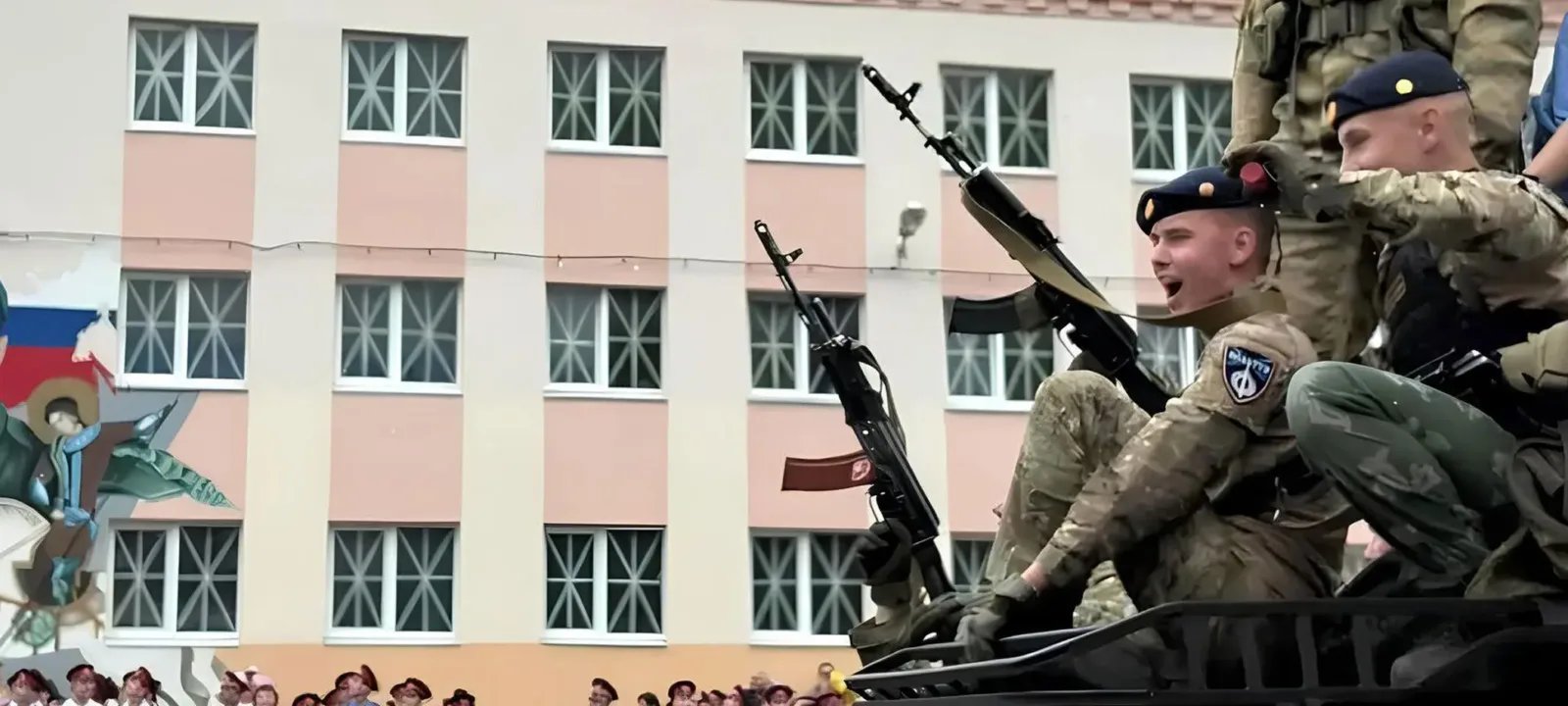
School No. 5, Mariupol. The school maintains a “Hall of Combat Glory—the ‘Eternally Living'” (Комната боевой славы «Вечно живые»), built around an exhibition titled “Mariupol in the Special Military Operation”: military equipment, grenade launchers, body armor, shell fragments, and a drone are made freely accessible to children, who are permitted to handle and try them on. The walls display portraits of Denis Pushilin’s predecessor Alexander Zakharchenko and of “Givi” and “Motorola”—commanders implicated in war crimes—presented to children as figures to emulate. Child tour guides at the exhibit wear the orange armband of the “Movement of the First.”
School No. 13, Melitopol. The school hosted a career-orientation visit by a representative of the Donetsk Higher Combined-Arms Command School, in uniform. Classroom displays read “Russia—My Horizons,” “Russia—a Country of Opportunity,” and “Glory to the Fatherland Through the Ages”, direct recruitment messaging aimed at Ukrainian schoolchildren for enrollment in a Russian military academy.
Kindergarten No. 17 “Teremok,” Henichesk. The kindergarten held an event titled “A Day in the Life of the Army” for its pre-school group, children aged five to six, including children posing in military uniform holding rifles, a hand-to-hand combat demonstration, and a visit to a shooting range. The event was attended by a member of the Federation Council, a colonel, and representatives of Rosgvardiya (Russia’s National Guard). This documents that militarization begins not in adolescence but in early childhood, before a child is capable of informed choice.
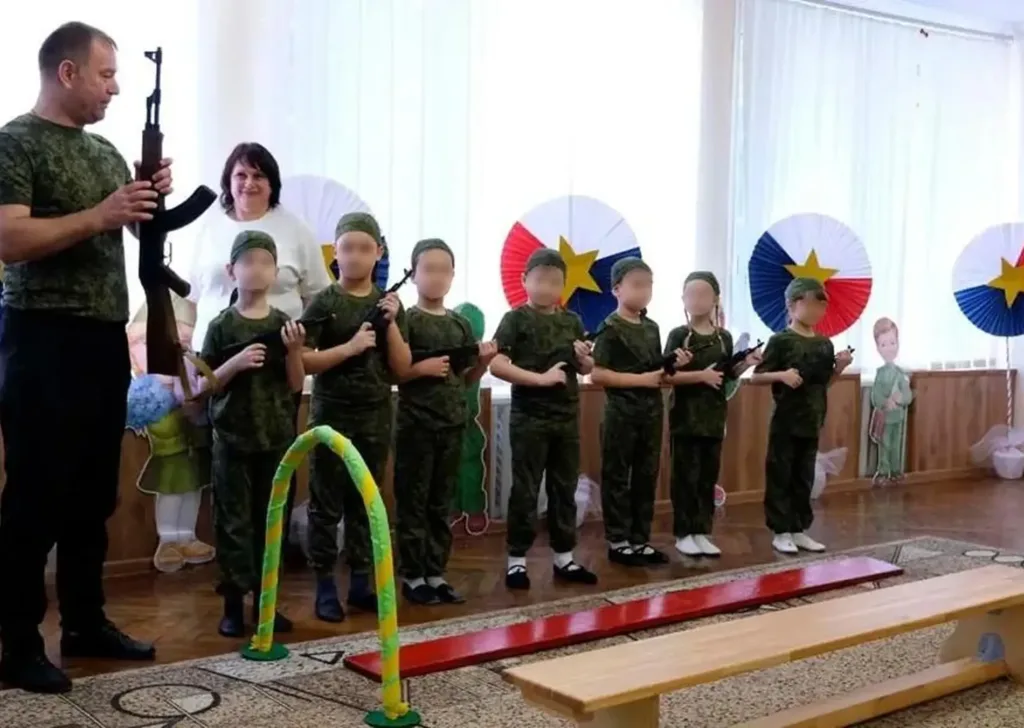
School No. 1, Melitopol. The school’s “Proud of My Motherland” event placed second-graders—seven- and eight-year-olds—in Russian military field caps, holding Russian flags. School administration described this publicly as evidence of the children’s “active civic position.”
B. State and Paramilitary Youth Organizations
Center “VOIN” (Warrior). A state paramilitary organization established in 2023 on the initiative of Yuri Trutnev and Sergei Kiriyenko, founded by the Russian Union of Martial Arts and Rospatriotcenter (a structure of Rosmolodezh, the federal youth agency); its founding and mandate are independently confirmed by Russian state and state-adjacent sources, including Rosmolodezh’s own reporting. Roughly three-quarters of its instructors are veterans of the invasion of Ukraine. Within two years, branches in occupied Donetsk, Luhansk, Zaporizhzhia, and Kherson had trained more than 10,000 cadets. Unlike Yunarmiya, which trains rank-and-file participants, independent assessments describe VOIN as cultivating a future military and political elite. The organization is building camps outside Berdiansk and in Mariupol; in March 2024 it announced the launch of experimental military training for fifth-graders.
Yunarmiya (“Youth Army”). A nationwide organization with more than 1.2 million participants and active expansion into occupied territory. Independent reporting places occupied-territory membership at roughly 147,000 in Donetsk, 100,000 in Luhansk, 41,000 in Zaporizhzhia, and 20,000 in Kherson; these figures originate with Russian-side and occupation-administration sources and should be treated as claimed rather than independently verified. The organization’s federal budget reportedly doubled to approximately RUB 1 billion (roughly USD 11 million) in 2025 and was budgeted at approximately RUB 1.25 billion (roughly USD 16 million) for 2026, funded through the state-run “Youth and Children” national project and direct Russian Ministry of Defence support; a further RUB 139 million (roughly USD 1.8 million) was reportedly allocated specifically for militarized-curriculum classroom equipment in occupied-territory schools. In February 2026, Ukraine’s Prosecutor General’s Office served notices of suspicion on eight individuals connected to Yunarmiya’s occupied-Donetsk branch, invoking Articles 28(3) and 438(1) of the Criminal Code of Ukraine (war crimes committed by an organized group), for militarizing Ukrainian children.
“Movement of the First” (Движение Первых). Russia’s state-run, all-national children’s and youth movement, established in 2022 and personally overseen at the federal level, functioning as the successor to the Soviet Pioneer and Komsomol organizations and serving, among other roles, as a disbursement channel for federal youth-militarization funding. Several centers reportedly affiliated with the organization—including the All-Russian Children’s Centres “Orlyonok” and “Smena” and the “Patriot” military-patriotic club in Crimea—were among the entities the European Union sanctioned in May 2026, though the EU’s press release names the centers themselves rather than “Movement of the First” as an organization (Section X.F). It has been mass-enrolled into schools across all four occupied oblasts.
“Zarnitsa 2.0.” A nationwide military-patriotic exercise involving weapons handling, marksmanship, mine-clearance drills, and armed tactical movement, documented as having been conducted in occupied Mariupol. A participant identified only as Sofia told the regional channel Mariupol 24 on April 16, 2026: “I want to go and fight from childhood… When you are a serviceman—first of all, it is a matter of pride.” That statement is direct evidence of the outcome of years of exposure to this programming.
The Warrior Center for Military and Patriotic Education, established by Russia’s Ministry of Defence in 2022, sends teenagers from all four occupied oblasts to residential camps such as the Avangard Defense and Sports Camp in Russia’s Volgograd oblast; Russia moved in 2025 to double the number of Yunarmiya centers specifically in occupied territory.
C. Specialized Military and Naval Educational Institutions
A network of military-oriented boarding institutions operates both inside occupied territory and inside Russia proper, feeding directly into Yunarmiya, VOIN, and eventual military service. Among the institutions documented in this report: the Naval Lyceum of occupied Mariupol, where Lev Kostiuk (Case 1) is enrolled as a cadet; the Shakhty Cossack Cadet Corps named for Ya. P. Baklanov in Rostov Oblast, from which Artem Kolohrymov (Case 8) graduated in June 2026; and other cadet corps across Russia’s southern regions that train Ukrainian children removed from occupied territory for eventual military service.
The VOIN “Warrior” Military-Sports Camp on the site of the former Ukrainian children’s recreation camp “Orlyonok” (Mariupol). Russia is constructing what is intended to be the largest VOIN military-sports facility on the site of a former Ukrainian children’s summer camp. The program covers eight tracks, including drone operation, weapons handling, tactical medicine, hand-to-hand combat, and field survival, staffed by instructors described as veterans of the invasion. The conversion of a children’s recreational facility into war-preparation infrastructure is emblematic of the broader pattern documented in this report.
D. Falsification of History Through Curriculum
Analysis of the eleventh-grade textbook “World History” (authored by Vladimir Medinsky and Alexander Chubaryan, 2023), used in occupied-territory schools, shows systematic indoctrination built into the curriculum itself. The section on international relations is structured to first cast the West as an aggressor—through the lens of Afghanistan, Iraq, Libya, Syria, and Yugoslavia—and then to fit Ukraine into that frame. The 2014 Maidan uprising is presented as “a bloody armed rebellion with direct Western support”; Ukrainian authorities are described as “Nazis”; the events in Odesa on May 2, 2014, and in Donbas are characterized as “genocide of the Russian-speaking population”; and the February 24, 2022 invasion is presented as a “special military operation to protect the residents of Donbas.” Maps in the textbook depict occupied Ukrainian territory as Russian as of October 2022.
V. Documented Individual Cases
The thirteen cases below were identified and documented by the Back to Ukraine initiative and are presented here in translation, with Free Russia Foundation’s added legal characterization drawn out fully in Section X. Every child or young adult named below appears in Ukraine’s state “Children of War” registry as missing or unaccounted for as of the most recent identification, unless otherwise noted.
Lev Ihorovych Kostiuk (16 y.o.)
Place of disappearance: Mariupol, Donetsk Oblast. Registry status: missing.
Lev Kostiuk is officially listed by Ukraine as missing. Monitoring of occupation media located him in a segment broadcast by the occupation channel Oplot TV under the headline “Strict Discipline and Cadet Uniforms Are Drawing More and More Mariupol Schoolchildren,” a recruitment piece for the Naval Lyceum of occupied Mariupol. Kostiuk appears on camera as a cadet, in naval uniform, in front of a Russian flag, identified on screen as “Lev Kostiuk. Cadet.” A child whom the Ukrainian state is actively searching for has been publicly used by a Russian propaganda broadcaster as the promotional face of a naval training institution. He was sixteen years old at the time of the broadcast.
Legal characterization: this conduct implicates Article 8 of the UN Convention on the Rights of the Child (the right to preserve identity) and the protections for children under the Fourth Geneva Convention.
Ivan Stanislavovych Kolka (21 y.o.)
Place of disappearance: Zelenivka, Kherson Oblast. Registry status: missing.
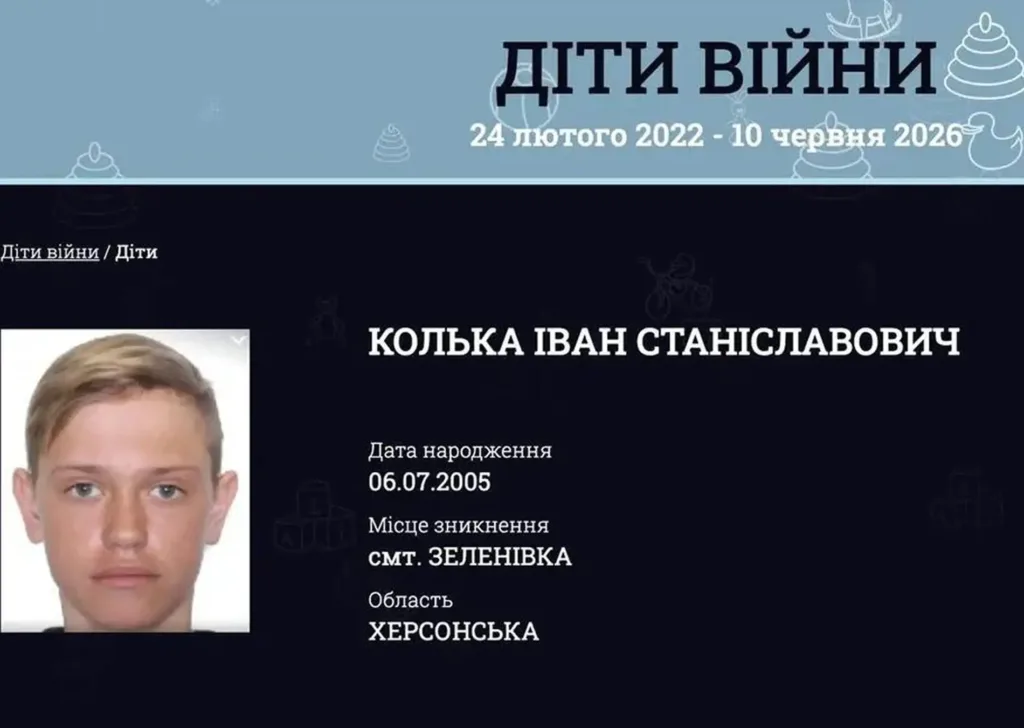
Identified through VKontakte by double verification: an earlier account was located whose stated date and place of birth matched the state registry, followed by a newer account using the same identifying data, which listed a current place of residence inside the Russian Federation.
On May 6, 2026, Kolka published a photograph of himself wearing a sweatshirt reading “Army of Russia.” He was twenty-one years old at the time. A child who disappeared from occupied Kherson Oblast reached adulthood under Russian control without returning to Ukraine, and now publicly displays affiliation with the armed forces of the state that removed him.
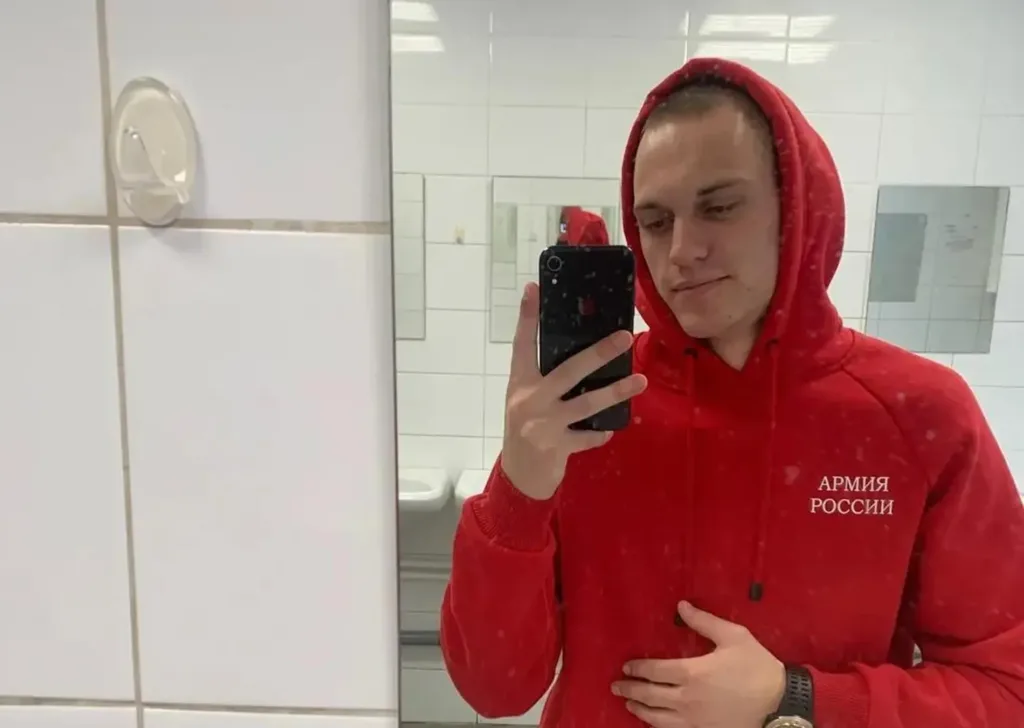
This case illustrates the report’s central thesis: between a child’s disappearance and his voluntary public display of Russian identity lie years of informational silence on Ukraine’s side and daily Russian influence on the child.
Pavlo Pavlovych Shyp (20 y.o.)
Place of disappearance: Vovchansk, Kharkiv Oblast. Registry status: missing (no photograph on file).
One of the clearest documented cases of the forced integration of an orphaned child into the Russian system. After the start of the full-scale invasion, Shyp was relocated to Prokhorovsky Municipal District, Belgorod Oblast. By August 2022, before turning sixteen, he was enrolled at the Dmitrievsky Agricultural College—confirmed by official enrollment order No. 272-O, dated August 15, 2022, on which Pavlo Shyp appears ninth on the list. The identification was confirmed through VKontakte.
The decisive fact: on December 20, 2024, the district administration’s website announced that Pavlo Shyp had been presented with the keys to a new home, provided by the state. This warrants emphasis for its systemic character: ordinary Russian orphans wait years in queues for housing, while children from occupied Ukrainian territory receive apartments out of turn and with public fanfare. This is not social welfare; it is an instrument for binding a child to the aggressor state through material dependency.
The institution where Pavlo studies conducts systematic military-patriotic training: students participate in “Zarnitsa 2.0” as part of the “PATRIOT DAK” detachment and in the “Student Spetsnaz” forum in Ryazan Oblast; the college’s official page carries recruitment advertising for service in the Russian Ministry of Defence’s unmanned-systems forces.
Legal characterization: this conduct shows indicia of forced assimilation and of creating conditions designed to sever a child’s connection to his state of origin—implicating Article 2(e) of the Genocide Convention (forcible transfer of children).
Artem Viktorovych Kiriushkin (21 y.o.)
Place of disappearance: Mariupol, Donetsk Oblast. Registry status: missing (no photograph on file).
This case is a uniquely valuable primary account of the mechanics of orphan deportation, set out by the child himself. Kiriushkin was identified through the page of the Lukhovitsy Agro-Industrial College (Moscow Oblast), where he won a regional journalism competition with an essay titled “Wheel of Fortune: A Journey from the DPR to the Town of Lukhovitsy,” honored with a certificate from the Moscow Oblast Union of Journalists.
The essay establishes the following sequence: early orphanhood (his mother died when he was a child; he was raised by his great-grandmother), the great-grandmother’s death, placement in a children’s shelter, and transfer to a foster family. At the start of the occupation, according to the text, “heavy shelling began, and the parents decided to leave us.” What followed was relocation “accompanied by the Russian army” (“I learned courage from the soldiers”), evacuation by plane to Russia in the summer of 2022, a foster family in Lukhovitsy, a state-provided furnished apartment, full state support, a case officer, a foster-care mentor, and—as the culminating act of integration—participation in the Russian presidential election.
A critical circumstance requiring international investigation: the phrase “the parents decided to leave us” may conceal a fundamentally different reality. Amid the intense shelling of Mariupol in the spring of 2022, the foster parents may have been killed, failed to pass filtration, been placed in filtration camps, or been forcibly separated from the child. A child who lived through this at sixteen or seventeen may have received an imposed version of events. The difference between “the parents abandoned the child” and “the occupying authority separated the child from parents who were killed or detained” is the difference between a family tragedy and a documented war crime. A related question requiring separate investigation is whether the Russian side made any attempt to notify the Ukrainian side about an orphaned child from occupied territory, as required by international humanitarian law, or whether the child was absorbed into the Russian system without oversight.
Kseniia Serhiivna Khachai (17 y.o.)
Place of disappearance: Mariupol, Donetsk Oblast. Registry status: missing.
Identified through the official VKontakte page of Priazovskyi State Technical University (renamed by occupation authorities as A.I. Kuindzhi Mariupol State University), occupied Mariupol. Khachai is a first-year student in the pedagogy faculty, specializing in primary education. On June 7, 2026, she received the first-degree diploma at the VI International Pedagogy Competition “The Art of Teaching,” representing the Russian institution.
This case demonstrates the self-reproducing mechanism of the russification system: a child listed as missing is training to become a primary-school teacher at a Russian institution on occupied territory. Once she completes her studies, Khachai may become a teacher herself—a direct instrument for shaping the worldview of the next generation of Ukrainian children inside the Russian education system. Today’s victim of the system becomes tomorrow’s link in its reproduction.
Volodymyr Andriiovych Levchenko (20 y.o.)
Place of disappearance: Kherson Oblast. Registry status: missing.
Identified through VKontakte. He is now an adult (twenty years old). A collected set of photographs documents a deep degree of integration into the Russian military and ideological environment: photographs in Russian army uniform bearing a tricolor chevron; a photograph in front of the Russian state flag in Yekaterinburg; accessories bearing the “V” symbol used to mark support for the invasion of Ukraine; the occupation administration’s coat of arms on his phone case; and a friendship with Anton Konoplianko, a former resident of Henichesk now serving in the Russian armed forces.
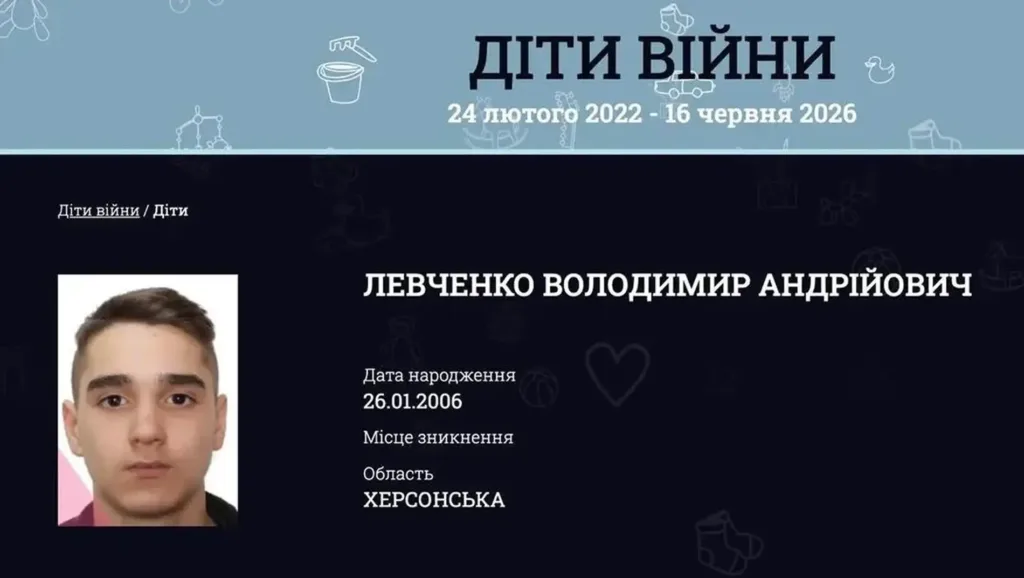
In October 2024, he took part in the congress of the All-Russian public organization “Fellowship of Orphanage Graduates—Children of the Whole Country,” indicating his status as an orphan and, correspondingly, his heightened vulnerability to a system of attachment built on state provision.
This case raises a question critical for the post-occupation period: what is the reintegration strategy for young people who spent their key formative years—sixteen to twenty—inside the Russian environment and who now voluntarily display the symbols of the aggressor state.
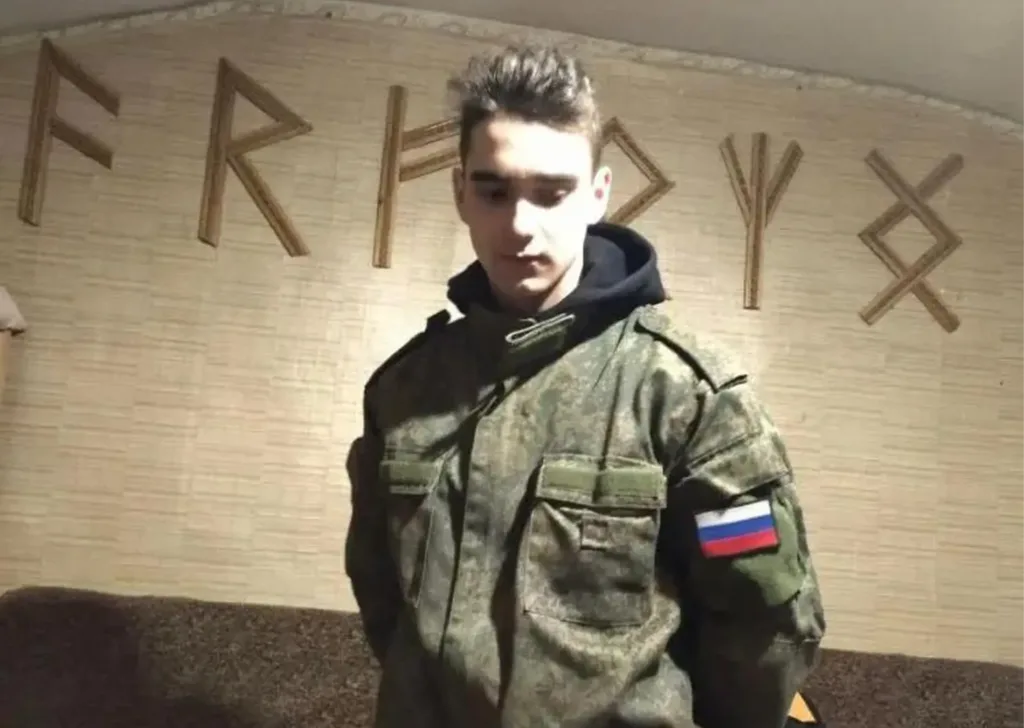
Serhii Leonidovych Chenhal (17 y.o.)
Place of disappearance: Donetsk Oblast. Registry status: missing (no photograph on file).
Identified through VKontakte. On December 26, 2024, he independently published a photograph of himself against the black-yellow-white Russian imperial flag with the caption “We are Russian, God is with us.” He was sixteen at the time of publication.
This case illustrates the speed and depth of ideological processing: a minor from occupied territory publicly identifies himself through imperial-nationalist Russian symbolism.
Artem Oleksiiovych Kolohrymov (15 y.o.)
Place of disappearance: Luhanske, Donetsk Oblast. Registry status: missing (no photograph on file).
Identified through open sources. He attended School No. 3 in Novoshakhtinsk before enrolling in the Shakhty Cossack Cadet Corps named for Ya. P. Baklanov (Rostov Oblast), which he completed in June 2026 (graduation banner: “Kolohrymov Artem. Graduate of 2026. ShKKK”).
During his studies he received training in marksmanship, camouflage, drone operation, and tactical medicine. He is an active participant in the “Movement of the First” and won a competition marking the 210th anniversary of the Russian capture of Paris.
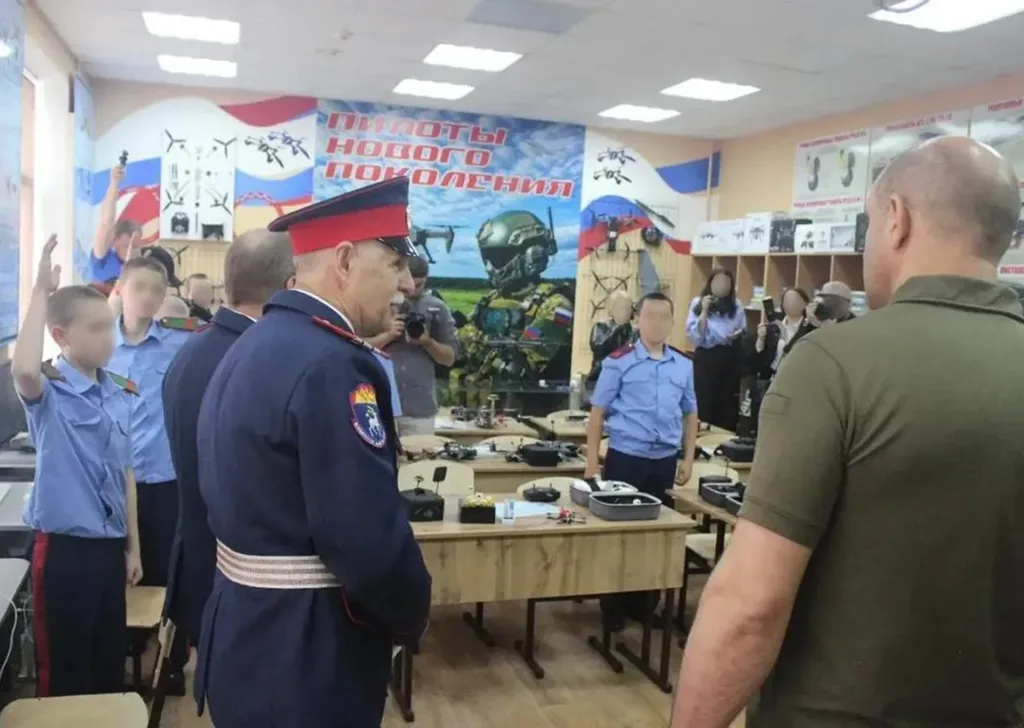
The corps environment is documented in detail: a drone classroom containing dozens of combat drones and FPV systems under the slogan “Pilots of the New Generation”; a classroom named for a drone operator killed in action; portraits of fallen graduates on the walls; demonstration performances on jeeps with automatic weapons and smoke grenades; and religious, Cossack, and special-forces symbolism throughout. The ideological center of the environment is an inscription on the school orchestra’s drum: “Should mortals fear death?” War is presented not as tragedy but as romantic calling and the highest expression of manhood.
His subscriptions include the Wagner Group, “Slavic Warriors,” and FSB and GRU special-forces communities.
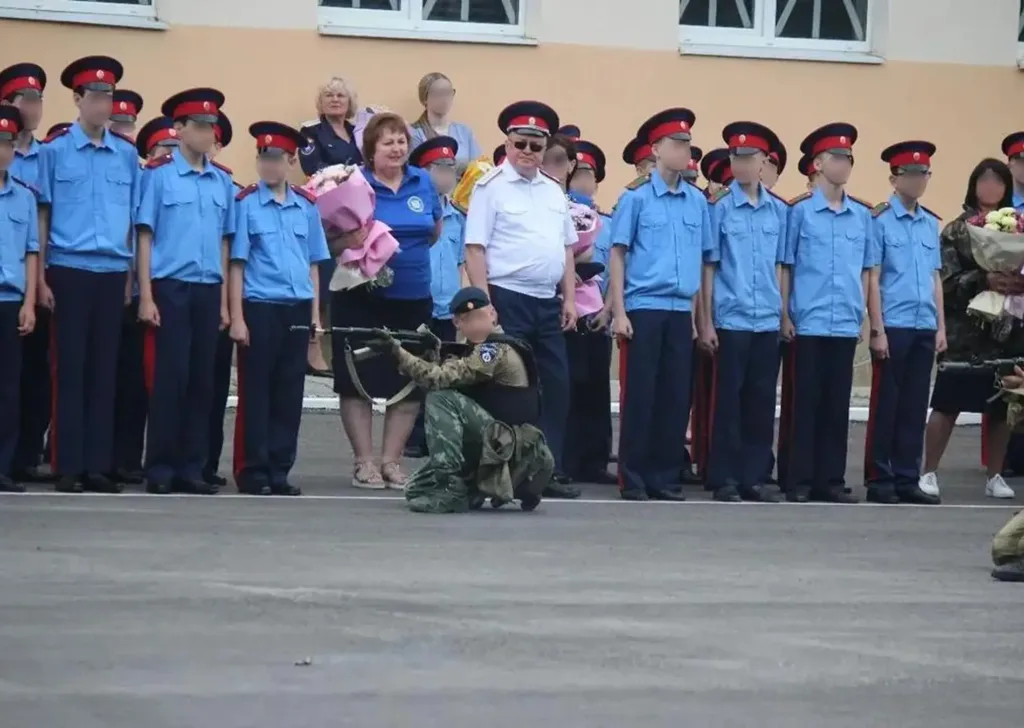
In the assessment of Back to Ukraine, this case represents a profound and likely irreversible loss: a child born on Ukrainian soil, fully formed by age fifteen as a future serviceman of the aggressor state’s armed forces, in an atmosphere that romanticizes war and death.
Ivan Oleksandrovych Bastriukov (18 y.o.)
Place of disappearance: Kupiansk, Kharkiv Oblast. Registry status: missing.
One of the most fully documented cases of a child completing the entire cycle of militarization, with evidence published in the open by the educational institution itself. Identified through the official page of Borchanskaya Secondary School, Valuysky District, Belgorod Oblast. The institution’s own sequential publications document the chronology: a July 2024 post noting that student Bastriukov was attending, for the second consecutive term, the “Armata” military-historical camp, with a photograph in front of the letter “A” rendered in the colors of the Russian tricolor. A further publication documented his participation in the “patriotic program” of the Preobrazhensky Defense and Sports Center of the Airborne Spetsnaz Fund (rock climbing, knot-tying, forced marches), with a group photograph in front of the main cathedral of the Russian Armed Forces at Kubinka, captioned “Time of Heroes” and a wish that the boy “become part of the great history of Russian special forces.” The same account lists Ivan as a member of the young-naturalists’ club of the “Movement of the First.”
This case’s central significance is that it demonstrates the unity of the system: a children’s naturalist club and special-forces military-patriotic training camps are not two separate worlds but a single mechanism, operating at different levels simultaneously, with shared structures, mentors, and direction. This year, Ivan completed the eleventh grade. A child removed from Kupiansk has passed through the entire cycle—from the school desk and the “Movement of the First” to special-forces training camps—and now stands at the threshold of conscription age in the country that took him from his home.
Oleksandr Yuriiovych Mustiatse (approx. 19 y.o.)
Place of disappearance: Krynky, Kherson Oblast (a village entirely destroyed in the course of hostilities). Registry status: missing.
This case is the first reliably established instance of direct participation by a child from the “Children of War” registry in combat operations against Ukraine as part of the aggressor state’s armed forces. It has since been independently reported by Ukrainian outlets including NV, Euromaidan Press, ZAXID.NET, Ukrainska Pravda’s life.pravda.com.ua, and by the Russian outlets Meduza and The Insider, confirming the case documented by Back to Ukraine.
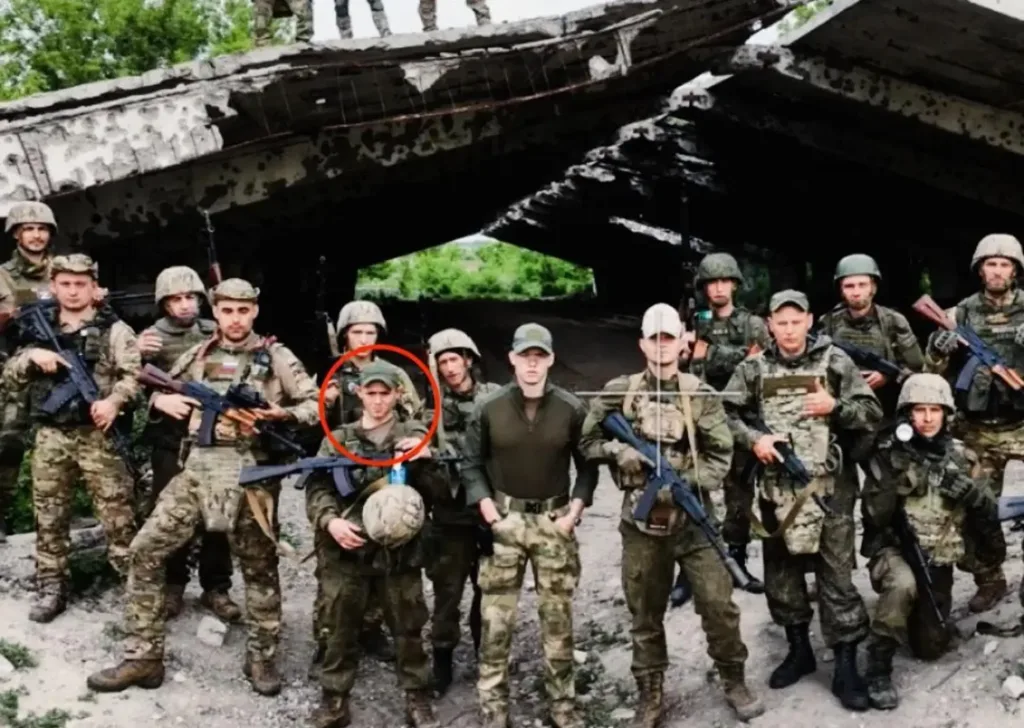
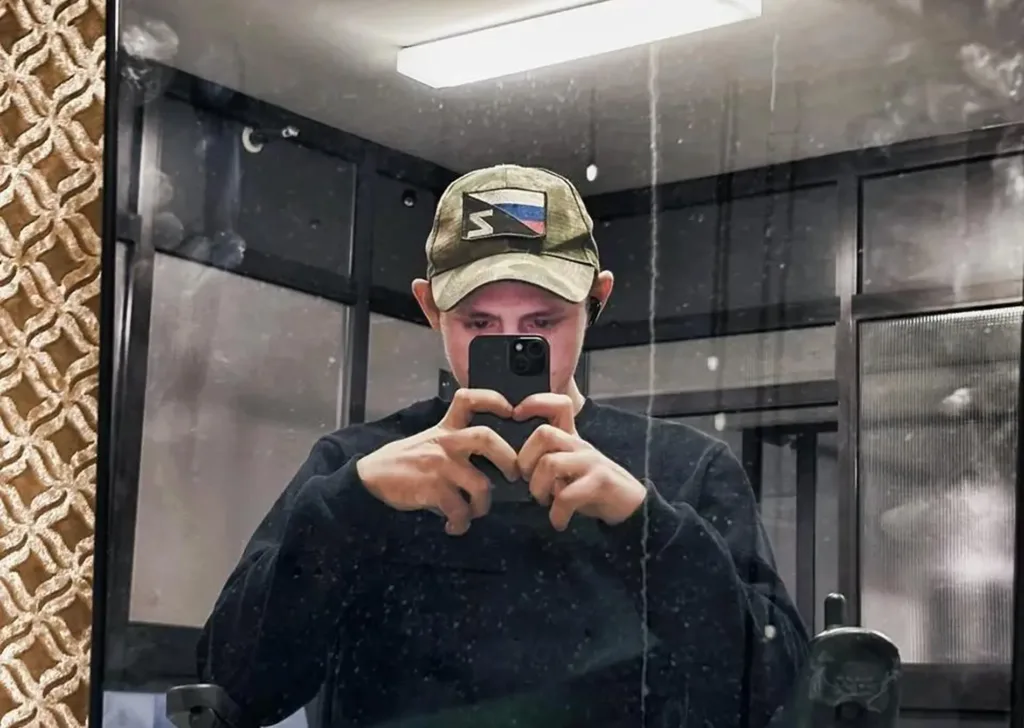
The chain of identification, as documented by Back to Ukraine:
- Stage 1—initial identification. Mustiatse is listed in Ukraine’s “Children of War” registry as missing from Krynky, Kherson Oblast. Monitoring of VKontakte located an account which, beginning in early 2025, began publishing photographs of him in Russian military uniform and a cap bearing the “Z” symbol. The stated date and place of birth matched the state registry, and the pictured individual showed a high degree of resemblance to the registered child, accounting for age progression.
- Stage 2—confirmation of combat participation. To confirm his participation in hostilities against Ukraine, Back to Ukraine contacted a fellow serviceman from his unit, who confirmed that Oleksandr had taken part in assaults on Ukrainian defensive positions, was wounded, and was treated at the N.N. Burdenko military hospital in Moscow—subsequently corroborated by photographs of Oleksandr in a hospital ward against a backdrop of “Z” symbolism.
- Stage 3—locating a current account. His original VKontakte account went inactive after his wound was confirmed. To establish his current whereabouts, Back to Ukraine analyzed the social circle of his wife, including her VKontakte friends list, and located an account registered under the name “Alexander Famenok,” with an avatar showing a serviceman in camouflage and a balaclava. Comparison of anthropometric features—the shape of the eyebrows, the eye shape, and the brow ridge—with previously collected photographs indicated a high probability that this was the same individual.
- Stage 4—direct contact. To confirm the identification and obtain comment, Back to Ukraine messaged the “Alexander Famenok” account directly, asking about the motivation for fighting on Russia’s side against Ukraine. The reply confirmed the identification. Asked his motivation, he wrote only: “I’ve always been for my own side. Russia has always been in my heart.” Subsequent attempts to obtain further comment or establish his actual motivation were unsuccessful; he stopped responding.
International resonance: Back to Ukraine’s publication of the Mustiatse case drew significant international attention, prompting renewed public discussion of the militarization and russification of children on occupied territory, their involvement in the war against Ukraine, and international accountability mechanisms; the case was independently reported across Ukrainian, Russian, and international outlets.
Response from Russian state media: Russian state outlets, propagandists, and military correspondents were compelled to respond and attempted to reframe the case as Oleksandr’s free and independent decision to join the Russian armed forces, absent any informational pressure, propaganda, or other outside influence. Back to Ukraine characterizes this framing as knowingly false and manipulative: it disregards the documented circumstances (years spent by the child inside the Russian occupation education and propaganda system, and the absence of free access to alternative information) and does not relieve the Russian Federation of responsibility for violating Article 51 of the Fourth Geneva Convention, which expressly prohibits an occupying power from compelling protected persons to serve in its armed or auxiliary forces, and separately prohibits any pressure or propaganda aimed at securing voluntary enlistment.
Valentyn Mustiatse (15 y.o.)
Brother of Oleksandr Mustiatse (Case 10). Status: under preliminary guardianship in the Russian Federation. Ukrainian media reporting on the family confirms that a younger brother of Oleksandr Mustiatse was separately identified among Yunarmiya participants.
Identified as a participant in the All-Russian military-patriotic exercise “Zarnitsa 2.0,” on a team called “Radar-12,” based at School No. 12 named for Hryhorii Antonovych Loiko (Stanytsia Novomyshastovska, Krasnodar Krai), where Valentyn played the role of combat engineer. Identification was made through anthropometric comparison given the limited quality of the available photographs and his assigned role in the competition.
On September 1, 2023, he was formally inducted into Yunarmiya—the school’s corresponding publication is captioned “The young army members solemnly swore their oath for the good of the Motherland.”
The school’s official page documents systematic, continuous military-patriotic activity: “lessons in courage” with combat veterans; a school museum with an exhibit on the war against Ukraine, accessible to first- and second-grade students; collection of humanitarian aid for Russian servicemen, presented as “part of school life”; and military-patriotic training camps at the “Patriot” center that introduce children to specialized military universities and to institutions of Russia’s Federal Security Service.
It has been established that all three Mustiatse brothers—Oleksandr, Valentyn, and Yaroslav—are under the preliminary guardianship of a person identified in municipal records as Anna Ivanivna Nazarova, indicating that the parents have either been deprived of parental rights or have died. A matter requiring separate verification is that a person of the same full name holds the position of head of the Social Welfare Department of the Pervomaisky District of Rostov-on-Don—an office whose competence includes adoption and guardianship matters.
In Back to Ukraine’s assessment, the case of Valentyn Mustiatse directly rebuts Russian propaganda’s claim of his older brother’s “free choice”: the younger brother follows an identical path of ideological and military-patriotic preparation, in the custody of the aggressor state, without any real alternative.
Hryhorii, Serhii, and Vadym Chymbur (19, 19, and 21 y.o., respectively)
Hryhorii Serhiiovych Chymbur, Serhii Serhiiovych Chymbur, and Vadym Serhiiovych Chymbur. Place of disappearance: Bilolutsk, Luhansk Oblast. Registry status: missing.
Hryhorii Chymbur has been identified as a serviceman of the Russian armed forces: a photograph taken in Moscow shows him in military uniform with a nametape reading “Chymbur H.S.” and an “Armed Forces of Russia” chevron, alongside his brothers. No evidence has been found to date of his direct participation in combat against Ukraine, but he has been identified as serving in Russian military intelligence attached to the Ministry of Defence.
Serhii Chymbur is documented wearing clothing bearing a “Z” insignia and a cap depicting the Russian imperial flag.
Vadym Chymbur’s affiliation with the Russian armed forces or other military formations could not be established; he appears alongside his brothers in a joint photograph apparently taken on the occasion of Hryhorii’s departure for, or return from, service.
It has been established that the brothers’ father has fought for the Russian armed forces since the start of the full-scale invasion and currently works as a security guard. Serhii completed a college in Shchyolkovo, Moscow Oblast, whose program includes marksmanship, tactical medicine, chemical defense, and drill training.
Vladyslav Mazurov (approx. 19 y.o.)
Registry status: missing.
Identified by the Back to Ukraine team as a serviceman of the Russian Federation armed forces, in military uniform bearing a “Ministry of Defence of the Russian Federation” chevron. Identification was conducted through OSINT analysis.
VI. The Role of Collaborators
A critical element of the system is the participation of individuals who voluntarily sided with the occupation authorities and personally carry out the ideological processing of children. Their particular danger lies in the fact that they operate from inside the local community, know the children and families involved, and hold their trust.
Svitlana Mykolaivna Kharytonenko (born November 3, 1970)—head, since November 2023, of the “Movement of the First” staff in Mariupol. A Ukrainian citizen who voluntarily sided with the occupiers, she personally organizes military-patriotic events for children, including “Zarnitsa 2.0.” In video material she notes with evident approval that the most popular station among the children is marksmanship. Her conduct falls within the provisions of the Criminal Code of Ukraine addressing state treason, infringement on territorial integrity, and voluntary assumption of a post within occupation structures.
Iryna Anatoliivna Honcharova—primary-school teacher and pedagogical methodologist at School No. 1, Melitopol. Organizer of the event placing second-grade children in military field caps holding Russian flags (Section IV.A).
A separate category consists of former servicemen of the Armed Forces of Ukraine who defected to Russia (the unit named for Maksym Kryvonis), whom Center VOIN brings in for meetings with Mariupol schoolchildren as “moral authorities”—intended to lower the psychological barrier to defection.
VII. Participation of International Sports Figures
This report documents the deliberate use of world-class athletes to lend legitimacy and appeal to the system of militarizing Ukrainian children.
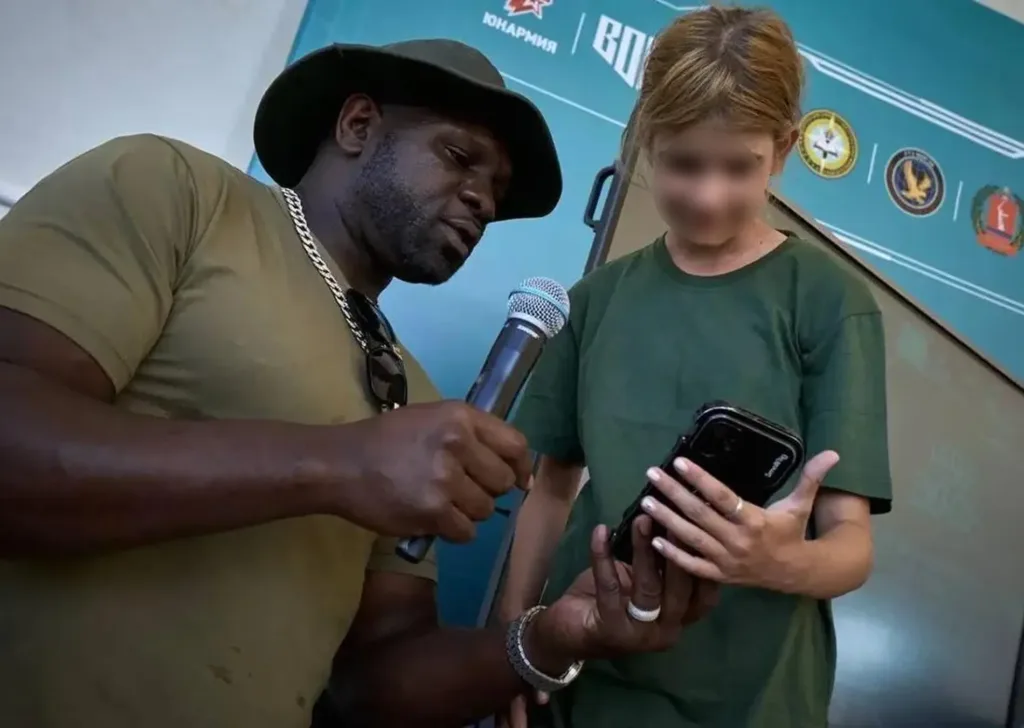
During the first inter-regional session of Center VOIN’s “Time of Young Heroes” program in Volgograd—which brought together 900 teenagers aged fourteen to seventeen from Donetsk, Luhansk, Zaporizhzhia, and Kherson oblasts—training sessions and “patriotic talks” for the Ukrainian children were conducted by:
- Kevin Johnson—a former American heavyweight boxer. In August 2023 he publicly changed his name to “Kevin Vladimirovich” in honor of Vladimir Putin, declaring “Now I am 100 percent Russian.” In January 2024 he was granted Russian citizenship by a decree signed by Putin, a fact independently confirmed by The Moscow Times, France 24, and other international outlets. He is a U.S. citizen who has voluntarily placed his public profile at the service of the ideological processing of Ukrainian children in the interests of the aggressor state.
- Alexander Povetkin—2004 Olympic boxing champion.
- Sergei Kharitonov—an active mixed martial arts competitor.
According to Russian government claims, roughly 4,500 teenagers from occupied Ukrainian territory will pass through the Volgograd camp over the summer of 2026. The prestige of world-class athletes functions as a tool of emotional attachment: a meeting with a champion stays with a child permanently—together with the entire ideological content of the event surrounding it.
VIII. Formation of Pro-Russian Influencers From Ukrainian Youth
Parallel to direct military mobilization, the Russian side runs a program that trains young influencers and propagandists from among Ukrainian youth on occupied territory—chiefly through a network of “blogger schools,” in particular the “Donbas Media Center” in Mariupol, funded in part through Russian presidential grants and integrated into structures such as the “New Media Workshop,” the “Top Blog” competition of the “Russia—Land of Opportunity” program, and the Rutube platform (Gazprom-Media) in partnership with the Russian Military-Historical Society.
Sofiia Krulikovska, born 2006, a native of Mariupol. Before the full-scale invasion she openly held a pro-Ukrainian position, including participation in pro-Ukrainian flash mobs. On March 5, 2022, her father was killed in a cluster-munition strike during Russian shelling of Mariupol. Her mother, Tamara Krulikovska, had before the invasion served as a deputy in the Vynogradne village council across the 4th, 5th, and 6th convocations for the “Opposition Platform—For Life” faction and simultaneously as village head; after the occupation she retained that position and, according to Petro Andriushchenko, voluntarily sided with the occupation authorities, reportedly assisting so-called “cleansing” operations in the village.
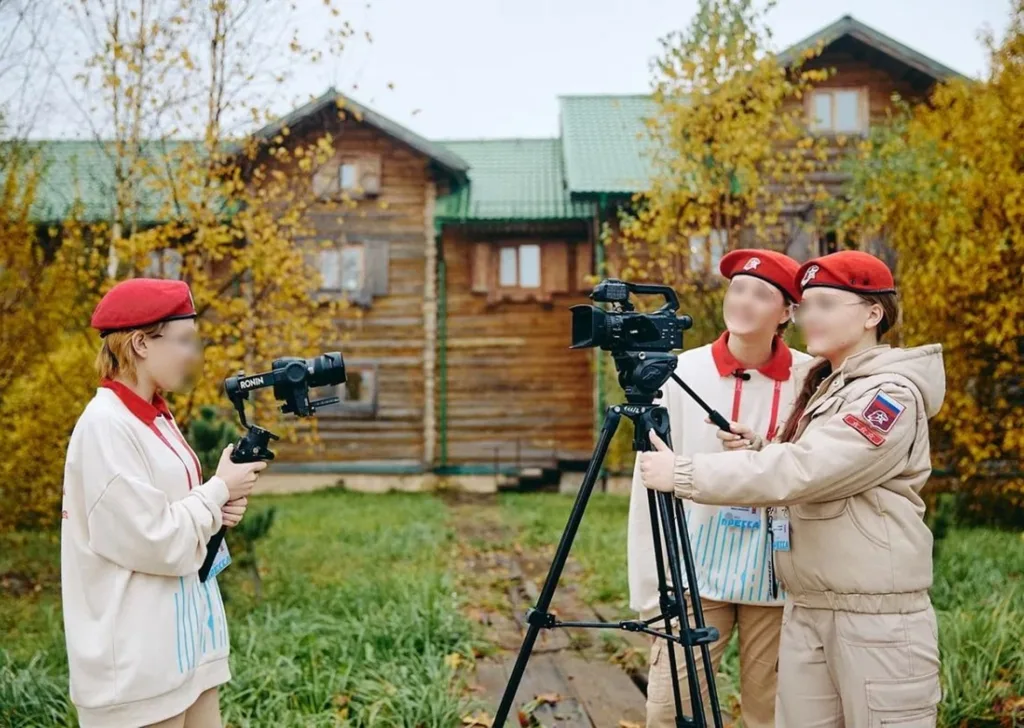
In 2024, Sofiia trained at the Donbas Media Center’s “blogger school,” after which she was sent to Moscow to the offices of VKontakte for a meeting with leading Russian bloggers. She was subsequently integrated into a network of state youth and media structures: a participant in the interregional festival “New Media—the Trend of Youth” (under the “Region for the Young” program and the national project “Youth and Children”), the Donbas Youth Forum, and the paramilitary organization “People’s Militia” (“patriotic education of youth” across what the organization terms the “territory of the Russian Federation’s historical regions”). She is credited as a staff correspondent for the channel Mariupol 24.
After completing the “blogger school,” the content of her publications changed: avoiding direct mention of the war and the occupation, she has focused instead on the theme of Mariupol’s “reconstruction” and new development, without reference to the causes of the city’s destruction.
Reach: Back to Ukraine’s material on the Krulikovska case, published on Threads, was read by more than 605,000 users—evidence of substantial public interest in the formation of pro-Russian influencers from occupied-territory Ukrainian youth.
The Krulikovska case illustrates a mechanism running parallel to direct military mobilization: media indoctrination that produces influencers who legitimize the occupation in the eyes of their peers and who, in Back to Ukraine’s assessment, are potentially capable of encouraging Ukrainian youth on occupied territory to support the war against Ukraine.
IX. Patterns and Long-Term Consequences
Analysis of the cases as a whole reveals a consistent pattern of identity replacement, comprising:
- Documentary replacement—new identity documents and citizenship, frequently issued on an accelerated and publicly showcased basis.
- Educational processing—instruction in Russian under falsified curricula, and military-patriotic upbringing beginning in early childhood.
- Material attachment—provision of housing, stipends, and full state support to orphans, delivered out of turn and with deliberate publicity.
- Social integration—a new foster family, case officers, foster-care mentors, and a new social circle.
- Rewriting of family history—imposing on the child a narrative that the parents “abandoned” him or her.
Particular vulnerability of orphaned children. The cases of Kiriushkin, Shyp, and Levchenko demonstrate that children without surviving guardians in Ukraine are a priority target of the system—they are the easiest to bind to the aggressor state through housing and provision. This is consistent with the openly stated objective of destroying the Ukrainian nation through the assimilation of its children.
The first outcomes of this process are already visible: young people from the “Children of War” registry publicly display Russian identity, study at Russian military and pedagogical institutions, and complete the full cycle of cadet training. The tragic endpoint of this process is illustrated by the case of Myroslav Sharudylov, a native of occupied Crimea who grew up inside the Russian system and was killed in 2024 while fighting against Ukraine as part of Russian forces. His portrait now hangs on memorial boards at two educational institutions, presented as an example for the next generation to follow.
X. International Legal Framework and Application
This section sets out the international legal frameworks implicated by the conduct documented in Sections IV through IX, summarizes the accountability action already taken by international bodies, and applies those frameworks to the specific documented cases and institutional mechanisms.
A. The Genocide Convention
Article II of the 1948 Convention on the Prevention and Punishment of the Crime of Genocide defines genocide as any of five enumerated acts “committed with intent to destroy, in whole or in part, a national, ethnical, racial or religious group, as such,” including, at Article II(e), “forcibly transferring children of the group to another group.” The inclusion of child transfer as a standalone genocidal act reflects the drafters’ recognition that a group can be destroyed through the loss of its next generation even without physical killing.
A growing body of peer-reviewed international-law scholarship—including analyses published in the Journal of Genocide Research (2023), the International Journal of Children’s Rights (2024), and the Polish Review of International and European Law (2025), together with a December 2025 legal analysis by the Public International Law & Policy Group—converges on the conclusion that Russia’s forcible transfer of Ukrainian children satisfies the prima facie elements of Article II(e), as a matter distinct from, and additional to, the war-crimes framing underlying the existing ICC arrest warrants. The cases in Section V provide granular, individual-level evidence supporting that conclusion: each documents a child removed from Ukrainian-controlled or contested territory, absorbed into Russian civil, educational, and in some instances military institutions, and—in several cases—never returned.
The Genocide Convention’s intent requirement is the central contested element in any prosecution, and this report does not purport to resolve it. It does, however, document conduct directly probative of intent: the systematic and public character of the program (Section IV); the extension of that program specifically to orphaned and unaccompanied children, who are the easiest to permanently absorb (Section IX); the state-level citizenship and adoption decrees of May 30, 2022 and January 4, 2024; and the falsification of curriculum content (Section IV.D) designed to displace Ukrainian national identity specifically, rather than merely to educate children under wartime conditions. Ukraine’s Human Rights Commissioner, Dmytro Lubinets, has characterized the January 2024 decree as designed to ensure that, in his words, adoption and “the change of their personal data” follow quickly once a child receives Russian citizenship, warning that “not a single Ukrainian child will remain” without it.
B. The Fourth Geneva Convention
The Fourth Geneva Convention (1949), governing the protection of civilians in time of war, applies to occupied Donetsk, Luhansk, Kherson, and Zaporizhzhia as a matter of settled international consensus regardless of Russia’s purported annexation of these territories, which has not been recognized by the United Nations General Assembly or any credible international body. Several of its provisions are directly implicated by the conduct documented in this report:
- Article 49 prohibits individual or mass forcible transfers, as well as deportations of protected persons from occupied territory to the territory of the Occupying Power or to that of any other country, occupied or not, regardless of motive. This is the core prohibition implicated by every case in Section V.
- Article 50 requires the Occupying Power, with the cooperation of national and local authorities, to facilitate the proper working of institutions devoted to the care and education of children, prohibits changing children’s personal status, and prohibits enlisting children in formations or organizations subordinate to the Occupying Power. It does not authorize adoption by the Occupying Power and requires that arrangements for orphaned children be made, where possible, by persons of their own nationality, language, and religion. The May 2022 and January 2024 citizenship and adoption decrees, and the placement of orphaned children such as Pavlo Shyp, Artem Kiriushkin, and Volodymyr Levchenko with Russian foster families and guardians (Section V, Cases 3, 4, and 6), squarely implicate this provision.
- Article 51 provides that “the Occupying Power may not compel protected persons to serve in its armed or auxiliary forces,” and further that “no pressure or propaganda which aims at securing voluntary enlistment is permitted.” This provision is directly implicated by the systemic infrastructure documented in Section IV—the school curricula, the state youth organizations, the cadet corps, and the camps, all of which function as a propaganda and pressure apparatus aimed precisely at securing what is publicly characterized as “voluntary” enlistment—and by the case of Oleksandr Mustiatse (Case 10), whose eventual service in the Russian armed forces followed years of exactly this kind of exposure during his minority.
- Articles 33 and 53 prohibit collective penalties and reprisals against protected persons and their property, and prohibit destruction of property not justified by military necessity. These provisions govern the treatment of the children’s homes and communities in occupied territory itself; this report does not document, on a case-by-case basis, the fate of individual children’s family property, and the material-attachment mechanism analyzed below (state-provided Russian housing, conditioned on citizenship) is a distinct fact pattern addressed under Article 50 rather than Articles 33 or 53.
C. The Rome Statute of the International Criminal Court
Article 8(2)(a)(vii) of the Rome Statute criminalizes “unlawful deportation or transfer” of protected persons as a grave breach of the Geneva Conventions constituting a war crime; Article 8(2)(b)(viii) separately criminalizes “the deportation or transfer of all or parts of the population of the occupied territory within or outside this territory” by an Occupying Power. These are the provisions underlying the International Criminal Court’s March 2023 arrest warrants against Vladimir Putin and Maria Lvova-Belova (Section X.F). Article 7 of the Rome Statute separately defines “deportation or forcible transfer of population” (Article 7(1)(d)) and “enforced disappearance of persons” (Article 7(1)(i)) as crimes against humanity when committed as part of a widespread or systematic attack directed against a civilian population—the characterization adopted by the UN Independent International Commission of Inquiry in March 2026 (Section X.F).
Article 8(2)(b)(xxvi) separately criminalizes, in international armed conflict, “conscripting or enlisting children under the age of fifteen years into the national armed forces or using them to participate actively in hostilities.” On the record documented in this report, the clearest evidence of eventual combat participation—the case of Oleksandr Mustiatse—appears to involve enlistment and deployment at or near the age of majority rather than under fifteen, and this report does not assert that Article 8(2)(b)(xxvi) is directly satisfied on the facts currently available. What the record does establish is that the propaganda, training, and institutional pressure that produced that outcome began years earlier, while Mustiatse and children in comparable cases (Cases 8, 9, and 11) were well under eighteen—which is the age threshold, rather than fifteen, under the separate framework addressed immediately below.
D. The UN Convention on the Rights of the Child and the Optional Protocol on Children in Armed Conflict
Article 8 of the Convention on the Rights of the Child obliges states to respect the right of the child to preserve his or her identity, including nationality, name, and family relations. Article 29 requires that education be directed to the development of respect for the child’s own cultural identity, language, and values—a standard squarely violated by the curriculum documented in Section IV.D. Article 38 requires states to take all feasible measures to ensure that persons under fifteen do not take a direct part in hostilities, and the Optional Protocol on the Involvement of Children in Armed Conflict (OPAC), to which both Ukraine and the Russian Federation are parties, raises that threshold: Article 1 requires states parties to take all feasible measures to ensure that members of their armed forces under the age of eighteen do not take a direct part in hostilities. The weapons-handling and drone-operation components of the cadet-corps training documented in Case 8, and the broader Yunarmiya and Zarnitsa 2.0 curricula documented in Section IV.B, engage this standard directly, independent of whether any individual child is later deployed into combat.
E. The 1907 Hague Regulations
Articles 46 and 47 of the Regulations annexed to the 1907 Hague Convention (IV) require that private property be respected and exempt it from confiscation, and formally prohibit pillage. These provisions, read together with Fourth Geneva Convention Articles 33 and 53, govern the seizure or destruction of Ukrainian property in occupied territory—a related but analytically separate question from the state-provided Russian housing analyzed in this report as a mechanism of identity replacement (Section X.G). The property question is treated at greater length in Free Russia Foundation’s parallel workstream on property seizure in occupied territory; this report does not extend that analysis to the specific cases in Section V.
F. Accountability Mechanisms to Date
On March 17, 2023, Pre-Trial Chamber II of the International Criminal Court issued arrest warrants for Vladimir Putin, President of the Russian Federation, and Maria Alekseyevna Lvova-Belova, Russia’s Commissioner for Children’s Rights, on grounds including the war crime of unlawful deportation and transfer of population (children) from occupied areas of Ukraine to the Russian Federation, under Rome Statute Articles 8(2)(a)(vii) and 8(2)(b)(viii). The warrants remain outstanding.
In March 2026, the UN Independent International Commission of Inquiry on Ukraine concluded, following its own investigation, that the deportation and forcible transfer of Ukrainian children by Russian authorities, together with related enforced disappearances, amount to crimes against humanity—a formal, deliberative finding by the UN’s own investigative body squarely consistent with the pattern documented in this report.
On May 11, 2026, the Council of the European Union adopted sanctions against sixteen individuals and seven entities specifically for their role in the deportation, forced assimilation, indoctrination, and militarized education of Ukrainian minors, including camp directors, “Movement of the First”-linked federal centers, and specialized military-training institutions. This is the first EU sanctions action addressed specifically and exclusively to this conduct.
In February 2026, Ukraine’s Prosecutor General’s Office issued notices of suspicion to eight individuals connected to Yunarmiya’s occupied-Donetsk branch, invoking Articles 28(3) and 438(1) of the Criminal Code of Ukraine (war crimes committed by an organized group)—the first domestic Ukrainian criminal proceedings addressed specifically to the militarization infrastructure documented in Section IV.B of this report. Genocide charges under Article 442 have not, as of this writing, been brought in connection with this conduct.
Gap assessment. The individuals and entities designated to date by the ICC, the EU, and Ukraine skew heavily toward Crimea and toward facilities located on recognized Russian territory. Few of the currently designated actors are specific to Kherson or Zaporizhzhia, and none of the thirteen individuals and no institution identified for the first time in Section V of this report—including Center VOIN, the Shakhty Cossack Cadet Corps, the Naval Lyceum of Mariupol, or the named collaborators in Section VI—currently appears on any sanctions list. This gap is addressed in the recommendations below (Section XI).
G. Application to the Documented Conduct
Continuing character of the offense. This report’s central factual finding—that the forcible transfer and deportation of Ukrainian children is a continuing offense, renewed each day the child remains under occupying control, rather than a single completed act—has a direct legal analogue. Article 14(2) of the International Law Commission’s Articles on Responsibility of States for Internationally Wrongful Acts provides that “the breach of an international obligation by an act of a State having a continuing character extends over the entire period during which the act continues and remains not in conformity with the international obligation.” On this basis, Russia’s obligation to cease the violation and to make full reparation—including the return of every child documented in this report and in the broader “Children of War” registry—does not diminish with time and is not affected by any statute of limitations; the 1968 UN Convention on the Non-Applicability of Statutory Limitations to War Crimes and Crimes Against Humanity confirms that no limitation period applies to the underlying criminal conduct in any event. Every year that passes without a child’s return is, in this framework, a fresh occasion for the international community to press the claim, not a reason for it to recede.
Orphaned and unaccompanied children (Cases 3, 4, 6, 11). The cases of Pavlo Shyp, Artem Kiriushkin, Volodymyr Levchenko, and Valentyn Mustiatse, together with his brothers, illustrate the clearest overlap between Genocide Convention Article II(e), Fourth Geneva Convention Articles 49 and 50, and Rome Statute Article 8(2)(b)(viii). In each case a child without a surviving or accessible Ukrainian guardian was moved into the Russian Federation, granted or fast-tracked toward Russian citizenship, and provided material benefits—housing under Federal Law No. 159-FZ, stipends, full state support—expressly conditioned on that transfer and citizenship having occurred. None of the source material reviewed for this report documents an attempt by Russian authorities to trace surviving Ukrainian family members or to notify Ukrainian authorities before finalizing these placements, as Article 50 requires. The unresolved question raised by Kiriushkin’s own published account—whether his foster parents were killed, detained, or forcibly separated from him during the 2022 assault on Mariupol, rather than having “decided to leave” him, as he was apparently told—is not a peripheral detail. If confirmed, it would establish that the state which now presents itself as his benefactor may be responsible for the deaths or disappearance of the family it took him from, converting what is currently documented as forcible transfer into a case involving an additional, undocumented set of crimes against the family itself.
Compelled and propagandized military integration (Cases 1, 8, 9, 10, 11). The cases of Lev Kostiuk, Artem Kolohrymov, Ivan Bastriukov, Oleksandr Mustiatse, and Valentyn Mustiatse together document the specific pathway Article 51 of the Fourth Geneva Convention was written to prevent: sustained institutional pressure and propaganda, beginning while each child was a protected minor under occupation or in Russian custody, producing what Russian authorities and state media characterize as free and voluntary military affiliation. Mustiatse’s case is the clearest because Back to Ukraine obtained his own account of his motivation; the Russian state media response to that case—reframing years of institutional exposure as an autonomous adult choice—is itself evidence that Russian authorities anticipated and sought to pre-empt exactly the Article 51 analysis set out here.
Systemic infrastructure (Section IV) and CRC Article 29. The falsification of historical curriculum (Section IV.D), the embedding of weapons training into ordinary school programming beginning in kindergarten (Section IV.A), and the routing of state funding through youth organizations such as Yunarmiya and the “Movement of the First” and specialized institutions such as Center VOIN (Section IV.B–C) are not incidental to the individual cases in Section V—they are the mechanism that produces them. Considered as a system, this infrastructure violates CRC Article 29’s requirement that education respect a child’s own cultural identity and is the clearest evidentiary link between the individual transfer cases and the broader genocidal-intent question under Genocide Convention Article II(e): a state genuinely acting out of humanitarian concern for displaced children would not need to erase, by decree and by curriculum, the fact that they are Ukrainian.
Media formation of influencers (Case, Section VIII). The Krulikovska case sits at the boundary of the frameworks above: it does not involve deportation or military integration, but it documents the same identity-replacement objective operating through media rather than through relocation or conscription, and it is relevant to the intent analysis under Genocide Convention Article II(e) for the same reason as the curriculum falsification addressed above—it shows a systematic program aimed at the specific and deliberate replacement of Ukrainian identity with Russian identity in Ukrainian children, rather than at their welfare.
XI. Conclusions and Recommendations
The deportation and forcible transfer of Ukrainian children constitutes a continuing offense aimed at the systematic destruction of their national identity. The Russian Federation carries this out openly, publishing the supporting material itself and presenting it as an achievement of its own government. The following recommendations are addressed separately to the three audiences best positioned to act on the findings of this report.
A. To the Government of Ukraine
- Expand domestic criminal proceedings—including the war-crimes charges already brought under Articles 28(3) and 438(1) of the Criminal Code against Yunarmiya’s occupied-Donetsk branch, and separately under Article 442 (genocide)—beyond that branch to encompass Center VOIN, the cadet-corps network, and the individuals identified in Section VI of this report.
- Investigate the circumstances under which each orphaned child documented in Section V came to be classified as an orphan, with particular urgency for the case of Artem Kiriushkin (Case 4), to establish the fate of parents and guardians presumed killed, detained, or forcibly separated during the occupation of Mariupol.
- Establish a formal channel connecting case documentation of this kind—whether produced by Ukrainian civil society, by initiatives such as Back to Ukraine, or by Ukraine’s own “Children of War” registry and Ombudsman’s office—to international sanctions nomination processes and to UN Working Group on Arbitrary Detention-style submissions, so that individually documented cases translate more quickly into designations and formal proceedings.
- Support and scale a sustained Ukrainian informational and cultural presence in the digital spaces occupied-territory children actually use—the same social networks and platforms through which the cases in this report were documented—as a preventive mechanism against the erosion of national identity documented in Section IX.
B. To the Russian Federation
- Cease the deportation, forced relocation, and militarized indoctrination of Ukrainian children documented in this report.
- Disclose complete data on the identity, location, and current status of every child in Ukraine’s “Children of War” registry, and grant independent international observers unrestricted access to verify that data.
- Facilitate the return of every documented child to Ukraine or to surviving Ukrainian family members, consistent with Fourth Geneva Convention Article 49.
- Hold accountable the officials responsible for administering this system, and provide compensation to the children and families affected.
C. To the International Community
- Formally incorporate the systematic replacement of Ukrainian children’s identity into ongoing International Criminal Court investigations as an element of genocide under Article II(e) of the 1948 Convention and as a crime against humanity, drawing on the individual case documentation in Section V of this report.
- Expand EU, U.S., UK, and allied sanctions to close the gap identified in Section X.F: designate Center VOIN, the Shakhty Cossack Cadet Corps, the Naval Lyceum of Mariupol, the “Donbas Media Center,” and the named individuals in Sections VI and VII of this report, including Kevin Johnson and the collaborators Svitlana Kharytonenko and Iryna Honcharova.
- Commission an independent review of international sports federations’ decisions to reinstate Russian athletes to competition, specifically addressing whether individual athletes’ participation in the militarization programming documented in Section VII bears on their eligibility.
- Support Ukrainian civil society and government efforts, including the digital-presence program recommended in Section XI.A, as a preventive complement to accountability measures that, on their own, cannot reach children before the identity loss described in this report becomes irreversible.