
The argument in brief
The Kremlin’s rhetoric of “traditional values” is not window-dressing on a repressive state; it is the state’s operating system, and the Russian Orthodox Church is its co-author. Under the pressure of the war, the doctrine has absorbed an unstated value: sacralized violence, turning a creed of family and continuity, built on a refusal of pluralism, into a “theology of dying.” From this the persecution of antiwar clergy follows directly: a priest who prays for peace is not a political dissident the Church reluctantly punishes, but a heretic against this new ideological canon based on these new values. Because the doctrine makes one set of values the norm and treats any deviation as a form of ideological heresy, it amounts in practice to a renunciation of religious freedom: not a repeal on paper, but a dismantling through values discourse and the discipline that enforces it.
A conventional authoritarian state may settle for obedience, silence, and a private faith kept out of public life. This doctrine asks for more: active loyalty, spoken aloud, a demand that is first visible in the Church, where the clergy must profess the new creed rather than merely keep quiet about the old one.
For an American foreign-policy audience, the implication is that this “Christianity” is not one to make common cause with: it is not a faith based on the Gospel but an ideology, built partly for export, that the Christian world itself cannot and should not recognize as its own.
The two faces of one system
Russia’s posture as a defender of Christianity abroad and its machinery for suppressing religious life at home are not two stories but one, a single system seen from two sides. For a Western audience the Kremlin presents Russia as a country that still believes in something—a defender of Christianity, of the family, of an older moral order that the secular West is said to have thrown away. The same rhetoric reaches a different public at home, where “traditional values” underwrite a war, discipline the clergy, and supply the vocabulary in which dissent is named and punished. The temptation is to call the foreign version cynical and the domestic one sincere, or the other way around. The truth is less comfortable: the two are not in tension. The defender of the faith abroad and the apparatus of suppression at home are the same construction seen from two sides.
I write this as a Russian and an Orthodox Christian who spent fifteen years inside the institutions of the Moscow Patriarchate before leaving them, and who does not regard the moral claims bound up in the phrase “traditional values” as empty. Concern for the family, for continuity between generations, for a life ordered by something more than appetite: these are real goods, and many Russians, like many in the West, hear the phrase and respond to what is real in it. That is why the argument here is not the familiar one that pits Russia against liberalism. My objection is not that the Russian state appeals to these goods. It is that the state, in cooperation with the Church, has counterfeited them, and that the counterfeit now licenses killing. The critique comes from inside the values, not from a position hostile to them, and, I should add, from inside the Church that produced them.
There is a paradox at the center of this, and it organizes everything that follows. A project that set out to sanctify the nation and the family has, under the pressure of a long war, ended by sanctifying violence and, ultimately, death. The cult of life produces a “theology of dying.” What was meant to guard continuity now consumes the young men in whom that continuity was supposed to live on. Ordinary hypocrisy is the gap between what a man preaches and how he behaves; this is something deeper, closer to self-destruction: by its own logic and the momentum of the war, the doctrine arrives at the negation of the very thing it set out to protect.
One distinction matters from the outset. The subject of this paper is the Russian ecclesial world specifically—the Moscow Patriarchate and its relationship to the Russian state—not “Orthodoxy” in general. The distinction matters throughout. The Ecumenical Patriarchate of Constantinople has received clergy whom Moscow defrocked; the war has fractured Orthodoxy along these very lines; the Ukrainian dimension is present in nearly every case I discuss. When those wider horizons enter, I mark them. But what is under examination is a particular Church in a particular relationship to a particular state, and the habit of letting “the Orthodox Church” stand in for the Moscow Patriarchate is one of the ways the problem has been allowed to hide in plain sight.
A second distinction matters here. Some of my claims are theological—that this doctrine is heresy against the classical faith, that the killer has replaced the martyr. Others are sociological: how a norm gets built, sold, and enforced. I make no apology for holding both, but a policy reader should know, at each turn, which register I am using.
One name, two addressees
Much of the mechanism is contained in the phrase itself. “Traditional values” operates on two registers at once. On the first, it names a set of moral norms: faith, family, sexual order, and continuity, with real purchase on real lives. On the second, it works as an element of imperial ideology: a doctrine of loyalty, mobilization, and expansion in which “values” authorize war and underwrite repression. The same two words carry different content for the domestic Russian public and for the foreign one, and the two versions can drift apart while the label holds them together. The task is to watch how the moral register lends its legitimacy to the imperial one, and how the gap between them is managed so that neither audience quite sees the other’s version.
My own earlier study of the rhetoric of values reaches the same conclusion, and it bears repeating here: in the post-Soviet setting, talk of values is best analyzed not as axiology but as an applied ideological instrument. Russia reaches for the language of values at the precise moments when it needs to break with a previous ideological construct, dismantle an old enemy image, or manufacture a new one. The values’ content is less stable than the function the rhetoric performs. That is why I prefer to speak of a rhetoric of values rather than a system of them.
Where the concept came from
It is commonly assumed that the Kremlin devised this ideology and then dressed it in cassocks, recruiting the Church as ornament. The genealogy runs the other way. The principal intellectual architect of the Russian “traditional values” discourse within the Church is Kirill himself, not as Patriarch but a decade earlier, as Metropolitan of Smolensk and Kaliningrad and head of the Department for External Church Relations. The concept appears, already substantially formed, in his article “Norms of Faith as Norms of Life,” published in the journal Tserkov’ i vremya in 1999 and in Nezavisimaya gazeta on 16 February 2000. Elena Stepanova, tracing the same lineage, dates the first use of the term in this particular Russian eclessial discourse to this atticle and notes that Kirill argued for a return to traditional values long before the Kremlin adopted the same agenda.
Read today, the 2000 text is startling for how complete it already is. Kirill frames the central conflict of the coming century as a contest between liberal civilizational standards and the values of national religious identity. He defines liberalism as, in the end, anti-Christian, because it has no category of sin. He treats Tradition (Predanie) as a norm and names any departure from it with a single, loaded word: heresy. Hold on to that word. It is borrowed from theology, and it will matter later, when we reach the practical consequences of the doctrine. Kirill lists the markers by which liberal decay is to be recognized: women’s ordination and the acceptance of homosexuality among them.
He also splits his conclusion into two. To society, he makes a mild proposal: a model that would allow liberal and traditional values to interact. To the state, he makes a far bolder one: that liberal thought, where it governs national development, “must be countered with a policy of introducing a system of values that are traditional for Russia” into education and the formation of the young. The appeal to the state has been there since 2000, waiting to be taken up. Two decades before the war prayer, the grammar of that prayer was already in place.
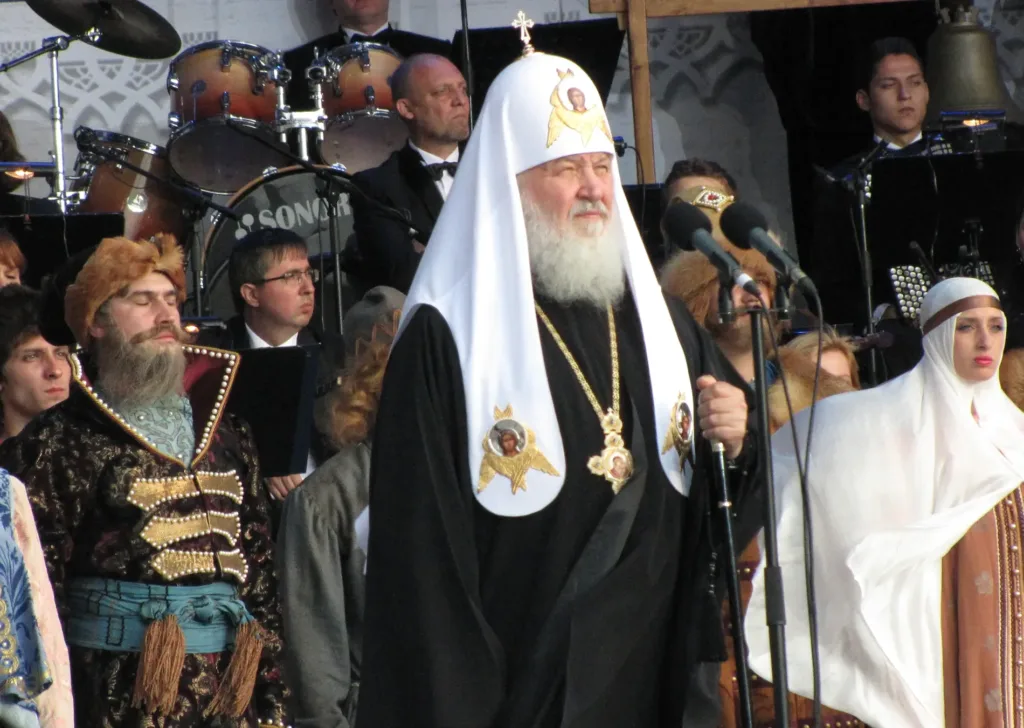
Kristina Stoeckl gave this activity its most useful name, describing the Russian Orthodox Church as a “moral norm entrepreneur”. Norms, as the international relations literature she draws on puts it, do not appear out of thin air. They are built by agents with strong convictions about proper conduct. Such agents construct a cognitive frame, often against a rival frame, and in doing so shift public perceptions of what is normal. The Russian Church’s innovation, in Stoeckl’s account, was to endorse the language of human rights while opposing its egalitarian expansion (her phrase is “human rights against human rights”), and to build a precise ideological position around a traditionalist camp drawn largely from Kirill’s External Relations Department. The Church was no latecomer to the values project in modern Russia. It was the project’s originator and its first vendor.
I have for years put this in blunter terms: Kirill sold the Kremlin the concept of traditional values. The qualification matters. He did not spend a decade pushing it on a reluctant state. He formulated it and then waited, nearly ten years, until the Kremlin found it interesting and useful, which happened in the early 2010s, amid the “conservative turn” that followed the 2011–2012 protests and intensified after the 2014 annexation of Crimea and rupture with the West. The lag is documentable. Between 2000 and 2012, the phrase belonged almost entirely to Kirill and the publicists around the World Russian People’s Council; even Vsevolod Chaplin, his closest aide, used it just three times in a 2008 book. Russian political rhetoric began to adopt it around 2010, following Putin. For a decade, the idea barely registered beyond Kirill’s circle, even within the Church, and it acquired force only once it had become part of state ideology.
So it was the state that ultimately chose to buy the product, and its motive was utility rather than conviction: a finished product sat on the shelf, and the buyer came late, for his own reasons. Kirill was not the doctrine’s only supplier: Dugin’s Eurasianism and Surkov’s political technology offered rival ideological frameworks, but his is the one the Church itself now enforces as canon. In the genealogy of the idea, the Church is the senior partner, even where, in raw power, it is the junior one.
Once the state had bought it, the concept began to behave like a sign cut loose from the thing it names. “Value” floated free of the moral life it was meant to describe and began to circulate as political currency, invoked and displayed and defended with little reference to whether anyone actually lived by it. As I have argued elsewhere, there is little sociological ground for the claim that Russians are in fact guided by the values their leaders proclaim; the gap between the rhetoric and the lived behavior of Russian society is wide and well attested. The point of the discourse was never description. It was differentiation: a way of drawing the line between us and the enemy, and of deciding who stands on which side.
The discourse is mostly based on three blocks. The first is the family: marriage, childbearing, parental authority, and continuity between generations. The second is sexuality, and in practice the rejection of LGBT rights and visibility, which by now carries much of the polemical charge and draws the sharpest line against the “decadent” West. The third is patriotism, the homeland, and service to it. An American reader meets the first two constantly, because they are the blocks the Kremlin exports and the ones Western audiences recognize as their own quarrel. This paper sets them aside, not because they are trivial or unconnected to repression, but because they are not where the particular machinery of religious repression examined here primarily operats. The block that bears on the persecution of anti-war Orthodox Christians is the third. Patriotism is where “values” become loyalty, loyalty becomes mobilization, and mobilization becomes a test the clergy are made to pass or fail. From here on, when I speak of the values discourse at work, it is this block I am tracking first of all.
Values instead of commandments
There is a reason Kirill reached for the word “values” rather than the language of the Gospel, and it is worth spelling out, because it is easy to miss from the outside. Kirill understood that post-Soviet Russia was a deeply secularized society. Seventy years of state atheism did not leave behind a population fluent in Scripture; many of those baptized in the revival of the 1990s kept the worldview and reflexes of Soviet life. To preach to that society in the idiom of the Gospel, in the language of sin and repentance and the commandments, would have reached only the small minority already inside the Church. “Values” solved the problem of audience. The word is secular on its face, morally serious without being confessional, and so it travels: it could speak at once to Orthodox believers, to nominal Christians, to Muslims and Jews and Buddhists, and to the wholly secular citizen who would never open a prayer book. A commandment requires a God to issue it. A value does not. That is part of what made it useful.
This is the move I have elsewhere called the core of post-Soviet civil religion: the Ten Commandments that order a Christian life were quietly displaced by a list of “traditional values.” The substitution looks like translation: the same morality rendered in words a secular society can hear. But something is lost in translation, and what is lost turns out to matter. A commandment binds the conscience of a person before God. A value is an attribute of a collective, a marker of identity, something a nation can be said to possess and defend. Move from the first to the second, and morality stops being what judges me and becomes what distinguishes us. On that hinge, everything later turns.
It helps to see what the lists actually contain, because the content shifted over time in a revealing direction. The Church drew up its own catalogs in 2011, in documents titled “Eternal Values: the Foundation of Russian Identity” and “Basic Values: the Foundation of National Identity,” the latter adopted by the World Russian People’s Council. The entries were still recognizably ecclesial. Alongside justice, freedom, family, and patriotism stood specifically religious terms: faith and sobornost’—conciliarity, the Orthodox idea of the Church as a communion of persons. And among them, already, were two terms worth noting: self-restraint and sacrifice.
When the state took over the lists, it secularized them. The catalog enshrined in the 2021 National Security Strategy, carried over into Presidential Decree No. 809 of November 2022, which made “traditional spiritual and moral values” an explicit object of state policy, quietly drops faith and sobornost’. In their place stands a list of thirteen secular entries—patriotism, civic consciousness, a strong family, historical memory, and the rest—with service to the Fatherland and responsibility for its fate set apart from them and given its own weight. The transcendent has been edited out; the sacred has migrated onto the state and onto service to it. As Stepanova observes, the official list deliberately sets aside the religious origin of these values while assigning the “traditional religions,” Orthodoxy first among them, the task of guarding them. The result is a strange object: a secular state liturgy of values, from which God has been removed but in which sacrifice for the nation has been promoted to the center.
Here is the claim on which the rest of the argument turns. Under the strain of the war, the Russian Orthodox Church has come to treat violence as one of its traditional values, without ever declaring it explicitly but increasingly enacting it in practice. I do not mean that the Church endorsed a proposition to that effect; it issued no such statement, and one should not invent one. I mean that in its practice, its emphases, and its silences, the Church now treats violence as a value: something to be blessed, rewarded, and required, above all of clergy, as a condition of institutional loyalty. What I am reconstructing is an implicit norm, legible in what the Church blesses and what it punishes rather than in any text one could quote.
The seed was present in the doctrine from early on. When the Church compiled its lists of “eternal” and “basic” values in 2011, sacrifice and self-restraint were already among them, beside family and faith. In peacetime, such words read as asceticism, the ordinary Christian vocabulary of self-denial. War woke their other meaning. The language of sacrifice that had evoked fasting and humility was extended in wartime to encompass dying, and then, by a further and darker turn, killing.
Behind this lies the longer process I described earlier as post-Soviet civil religion, and the war is where it comes due. In that synthesis of thin Orthodox form and durable Soviet content, the defense of “traditional values” took on the charge of an apocalyptic battle, and the same logic converged with a cult of Victory that one Orthodox priest, Archpriest Georgy Mitrofanov, named as early as 2005: pobedobesie. This coinage repays a closer look, because the English “victory-obsession” loses what is most telling in it.
The word fuses pobeda, “victory”, with besie, derived from bes, “demon”. The same root gives the Russian word for demonic possession, the state of being ridden by an unclean spirit. Pobedobesie does not name an excess of patriotism that has gone a little too far. It names a possession: the worship of victory to the point of derangement, the sacred crowded out by something that wears its garments and is in truth its inversion.
Mitrofanov chose the word with theological precision: not piety overdone but idolatry, a demon in the place where God should be. That such a diagnosis was available inside the Church as early as 2005, and went unheeded, shows how long the substitution had been underway before the war made it lethal. Killing entered the system of values not by decree but by this slow replacement of contents beneath a surface that still looked religious.
The turn became explicit on 25 September 2022, four days after Putin ordered partial mobilization for the war of aggression in Ukraine. In his Sunday sermon, Patriarch Kirill told the faithful that a soldier who dies in the line of military duty, faithful to his oath and his calling, performs an act “tantamount to a sacrifice”—he sacrifices himself for others—and that this sacrifice washes away all sins. He compared it directly to the sacrifice of Christ on the cross. The same period saw the mandatory “Prayer for Holy Rus’,” composed by Kirill and read across Russia, petitioning God to “grant us victory.” A word on “Holy Rus’,” since the phrase recurs and is opaque from outside. It is not a place on any map but an idea: an imagined sacred community binding Russia, Ukraine, and Belarus into one people with one spiritual destiny, with Moscow as its natural head. To pray for the victory of Holy Rus’ is to pray for a particular war aim dressed as a metaphysical truth, the truth that Ukraine has no separate existence to defend. This is why a prayer can carry so much freight, and why changing a single word in it can count as treason against a worldview.

It is important to be exact about what this inverts. In the classical Christian understanding, the martyr is a witness (the Greek martys), sanctified by bearing witness to Christ unto death. Martyrdom does not arise simply from dying in the performance of military duty. Kirill’s formula instead makes death in military service itself spiritually redemptive, collapsing a distinction classical Christian theology ordinarily maintains between martyrdom for Christ and death in war. This was noticed at once, and not only by émigrés or external critics. Theologians formed within the Russian Church itself saw immediately that the classical doctrine had been turned inside out, since the tradition holds that sins are washed away by repentance, baptism, and martyrdom for Christ, not by the discharge of military duty. Cyril Hovorun, a theologian and priest of Ukrainian origin, whose own Church was on the receiving end of this war, said Kirill had replaced the Christian idea of martyrdom with a sanctification of killing.
Mikhail Epstein, in Russkii antimir, provides the conceptual vocabulary for the larger movement, and I can take it here without his eschatology. His governing perception is one of inversion: he describes the war in Ukraine as politically senseless and self-destructive, governed by a logic that turns victory into defeat. That is the shape of the thing. A doctrine built to affirm life—the nation’s, the family’s, the people’s—arrives, by way of the war it blesses, at the production and sanctification of death. I set aside Epstein’s apocalyptic register; this is a policy paper, not a work of metaphysics. But his central diagnosis, that the “Russian world” has become an anti-world, negating what it set out to defend, is an apt philosophical name for the paradox I began with. And these values, I should add, are anti-values in Epstein’s sense.
Why the priest who prays for peace is the heretic
If violence has become a value, and the war prayer its catechism, then the persecution of anti-war clergy is not a separate scandal running alongside the values project. It is the values project enforcing itself. A priest who prays for peace has not committed a political offense that the Church reluctantly punishes on the state’s behalf. He has broken a new wartime norm that the Church has incorporated into a values doctrine it had itself been developing since the 2000s. He becomes, functionally, the heretic of the new ideological canon, in the sense Kirill gave the word in 2000: the one who departs from the norm Kirill himself set. Defrocking him is the Church defending its new doctrine, not the state borrowing the Church’s machinery.
This is also where the doctrine shows what it does to religious freedom, and the point is worth stating carefully, because Russia has repealed nothing on paper. The constitution still guarantees freedom of conscience. What the traditional-values doctrine does is incompatible with that guarantee in its logic and helps hollow it out in practice. Once one set of values is declared the norm and any deviation is heresy, there is little protected space left for war-related religious dissent within the Moscow Patriarchate; the priest who reads the prayer differently is treated not as exercising a freedom, but as committing an offense. And the offense is telling. An authoritarian state asks for obedience: stay out of politics, do not gather in the square, and your private faith is your own. What is demanded of the Russian clergy now is not silence but speech, not abstention but assent, the active recital of a prayer for victory at every Liturgy. That demand is for positive ideological loyalty, not mere quiet. It is evidence of a system demanding ever more explicit demonstrations of loyalty, and it shows first in the Church, where a man is punished not for what he did but for what he would not say.
The documentary record bears the weight of this reading. In multiple cases set out in my report on religious persecution in Russia, the ecclesiastical charge comes first, filed preemptively, before the state proceedings begin, and defrocked clergy are advised to leave the country within hours, under threat of criminal prosecution. In these cases, the Church is not simply following the Kremlin’s lead. It is moving ahead of it, policing a value it owns. Two jurisdictions, ecclesiastical and criminal, enforce the same norm from two directions.
Consider the single gesture that captures the whole mechanism. A priest of the Moscow Patriarchate, ordered to recite the Prayer for Holy Rus’, changes one word. Where the text written by Kirill asks God for victory, he asks instead for peace. For that substitution, he is stripped of his priesthood. Stated coldly, it looks wildly disproportionate, a whole apparatus mobilized against a single word. By the end of this argument, it should look like the opposite: a system behaving with flawless internal logic, punishing the very thing it understood itself to be defending. The two cases that follow are the clearest instances of a wider pattern: dozens of Orthodox clergy have been disciplined on the same charge, and at least three Christians have died in custody following persecution connected to their antiwar religious activity.
Priest Ioann Koval: one word
Ioann Koval, an ethnic Ukrainian serving in a Moscow parish, made that substitution, changing “victory” to “peace”, in early 2023. A member of his own congregation reported him. In May 2023, the Moscow diocesan ecclesiastical court defrocked him; he became the first priest to be removed from holy orders for altering the text of the war prayer. What is most revealing is the Church’s own account of the offense. Vakhtang Kipshidze, deputy head of the Synodal department for relations with society, defended the inviolability of the wording: if a priest may change prayers to match his convictions, he said, the very unity of the Church is challenged. That is the doctrine speaking in its own voice. The word is not incidental; it is the norm. To alter it is to break the unity the norm constitutes. Koval appealed to Ecumenical Patriarch Bartholomew, who in June 2023 found that he had been punished for his stance on the war rather than for any genuine canonical fault, and restored him to the priesthood. He now serves in Antalya, Turkey.
Koval’s substitution, a single word swapped inside the liturgical text, was a refusal at the level of the word. The next case is a refusal at the level of the idea.
Archpriest Aleksei Uminsky: “I don’t know what Holy Rus’ is”
Aleksei Uminsky was no marginal figure. For roughly three decades, he was rector of the Church of the Life-Giving Trinity in Khokhly, in central Moscow, one of the best-known priests in the country, a preacher and writer of standing who did hospice work with dying children and led Mikhail Gorbachev’s funeral in 2022. By all accounts, he had stopped reciting the Prayer for Holy Rus’ with its prescribed emphasis on victory, though he never announced this outright. What followed was swift and deliberately humiliating. On 5 January 2024, two days before Orthodox Christmas, a decree from Patriarch Kirill suspended him from ministry and removed him from the parish, which kept him from the altar on the feast itself. He was then summoned before the diocesan court without being shown the charges or any investigation file. The court kept up the forms while gutting the substance: a priest could be tried in absentia only after failing to appear three times, yet the three sessions were scheduled on consecutive days, Thursday through Saturday, after which the judges unanimously confirmed a decision that appeared to have been prepared in advance to defrock him “for violating the priestly oath.” Kirill confirmed the sentence on 8 February. As the proceedings unfolded, “Orthodox patriots” began publicly urging the state investigative authorities to take note of Uminsky’s statements, and friends advised him to leave Russia. An open letter in his defense gathered some twelve thousand signatures within days; it changed nothing.
Asked directly, at the disciplinary hearing itself, why he would not read the prayer, Uminsky answered: “I don’t know what Holy Rus’ is.” The answer marks the escalation from Koval. Koval refused to use a word in the text. Uminsky refused the premise of the text, the entire ideological construct in whose name the prayer exists. He had gestured at this publicly the previous November, saying it was wiser to attend churches that prayed for peace rather than victory—without ever admitting on air to his own noncompliance. He was defrocked not for praying wrongly but for refusing to honor what the prayer sacralizes, a prayer that, as he put it himself, has stitched into it not only the mythology of Holy Rus’ but a set of quite specific political commitments. The man installed in his place at Khokhly was Andrei Tkachev, a former priest of the Ukrainian Orthodox Church who moved to Russia in 2014 and became a loud supporter of the war. Where a priest who would not bless the war once stood, the Church installed a priest who does; the vacated place was filled by its opposite.
Both men were restored by Constantinople in February and now minister outside Russia. Uminsky was restored in February 2024 and now serves in Paris under the Greek Orthodox Metropolis of France. They are not isolated cases. A group of five priests in Lithuania, defrocked for their steady antiwar stance, was likewise received into the Ecumenical Patriarchate, and parishes across Western Europe have left the Moscow Patriarchate or stopped commemorating Kirill’s name. The pattern is its own quiet commentary: what the Moscow Patriarchate punishes as disloyalty, another Orthodox Church receives as fidelity. The fracture the war opened within Russian Orthodoxy is not between Orthodoxy and the modern world. It runs straight through the altar.
The alternative they are suppressing
It is usually assumed that the alternative to Putinist “traditionalism” must be Western liberalism, and that rejecting the Russian state’s moral claims is to end up, by default, in the secular camp. The whole apparatus depends on that assumption, and it is false. The alternative to the war theology is not liberalism. It already exists inside the Russian tradition, which is why the repression turns inward. The state and the official Church are not defending Russian Orthodoxy against an external solvent. They are suppressing a rival within Russian Orthodoxy, and the force used against it is a measures how real it is.
What these acts of defrocking, imprisonment, and exile seek to supress is a recognizable theological position, not a borrowed liberal one. The classical understanding of martyrdom as witness rather than killing, the one Kirill’s September 2022 formula inverted, is one strand. Nicholas Afanasyev’s eucharistic ecclesiology is another: for the great theologian of the Russian emigration in Paris, the Church is constituted by the local community gathered around the eucharistic table and so cannot be collapsed into an instrument of the nation-state. Alexander Schmemann, Afanasyev’s heir, supplies a third: his liturgical theology holds that the Liturgy is the entry of God’s Kingdom into the world and so cannot be conscripted to consecrate the world’s killing. Both men belong to the churches of the Russian emigration, and it offers a theological language that the war theology cannot accommodate.
The men in the previous section are not a remnant to be pitied. They are the carriers of this tradition, and their persecution is the system’s involuntary testimony that this tradition remains alive. A Church hierarchy secure in the legitimacy of its own Christian tradition would have little to fear from a priest who prays for peace. That it fears him enough to strip him of his orders within days, and to hurry him out of the country within hours, tells you what he carries is dangerous precisely because it is the real article, and the official version is the counterfeit. The diagnosis is not a program but a reading of what the suppression itself gives away: the alternative is real, and we know it by the force spent to make it inaudible. To the outside world, the Russian Orthodox Church looks unified behind its Patriarch. That unity is a manufactured product, and the persecution described here is the factory. I mean first of all the hierarchy’s unity, not the private convictions of the laity. That is a different question—and, on the evidence that exists, a more divided one.
Implications: a frame for policymakers
For an American foreign-policy audience, what follows is less a set of recommendations than a way of reading. The most useful thing the reader can carry away is the distinction this paper has tried to hold open: between real moral concern and its political counterfeit. The distinction lies not in the vocabulary but in what the rhetoric does. A concern for the family does not require a war prayer; a concern for continuity does not justify the killing of the young. When the language of values is used to mobilize, name enemies, extract loyalty, or sanctify death, it has crossed from the first register into the second, whatever it still sounds like. That test does not ask the reader to give up the values.
It asks only that the reader notice Constantinople already receives what Moscow expels, and refuse to let the Russian state hold those values hostage.
This bears directly on a romance that persists in parts of the American religious right: the image of Putin’s Russia as a Christian civilizational alternative, a state that kept faith where the West lost it. One comparison is worth drawing carefully. In December 2010, then-Prime Minister Putin remarked, attributing the thought to “certain theoreticians,” that Orthodoxy is closer to Islam than to Catholicism, and offered it as a basis for domestic concord in a multi-confessional Russia. The remark was an echo, not an origin; it reproduced the axis Kirill had drawn in 1999–2000, the “traditional religions” of Russia aligned against the liberal West. It remained a characteristic personal view rather than an institutionalized doctrine, and the fact that it was never institutionalized is itself instructive. One possible explanation is that the foreign-facing brand needed to remain legibly Christian, and an Orthodox-Islamic axis would have muddied the message meant for the Western audience. The calibration of the two addressees shows in just this: what could be said at home could not be said abroad.
There is a deeper point underneath the remark, one that cuts against the romance more sharply than Putin can have intended. The figure the Moscow Patriarchate now sanctifies—the fallen soldier whose death in combat is presented as washing away his sins—does not fit the classical Christian category of martyrdom. The theological anomaly. Is therefore nearest structural analog lies outside Christianity, in the figure of the shahid, the one whose death on the path of God is itself accounted purification. Epstein, who draws the same comparison, immediately and rightly limits it. The shahid is theologically coherent within Islam and outward-facing: the sword is turned against the external enemy. The Moscow construction is neither. It sanctifies the killing of one’s own in a war against a people Kirill himself calls brothers. It dresses this as an act of love—an inversion with no analog in either tradition. None of this is a charge against Islam, whose concept of the shahid is coherent on its own terms; the comparison runs the other way. The point is that the Moscow Patriarchate has betrayed itself. What the American conservative admires as Christian firmness is something Christianity cannot call martyrdom at all, and the nearest name for it has to be borrowed from a tradition that, looked at closely, does not quite fit either.
A final caution about the comparative frame, since it shapes how this case gets filed. Several careful analysts, Stepanova among them, as well as my own persecution report, use “Christian nationalism” as the category, on the ground that the Moscow Patriarchate meets the criteria scholars have used for the phenomenon elsewhere: the sacralization of state power, the identification of nation with divine purpose, and the framing of dissent as betrayal of both faith and country. The comparison earns its place, and it connects the Russian case to the networks of scholarship and resistance built around the same phenomenon in the United States, Hungary, and Poland. Let it work in the implications rather than in the diagnosis, because it also costs precision. Christian nationalism, as a comparative category, was developed to describe the sacralization of the nation or the family. It is less equipped to account for the sacralization of killing—that is a different phenomenon, and it belongs more directly to the literature on values as an exported ideological instrument, not to the nationalism literature. What distinguishes the Moscow Patriarchate’s wartime theology is the promise of spiritual absolution through death in combat. The sacralization of the soldier’s death is therefore a distinctive feature of the Moscow Patriarchate’s wartime theology, and it is what most needs explaining. It is fine to file the Russian case alongside the others; just do not let that filing erase the one feature that makes it lethal.
The usable frame, then, is this. The Kremlin’s religious posture is not simply a sincere religious conviction to be met with argument about whether Russia is really Christian, nor merely hypocrisy to be exposed by pointing at the gap between word and deed. It is an integrated system in which a moral language, authored by the Church and bought by the state, supplies the legitimacy on which both a war of aggression and a domestic machinery of repression draw. The foreign face and the domestic face are the same.
So neither America nor the wider Christian world has reason to be taken in by this rhetoric, and it is worth saying plainly why. It is not Christian at its core. It has put the killing of one’s neighbor where the Gospel puts the refusal to kill, and a faith that absolves the soldier through death in combat is not a sterner Christianity; it is a different religion in Christian dress. Nor is it rooted in the actual religious and social life of Russians, who by every honest measure do not live by the values their leaders recite. It is an ideology imposed from above, not a piety risen from below. And it was built in part for export, engineered to win admirers in the West. To mistake it for an ally of Christian conviction is to be recruited by it.
That export network was never merely rhetorical: the World Congress of Families and its partners provided much of the institutional apparatus, and the network did not survive the invasion intact. Some Western allies quietly distanced themselves after 2022; Moscow, meanwhile, gained ground in parts of Africa and Latin America. The machine is real. It is not the machine it was in 2015. The fusion looks less stable from inside, too. Kirill’s own position has long been shadowed by KGB allegations and, in my assessment, allegations involving the diversion of Church funds into personal accounts. He is now caught in an open succession fight, amid health rumors, episcopal reshuffles, and bishops already jockeying over who will inherit this machinery next.
To take seriously the goods this doctrine has counterfeited family, continuity, a life ordered by more than appetite is now, in Russia, to stand against the state that claims to speak for them. The clergy who have been punished and forced into exile have taken them seriously in that exact sense. That is not a paradox the reader needs to resolve. It is the fact to start from.
Sources
- Chapnin, Sergei. Religious Communities Under Pressure: Documenting Religious Persecution in Russia, 2022–2026. Albion Bixby Publishing, 2026. https://www.amazon.com/Religious-Communities-Under-Pressure-Documenting/dp/B0H5G277LW
- Chapnin, Sergei. “The Rhetoric of Traditional Values in Contemporary Russia.” In Kristina Stoeckl and Dmitry Uzlaner, eds., Postsecular Conflicts. Innsbruck University Press, 2020, 127–141. https://doi.org/10.15203/3187-99-3-11
- Chapnin, Sergei. “Post-Soviet Civil Religion as a Substitute for Orthodox Christianity.” Studia UBB Theologia Catholica Latina 68:1 (2023), 110–119. https://www.ceeol.com/search/article-detail?id=1125659
- Chapnin, Sergei. “The Illusion of Unity: Patriarch Kirill’s Ideological Ultimatum to the Church.” Public Orthodoxy, 9 February 2024 (on the Uminsky case). https://publicorthodoxy.org/good-reads/patriarch-kirills-ideological-ultimatum/
- Chapnin, Sergei. “An Act of Lighthearted Betrayal: How Moscow’s Official Church Hunts Down Her Anti-War Priests.” Public Orthodoxy, 12 May 2023 (on the Koval case). https://publicorthodoxy.org/2023/05/12/act-of-lighthearted-betrayal/
- Epstein, Mikhail. Русский антимир: политика на грани апокалипсиса (The Russian Anti-World: Politics on the Verge of Apocalypse). Franc-Tireur USA, 2023. https://imwerden.de/pdf/epstein_russky_antimir_2023__izd.pdf
- Stepanova, Elena. “Traditional Values in the Interpretation of the Russian Orthodox Church and the State.” Political Theology, 14 Oct 2025. https://doi.org/10.1080/1462317X.2025.2571292
- Stoeckl, Kristina, and Dmitry Uzlaner. “The Russian Orthodox Church and the Moralist International in Times of War: Ruptures and Continuities in Russia’s Traditional Values Agenda.” Journal of Church and State 68:3 (2026), csag023. https://doi.org/10.1093/jcs/csag023
- Kirill (Gundyaev). “Норма веры как норма жизни” (Norms of Faith as Norms of Life). Nezavisimaya gazeta, 16 February 2000 (first published in Tserkov’ i vremya, no. 2, 1999). https://www.ng.ru/ideas/2000-02-16/8_norma.html
Additional reporting and primary sources
- Verified press and primary reporting on Patriarch Kirill’s sermon of 25 September 2022 (RFE/RL, Religion News Service, Ukrainska Pravda, et al.).
https://www.rferl.org/a/russia-patriarch-kirill-dying-ukraine-sins/32052380.html
https://religionnews.com/2022/09/27/moscow-patriarch-russian-war-dead-have-their-sins-forgiven/
https://www.pravda.com.ua/eng/news/2022/09/25/7369023/ - Verified reporting on the defrocking of Ioann Koval (Public Orthodoxy; Associated Press; Meduza).
https://publicorthodoxy.org/2023/05/12/act-of-lighthearted-betrayal/
https://apnews.com/article/russia-orthodox-church-defrocked-priests-ukraine-war-21660b57105a95a04e6321fb8baffa9e - Verified reporting on the defrocking of Aleksei Uminsky (Carnegie; RFE/RL Systema; Meduza).
https://www.rferl.org/a/russia-church-persecution-ukraine-war-prayer/33764424.html
https://www.rferl.org/a/russia-orthodox-church-expulsion-priest-ukraine-antiwar/32773131.html
https://meduza.io/en/news/2024/01/13/moscow-priest-who-was-removed-from-post-defrocked-for-refusing-to-recite-prayer-for-holy-rus-victory - Putin’s December 2010 remark as reported contemporaneously (Window on Eurasia / RISU).
https://risu.ua/en/window-on-eurasia-putin-says-orthodoxy-closer-to-islam-than-catholicism-is_n43445